Facts
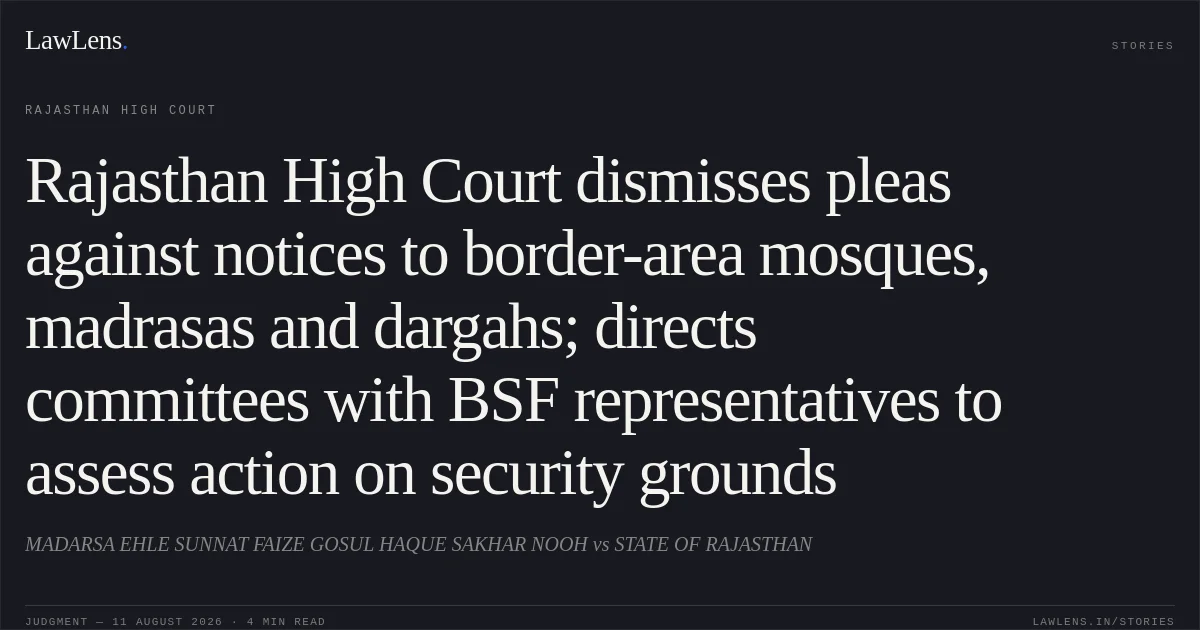
The judgment concerned a batch of writ petitions challenging eviction, vacation and show-cause notices issued to persons and institutions managing Dargahs, Masjids, Madrasas and other structures situated within approximately 0–50 kilometres of the Indo–Pakistan border in Rajasthan.
Source reference: pp. 11–13; paras. 1–2The notices were issued under provisions of the Rajasthan Land Revenue Act, 1956, the Rajasthan Colonization Act, 1954, and local Gram Panchayat laws, alleging unauthorized occupation or construction on Government/agricultural land, absence of requisite permissions, and land use without lawful conversion.
Source reference: pp. 11–13; paras. 1–2The petitioners alleged that the proceedings were predetermined, that proper notice and hearing had not been provided, and that the respondents intended to demolish the structures in disregard of the Supreme Court’s directions concerning demolition of structures.
Source reference: pp. 14–17; paras. 4–9The Court treated S.B. Civil Writ Petition No. 13243/2026 as the lead matter and applied its decision mutatis mutandis to the connected petitions.
Source reference: p. 12; para. 1Issues
1. Whether writ petitions under Article 226 of the Constitution were maintainable against show-cause notices issued under the Rajasthan Land Revenue Act, 1956, the Rajasthan Colonization Act, 1954, and related laws, particularly when statutory remedies and appellate mechanisms were available.
Source reference: pp. 24–25, 35–36; paras. 24, 30–312. Whether the notices and proposed proceedings were vitiated by violation of natural justice, including inadequate service, insufficient time, denial of personal hearing, or failure to disclose material relied upon by the authorities.
Source reference: pp. 14–17, 28–32; paras. 5–9, 263. Whether the petitioners had established the necessary locus standi, authority, identity, title, possession or lawful connection with the concerned religious institutions and properties.
Source reference: p. 23; para. 224. Whether the alleged absence of permission under Sections 5 and 6 of the Rajasthan Religious Buildings and Places Act, 1954, and the alleged unauthorized occupation or change of land use justified continuation of the statutory proceedings.
Source reference: pp. 23–25; paras. 23–245. Whether national-security considerations relating to properties situated within the border belt justified a calibrated application of natural justice and regulatory action by the authorities.
Source reference: pp. 29–34; paras. 26–29Law Applied
The Court applied Sections 90-A and 91 of the Rajasthan Land Revenue Act, 1956, and Sections 14, 15 and 22–24 of the Rajasthan Colonization Act, 1954, which provide mechanisms for dealing with unauthorized occupation, unlawful land use and encroachments, together with appellate remedies before the Revenue Appellate Authority and the Board of Revenue.
Source reference: pp. 24–25, 35–36; paras. 24, 31Sections 5 and 6 of the Rajasthan Religious Buildings and Places Act, 1954 require prior permission of the Collector for the use of public places for religious purposes and for construction or conversion into a public religious building.
Source reference: pp. 23–24; para. 23The Court relied on Executive Engineer, Bihar State Housing Board v. Ramesh Kumar Singh, (1996) 1 SCC 327, for the principle that writ jurisdiction ordinarily should not be invoked against a mere show-cause notice where the affected party can respond before the competent authority.
Source reference: p. 35; para. 30Relying on Madhyamam Broadcasting Ltd. v. Union of India, (2023) 13 SCC 401, the Court held that natural justice is not wholly excluded in national-security matters but may be tailored where cogent material establishes a bona fide security concern and disclosure may prejudice national security.
Source reference: pp. 29–32; para. 26The Court also considered the Supreme Court’s demolition-related directions in Re: Directions in the Matter of Demolition of Structures, (2025) 5 SCC 1, but distinguished them on the basis that the present matters involved show-cause notices, alleged unauthorized constructions and border-security considerations.
Source reference: pp. 17–18, 34–35; paras. 9, 29Reasoning
The Court found that the petitions raised disputed factual questions concerning title, ownership, possession, authorization, land use and the petitioners’ connection with the concerned institutions, which could not appropriately be adjudicated in writ jurisdiction.
Source reference: pp. 23–25; paras. 22–24The notices were treated as preliminary proceedings requiring the petitioners to appear, explain their position and produce supporting documents; they did not themselves direct demolition, and no coercive action had yet been taken.
Source reference: pp. 25–28; para. 25Since the petitioners had either failed to participate in or had not adequately pursued the proceedings before the competent authorities, the Court held that they could not bypass the statutory process by invoking Article 226.
Source reference: no citationThe Court further held that the alleged absence of Collector’s permission under Sections 5 and 6 of the Religious Buildings and Places Act, coupled with the allegations of unauthorized occupation and unlawful construction, prima facie justified administrative scrutiny.
Source reference: pp. 23–25; paras. 23–24Although the Court accepted that national security could not be invoked without supporting material, it accorded deference to the executive’s assessment of security concerns in the sensitive border area and held that disclosure of intelligence inputs was not necessarily required in open proceedings.
Source reference: pp. 29–32; para. 26In its view, the issuance of notices and provision of an opportunity to appear constituted substantial compliance with natural justice, particularly because the petitioners had not utilised that opportunity.
Source reference: pp. 28–32; para. 26Holding
The Court dismissed the entire batch of writ petitions as not maintainable and found no basis to interfere with the impugned show-cause notices at that stage.
It held that the petitioners should pursue the statutory proceedings and appellate remedies available under the relevant revenue and colonization laws, and that the notices did not establish any immediate or substantiated threat of demolition.
Source reference: pp. 25, 35–36; paras. 25, 31–32The Court nevertheless directed the constitution of district-level committees including the District Collector, Superintendent of Police and a BSF representative to examine individual cases on the basis of available evidence, intelligence inputs and other relevant material.
Source reference: pp. 36–37; paras. 33.1–33.5The Court directed that a committee comprising the District Collector, Superintendent of Police and a representative of the BSF examine each sensitive property individually and take an appropriate, reasoned decision, including possible eviction, dispossession or demolition where warranted by the material and applicable law.
Source reference: pp. 36–38; paras. 33.1–33.5No order as to costs was made, and pending applications and stay applications were disposed of.
Source reference: p. 38; para. 34Acts & Sections Cited
11 provisions across 4 statutes referred to in this judgment. Each provision opens on LawLens.
rajasthan colonisation act,19546
RAJASTHAN LAND REVENUE ACT, 19562
Border Security Force Act, 19681
Original Court PDF
MADARSA EHLE SUNNAT FAIZE GOSUL HAQUE SAKHAR NOOHvsSTATE OF RAJASTHAN
Click to open original judgment
Original judgment, available to read, download and summarize on LawLens.in