Facts
The petitioners sought quashing under Section 528 of the Bharatiya Nagarik Suraksha Sanhita, 2023, of FIR No. 46/2025 registered at Police Station Sadar, Ganganagar, for offences under Sections 111(2)(b), 111(3), 111(4), 111(6), 317(2), 317(5), 318(4) and 61(2)(b) of the Bharatiya Nyaya Sanhita, 2023, along with Sections 66-C and 66-D of the Information Technology Act, 2000.
Source reference: para. 1The petitioners contended that FIR No. 46/2025 was an impermissible second FIR arising from the same transaction as earlier FIR No. 38/2025, registered at Police Station Purani Abadi for offences under Sections 420, 406 and 120-B IPC.
Source reference: paras. 2–4The State submitted that FIR No. 38/2025 concerned an individual cheating complaint and that a Final Report had been submitted because the alleged occurrence fell outside the concerned police station’s territorial jurisdiction.
Source reference: para. 6During investigation, searches allegedly resulted in the recovery of cash, ATM cards, laptops, computers, rubber stamps, cheque books, mobile phones and property documents.
Source reference: para. 7Issues
1. Whether FIR No. 46/2025 was liable to be quashed as an impermissible second FIR concerning the same incident or transaction as FIR No. 38/2025?
Source reference: paras. 13–182. Whether the provisions of the BNS could be invoked where the earlier complaint related to an occurrence allegedly committed in 2023, before the BNS came into force?
Source reference: paras. 19–213. Whether the material relied upon by the prosecution, including recoveries of electronic devices and financial instruments, prima facie attracted Section 111 BNS relating to organised crime?
Source reference: paras. 22–244. Whether the High Court should exercise its inherent jurisdiction under Section 528 BNSS to quash the FIR while investigation was still in progress?
Source reference: paras. 25–30Law Applied
The Court applied Section 528 BNSS, which preserves the High Court’s inherent jurisdiction to prevent abuse of process and secure the ends of justice.
Source reference: para. 1The governing rule on successive FIRs is that a second FIR relating to the same incident, occurrence or transaction is ordinarily impermissible; however, a separate FIR is legally permissible where the subsequent information discloses a distinct incident or criminal activity, a wider conspiracy, substantially different scope, or previously unknown facts.
Source reference: paras. 14–15This principle was drawn from T.T. Antony v. State of Kerala, (2001) 6 SCC 181, and the principles summarised in State of Rajasthan v. Surendra Singh Rathore, 2025 INSC 248.
Source reference: paras. 14–15The Court also applied the principle from M/s Neeharika Infrastructure Pvt. Ltd. v. State of Maharashtra, (2021) 10 SCC 118, that an FIR should not ordinarily be quashed when its allegations prima facie disclose cognizable offences; the High Court should not conduct a mini-trial, assess evidentiary sufficiency, or interfere with an ongoing investigation except in exceptional cases.
Source reference: paras. 25–29Reasoning
The Court held that FIR No. 38/2025 concerned an individual complaint of cheating, whereas FIR No. 46/2025 allegedly involved a substantially wider criminal scheme comprising multiple bank accounts, cyber-fraud complaints, Forex/USDT transactions, inducement of several persons, alleged employment-related fraud and acquisition of properties from alleged proceeds of crime.
Source reference: paras. 16–17Applying Surendra Singh Rathore, the Court found that the earlier transaction could prima facie form part of a larger cyber-fraud conspiracy and that the fact that the material surfaced during investigation of the earlier FIR did not, by itself, invalidate the subsequent FIR.
Source reference: paras. 17–18On the BNS issue, the Court declined to quash the FIR merely because the earlier transaction related to 2023.
Source reference: paras. 19–21Since the subsequent FIR was not confined to that transaction and allegedly concerned distinct activities, the temporal applicability of particular BNS provisions would depend on when the acts forming those offences were committed and could be determined during investigation.
Source reference: paras. 19–21Regarding Section 111 BNS, the Court accepted that mere recovery of ATM cards, electronic devices, cheque books or other articles would not independently establish organised crime.
Source reference: paras. 22–24However, the prosecution case also relied on alleged links between bank accounts and mobile numbers, numerous cyber-fraud complaints, multiple victims, routing of funds and acquisition of property from alleged crime proceeds.
Source reference: paras. 22–24These allegations prima facie disclosed cognizable offences requiring investigation.
Source reference: paras. 22–24Accordingly, under the principles in Neeharika Infrastructure, the Court declined to undertake a detailed evidentiary assessment or determine at the FIR stage whether every ingredient of Section 111 BNS would ultimately be proved.
Source reference: paras. 24, 28–29Holding
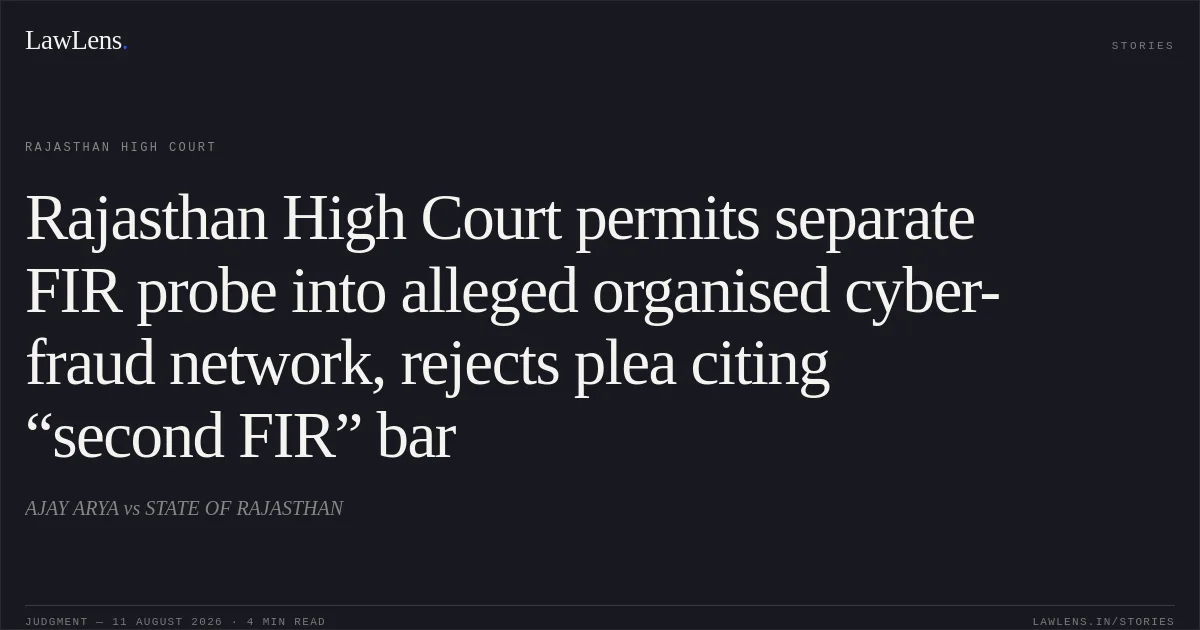
The Court held that FIR No. 46/2025 could not, at that stage, be characterised as an impermissible second FIR relating to the same transaction, since the material prima facie disclosed wider and distinct criminal activity requiring investigation.
It further held that the FIR could not be quashed merely on the ground that the earlier complaint related to 2023 or that the applicability of Section 111 BNS might ultimately fail.
Source reference: paras. 32–34No case for exercising inherent jurisdiction under Section 528 BNSS was made out.
Source reference: paras. 32–34The petition seeking quashing of FIR No. 46/2025 was accordingly dismissed, and pending applications, if any, were disposed of.
Source reference: paras. 32–34Acts & Sections Cited
8 provisions across 3 statutes referred to in this judgment. Each provision opens on LawLens.
Bharatiya Nagarik Suraksha Sanhita, 20232
Bharatiya Nyaya Sanhita, 20234
Indian Penal Code, 18602
Original Court PDF
AJAY ARYAvsSTATE OF RAJASTHAN
Click to open original judgment
Original judgment, available to read, download and summarize on LawLens.in