Facts
The petitioner, an excisable goods manufacturer, was issued show-cause notices for unauthorizedly utilizing Cenvat credit to pay duty liabilities instead of paying in cash as per Section 11D of the Central Excise Act.
Source reference: para. 2–3While the Tribunal initially ruled in favor of the petitioner, the High Court (in Tax Appeal No. 1744 of 2007) reversed this, holding that the petitioner had collected duty from customers and was required to deposit it with the Government in cash.
Source reference: para. 4–5Following this judgment, the petitioner deposited the total duty amount of ₹3,74,33,462/- via their Personal Ledger Account (PLA).
Source reference: para. 5The petitioner then requested the Department to re-credit the equivalent amount back into their Cenvat Register, as the original debit from Cenvat was now a "double payment".
Source reference: para. 6The Assistant Commissioner rejected this request via communication dated 13.01.2014, asserting that there is no provision for suo motu re-credit and requiring the petitioner to file a formal refund claim under Section 11B.
Source reference: para. 7Issues
1. Whether the Department was justified in rejecting the request for re-credit of Cenvat amount on the ground that the law only permits a formal refund application under Section 11B of the Central Excise Act.
Source reference: para. 8, 112. Whether the re-credit of Cenvat account entries constitutes an "outflow of funds" requiring the rigors of Section 11B or is merely a book-entry regularization.
Source reference: para. 12Law Applied
Section 11B of the Central Excise Act, 1944, regarding refunds of duty.
Source reference: para. 7, 13Section 11D regarding duty collected from buyers to be deposited with the Government.
Source reference: para. 5Rule 5 of the CENVAT Credit Rules, 2004, which governs the refund of Cenvat credit.
Source reference: para. 5Principle established by the Madras High Court in ICMC Corporation Ltd. v. CESTAT, which holds that re-credit is an account entry reversal rather than a fund outflow, thus exempting it from the procedural requirements of Section 11B.
Source reference: para. 9.1The principle that the Department cannot effect a double recovery for the same subject matter.
Source reference: para. 13Reasoning
The Court observed that the petitioner was not seeking a suo motu re-credit in a vacuum, but rather the regularization of an account after paying the duty twice: first via Cenvat debit (which was later declared unauthorized) and second via cash through PLA following the High Court’s order.
Source reference: para. 12–13The Court reasoned that if the Department’s insistence on a Section 11B refund were followed, it would lead to a cash refund of Cenvat credit, a scenario already held impermissible by the coordinate bench in the previous tax appeal.
Source reference: para. 13Since the petitioner had already satisfied the duty liability in cash (PLA), the original Cenvat debit became redundant. The Court determined that the Assistant Commissioner’s refusal to allow re-credit was a technical error that failed to acknowledge that the re-credit was a "natural corollary" to the cash payment to avoid double taxation.
Source reference: para. 6, 13Holding
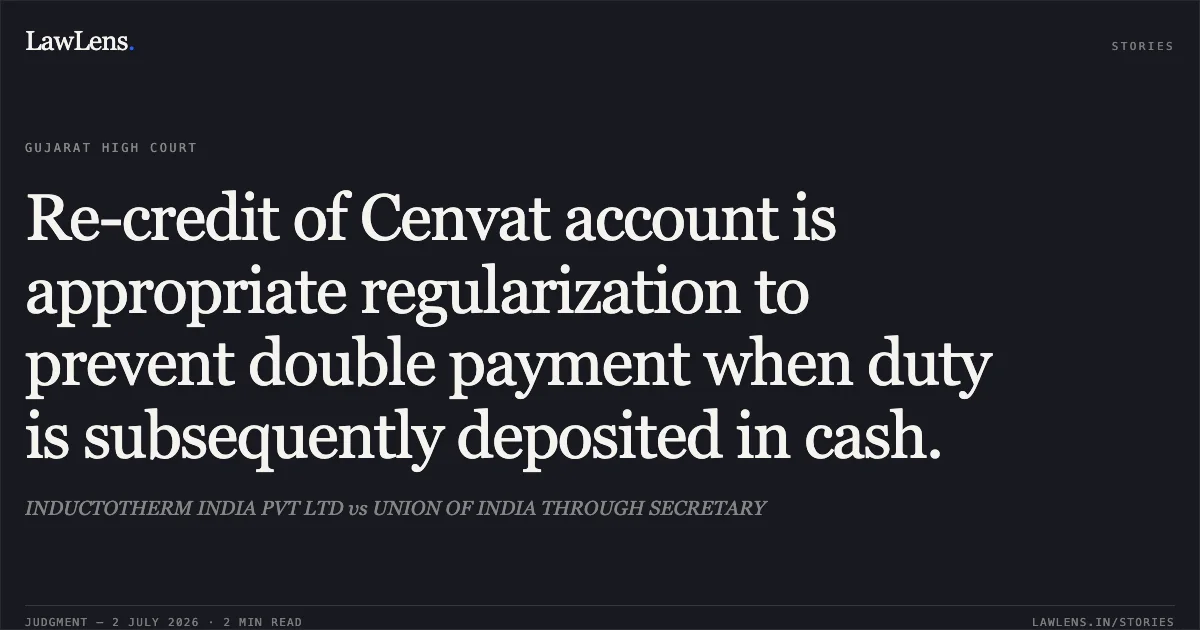
The Department is required to re-credit the amount as it cannot retain both the Cenvat debit and the cash payment.
The Court allowed the petition and quashed the communication dated 13.01.2014, directing the respondents to sanction and re-credit the amount of ₹3,74,33,462/- into the petitioner’s Electronic Credit Ledger under the GST regime within six weeks.
Source reference: para. 14Acts & Sections Cited
1 provisions across 1 statute referred to in this judgment. Each provision opens on LawLens.
Central Excise Act, 19441
Original Court PDF
INDUCTOTHERM INDIA PVT LTDvsUNION OF INDIA THROUGH SECRETARY
Click to open original judgment
Original judgment, available to read, download and summarize on LawLens.in