Facts
The petitioner company underwent Corporate Insolvency Resolution Process (CIRP) starting 19.12.2017
Source reference: p. 3Following a failed resolution plan, the NCLT ordered liquidation on 19.12.2019
Source reference: p. 3On 03.03.2021, the liquidator executed a sale agreement transferring the petitioner as a "going concern" to Arrhum Tradelink Private Limited (ATPL) on a "clean slate" basis
Source reference: p. 3, 7Subsequently, the Income Tax Department issued a notice on 13.04.2023 under Section 148 of the Income Tax Act, 1961, seeking to reopen assessment for A.Y. 2019-20
Source reference: p. 2The reopening was based on search operations at CFM ARC (which had acquired the petitioner's debts at a haircut), alleging that the cessation of interest liability (Rs. 13.52 crore) constituted escapement of income under Section 41(1) of the Act
Source reference: p. 2, 6Issues
1. Whether the Income Tax Department can initiate reassessment proceedings for past liabilities against a corporate debtor acquired as a "going concern" under the Insolvency and Bankruptcy Code (IBC) on a "clean slate" principle.
Source reference: p. 4, 72. Whether the reassessment notice was validly issued when premised on the assumption/conjecture that the assessee "might have" claimed interest deductions.
Source reference: p. 3, 10Law Applied
The Court primarily applied the "Clean Slate" doctrine under the Insolvency and Bankruptcy Code, 2016, and Regulation 32(e) of the IBBI (Liquidation Process) Regulations, 2016, which mandates that once a resolution plan is approved or a sale as a going concern is completed, all past liabilities and investigations stand extinguished
Source reference: p. 4, 7It relied on the Supreme Court precedent in Ghanshyam Mishra & Sons (P) Ltd. v. Edelweiss Asset Reconstruction Co. Ltd., which holds that successful bidders cannot be surprised with "hydra-headed" claims after the takeover
Source reference: p. 10It further applied the principle from KRBL Limited v. State of Gujarat regarding the priority of IBC over state tax claims and the protection of bona fide purchasers
Source reference: p. 4, 9Reasoning
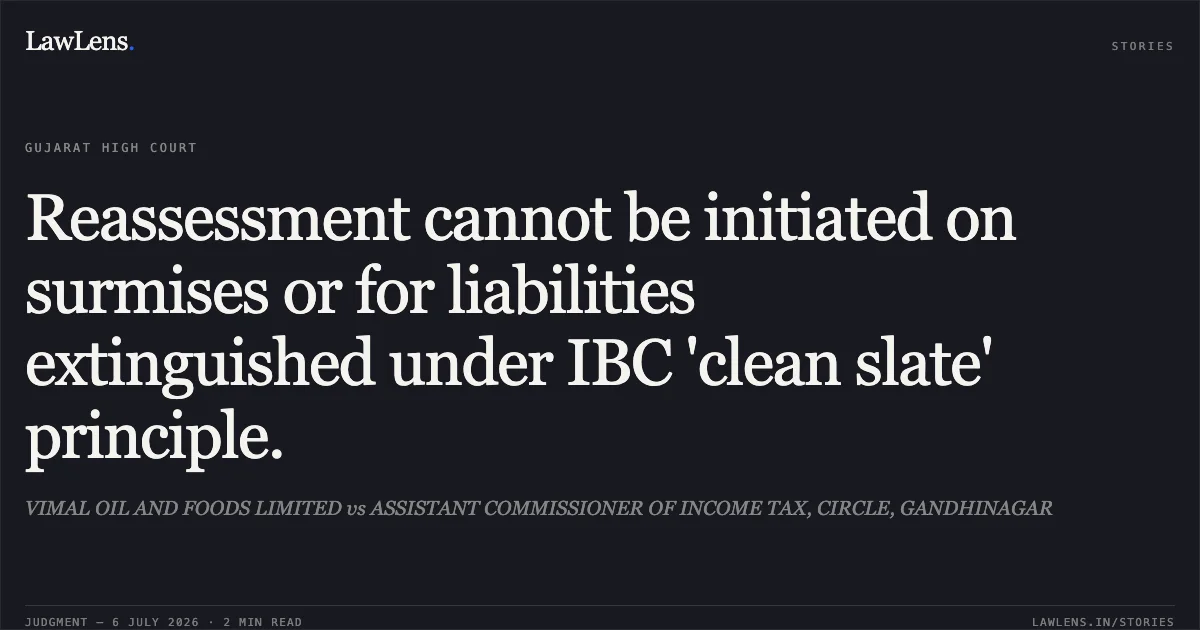
The Court reasoned that since the petitioner was sold as a "going concern" under the IBC, the "clean slate" principle applied, meaning all prior liabilities were extinguished upon the execution of the sale agreement on 03.03.2021
Source reference: p. 7, 9The respondent’s attempt to reopen assessment for A.Y. 2019-20 ignored this statutory protection afforded to the new management
Source reference: p. 10Furthermore, the Court found the Revenue's justification for reopening—that the petitioner "might have" claimed interest deductions—to be based entirely on surmises and conjectures
Source reference: p. 10The petitioner had provided evidence that it had not claimed such deductions since the debt became an NPA in FY 2015-16, a fact the Assessing Officer failed to verify from available profit and loss accounts before issuing the notice
Source reference: p. 8, 10Holding
The Court answered that the reopening of assessment was legally untenable as it violated the "clean slate" principle and was based on unsubstantiated presumptions
The High Court allowed the writ petitions and quashed the impugned notices issued under Section 148 and orders passed under Section 148A(d) of the Income Tax Act
Source reference: p. 11Rule was made absolute
Source reference: p. 11Acts & Sections Cited
3 provisions across 2 statutes referred to in this judgment. Each provision opens on LawLens.
Insolvency and Bankruptcy Code, 2016.2
Transfer of Property Act, 18821
Original Court PDF
VIMAL OIL AND FOODS LIMITEDvsASSISTANT COMMISSIONER OF INCOME TAX, CIRCLE, GANDHINAGAR
Click to open original judgment
Original judgment, available to read, download and summarize on LawLens.in