Facts
The petitioner, a partnership firm engaged in development and construction, challenged proceedings initiated under Section 148A of the Income-tax Act, 1961 (“the Act”) for reopening its assessment for Assessment Year 2021–22.
Source reference: no citationThe proceedings were based on a Suspicious Transaction Report indicating substantial credits and debits in the petitioner’s bank accounts, including transactions allegedly involving routing of funds and high-value non-cash withdrawals.
Source reference: p.4; para. 5The reported credits aggregated approximately Rs.89.86 crore and debits approximately Rs.89.77 crore.
Source reference: p.4; para. 5A show-cause notice under Section 148A(1) was issued on 13 March 2025.
Source reference: p.2; para. 2The petitioner responded on 29 March and 9 April 2025, furnishing audited financial statements, partners’ capital accounts, tax audit reports and details of transactions with partners and other entities.
Source reference: p.2; para. 2; p.5; para. 6The petitioner explained that the transactions involved its partners, including Venus Infrastructure Development Private Limited (“VIDPL”), and that its investments and advances were funded through partners’ capital and unsecured loans.
Source reference: p.5; para. 7It also contended that no income chargeable to tax had escaped assessment.
Source reference: p.5; para. 7Despite these explanations, the Assessing Officer passed an order under Section 148A(3), concluding that income chargeable to tax amounting to Rs.61,83,23,518 had escaped assessment.
Source reference: p.5; para. 6The order relied substantially on the suspicious nature of the transactions, the petitioner’s lack of a loan-providing business, and the alleged absence of any requirement for such funds.
Source reference: p.5; para. 6; p.6; para. 7The petitioner therefore challenged the show-cause notice, the order under Section 148A(3), and the consequential notice under Section 148 of the Act.
Source reference: no citationIssues
1. Whether the Assessing Officer was justified in initiating reassessment proceedings under Sections 148 and 148A of the Act solely on the basis of suspicious banking transactions reported through an STR, without material demonstrating escapement of taxable income?
Source reference: p.6; para. 82. Whether the Assessing Officer adequately considered the petitioner’s replies and documentary evidence explaining the transactions with its partners and other entities before passing the order under Section 148A(3)?
Source reference: p.5; para. 73. Whether the fact that the petitioner was not engaged in the business of lending, or allegedly had no requirement for the funds, could by itself constitute sufficient justification for reopening the assessment?
Source reference: p.6; paras. 7–9Law Applied
The Court applied Sections 147 and 148 of the Income-tax Act, which permit reassessment where the Assessing Officer has reason to believe that income chargeable to tax has escaped assessment, and Section 148A, which requires consideration of the assessee’s response before deciding whether notice under Section 148 should be issued.
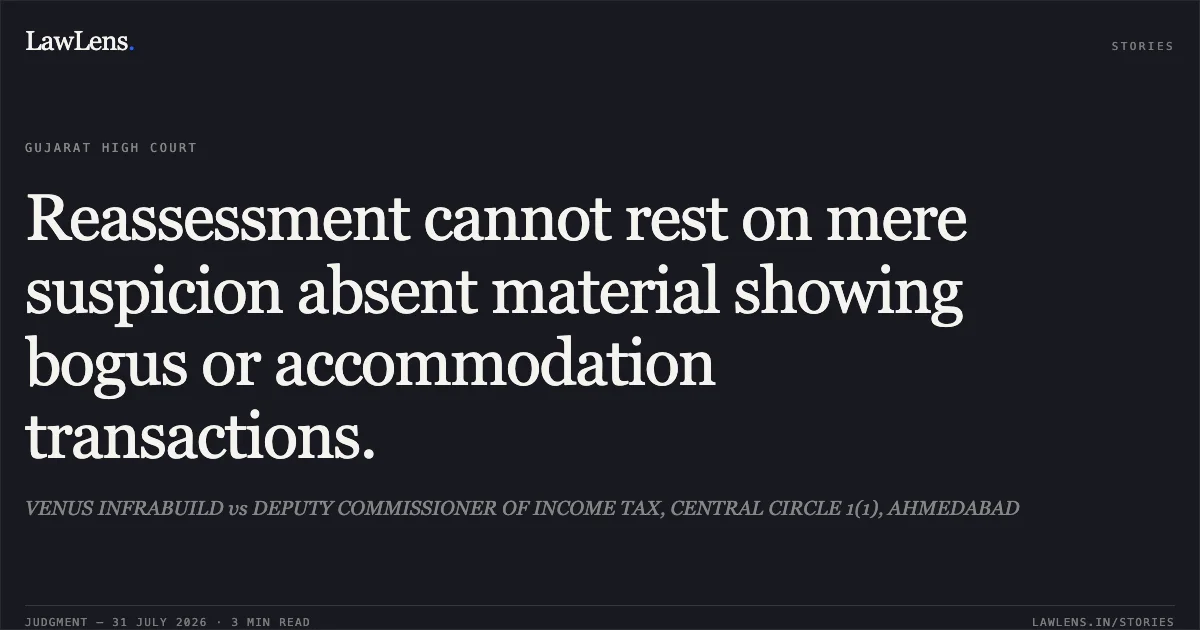
Source reference: p.2; paras. 2–3; p.5; para. 6The Court recognised that an STR may constitute information enabling the Revenue to examine possible escapement of income, but held that mere suspicion arising from banking patterns is insufficient unless supported by tangible material connecting the transactions with bogus entries, accommodation entries, or actual escapement of taxable income.
Source reference: p.6; para. 8The authority passing an order under Section 148A(3) must meaningfully consider the assessee’s explanation and supporting documents; a cursory rejection or reproduction of bank statements does not satisfy that requirement.
Source reference: p.5; para. 7Reasoning
The Court found that the petitioner had furnished a detailed explanation of the credits, debits, unsecured loans, partners’ capital contributions, interest payments and interest-free advances, supported by documentary evidence.
Source reference: p.5; para. 7However, the Assessing Officer did not substantively deal with those explanations and instead relied on the general circumstance that the petitioner was not in the lending business and had no apparent requirement for the funds.
Source reference: p.5; para. 7The Court held that transactions between the petitioner and its partners, without more, did not establish escapement of income.
Source reference: p.6; para. 8The Revenue had not identified any material, information or third-party statement showing that the transactions were bogus or constituted accommodation entries resulting in taxable income escaping assessment.
Source reference: p.6; para. 8Although the Court did not doubt the Revenue’s power to examine information originating from an STR, it held that suspicion unsupported by material could not sustain reassessment proceedings.
Source reference: p.6; paras. 8–9The petitioner’s business profile or lack of lending activity could not, by itself, justify reopening under Sections 147 and 148.
Source reference: p.6; paras. 8–9Holding
The Gujarat High Court allowed all the connected writ petitions.
It held that the Revenue had failed to justify the reopening of the petitioner’s assessment because the alleged suspicious transactions were not supported by material demonstrating escapement of taxable income, and the petitioner’s replies and documents had not been properly considered.
Source reference: p.6; paras. 8–9Accordingly, the impugned proceedings, including the show-cause notice and the order under Section 148A(3) dated 25 June 2025, along with the consequential reassessment notice under Section 148, were quashed and set aside.
Source reference: p.7; para. 9Acts & Sections Cited
5 provisions across 1 statute referred to in this judgment. Linked provisions open on LawLens.
Indian Partnership Act, 19325
Original Court PDF
VENUS INFRABUILDvsDEPUTY COMMISSIONER OF INCOME TAX, CENTRAL CIRCLE 1(1), AHMEDABAD
Click to open original judgment
Original judgment, available to read, download and summarize on LawLens.in