Facts
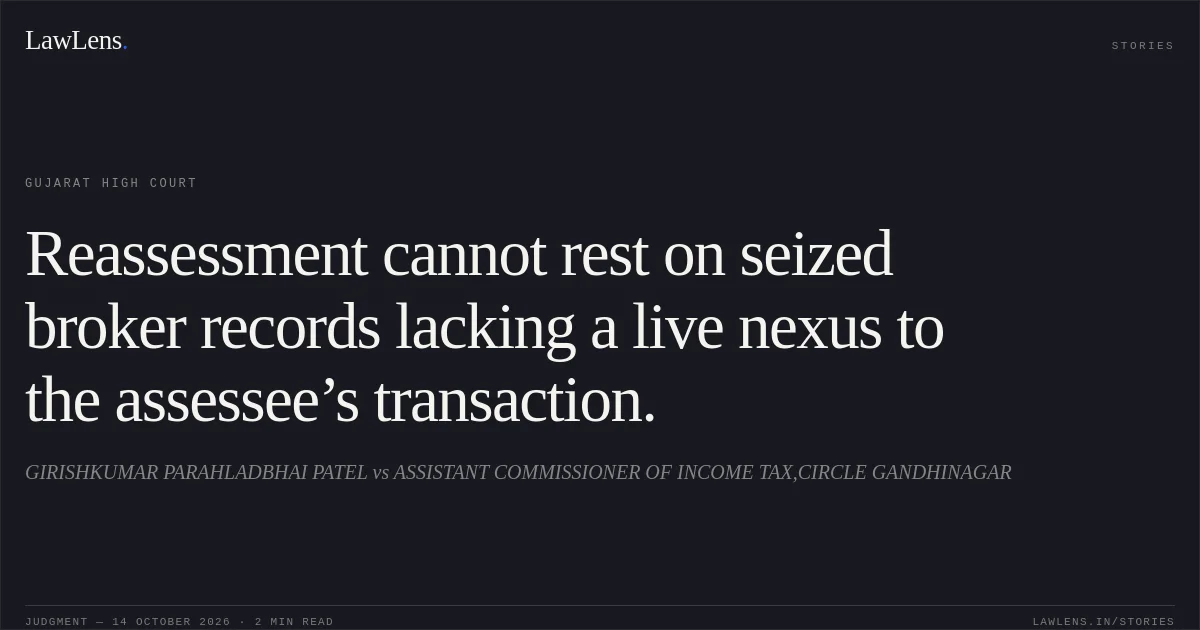
The petitioner challenged a notice dated 18 March 2026 under Section 148 of the Income-tax Act, 1961, seeking to reopen the assessment for A.Y. 2022–23.
Source reference: no citationThe reassessment was based on an entry dated 16 January 2020 in an inquiry register seized during a search of City Estate Management India.
Source reference: no citationThe Revenue relied on the entry’s reference to land at Bhadaj, including Survey No. 509/A, to allege that the petitioner had paid unaccounted consideration when purchasing land with co-purchasers under a registered sale deed dated 1 June 2021.
Source reference: no citationThe parties submitted that the petition could be disposed of in accordance with the High Court’s common judgment dated 8 October 2026 in *Special Civil Application No. 13210 of 2026 and allied matters*.
Source reference: p. 1Issues
Whether the seized inquiry-register entry supplied a sufficient link between the petitioner and the alleged on-money payment to support reopening under Section 148 of the Act.
Source reference: pp. 7–9, paras. 11–18Whether the notice under Section 148 for A.Y. 2022–23 should be quashed in light of the Court’s findings in the common judgment dated 8 October 2026.
Source reference: p. 10Law Applied
Section 148 of the Income-tax Act permits reassessment where the statutory conditions for reopening are met; where the Revenue relies on material seized from another person, the information must have a sufficient connection with the assessee to suggest escapement of income.
Source reference: pp. 5–6The Court considered Explanation 2(iv) to Section 148, concerning seized documents that “pertain to” or information that “relates to” an assessee, and Sections 132(4A) and 292C, which provide presumptions concerning seized material.
Source reference: pp. 5–6Applying its prior decisions, including *Naliniben Jagdishkumar Gandhi*, *Trupti Aakash Desai*, and *Kantilal Parsotamdas Patel*, the Court required a live nexus between the seized material and the assessee before reopening could be sustained.
Source reference: pp. 8–9, paras. 15–17Reasoning
The common judgment found that the register entry preceded the petitioner’s purchase by about one and a half years and was described by the broker as recording land or plots available for sale, not completed transactions.
Source reference: p. 7, para. 11The entry covered several survey numbers and a total area substantially larger than the single parcel purchased by the petitioner and co-purchasers; it also contained names not shown to be connected to the petitioner or the sale.
Source reference: pp. 8–9, paras. 13–14The broker’s statements did not identify the petitioner or the co-purchasers as parties to the transaction, and the Court found no direct or indirect link between them and the seized entry.
Source reference: p. 9, paras. 14–18The present petition was disposed of on that basis, in terms of the common judgment.
Source reference: p. 10Holding
The Court allowed the petition in terms of its common judgment dated 8 October 2026, quashed and set aside the notice under Section 148 for A.Y. 2022–23, and made the Rule absolute.
Acts & Sections Cited
5 provisions across 1 statute referred to in this judgment. Linked provisions open on LawLens.
Income Tax Act, 19615
Original Court PDF
GIRISHKUMAR PARAHLADBHAI PATELvsASSISTANT COMMISSIONER OF INCOME TAX,CIRCLE GANDHINAGAR
Click to open original judgment
Original judgment, available to read, download and summarize on LawLens.in