Facts
The petitions challenged notices dated 27 August 2024 issued under Section 148 of the Income-tax Act, 1961, and corresponding orders under Section 148A(d), seeking to reopen assessments for A.Y. 2018–19.
Source reference: pp. 2–3, paras. 3–4In SCA No. 8342 of 2025, the assessee, Kamlaben Ramanbhai Patel, had died on 27 June 2020; nevertheless, the Section 148A(b) notice, Section 148A(d) order and Section 148 notice were issued in her name.
Source reference: pp. 2–3, paras. 3–4In SCA No. 8993 of 2025, the Assessing Officer alleged escapement of income of ₹1,01,35,652 by rejecting the registered valuer’s report relied upon by the assessee and adopting the DVO’s valuation of ₹8,30,000 as on 1 April 2001, determined in the case of a co-owner.
Source reference: pp. 4–6, paras. 5–6The DVO had relied upon sale instances from Tandalja village, whereas the assessee’s property was situated at Sevasi, Vadodara.
Source reference: pp. 9–10, paras. 9–10Issues
Whether reassessment proceedings initiated by issuing notices in the name of an assessee who had died before the initiation of proceedings were legally valid under the Income-tax Act?
Source reference: p. 3, para. 4Whether, for the extended limitation period under Section 149(1)(b)(i), capital gains arising from the sale of land and the subsequent deposit of sale proceeds could constitute income represented in the form of an “asset”?
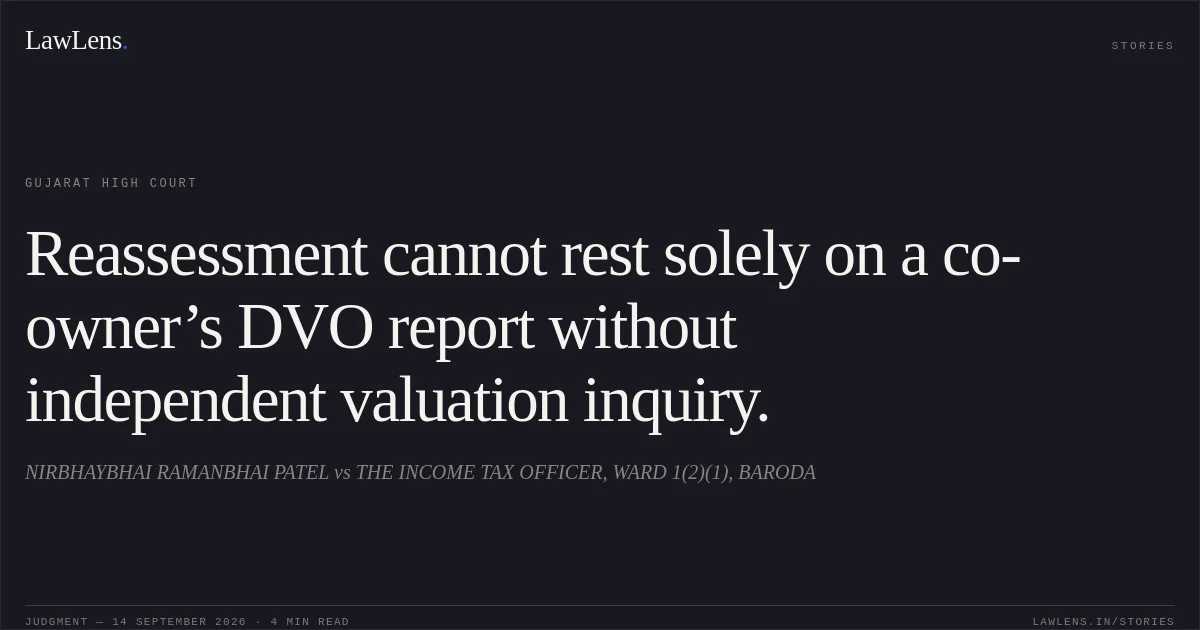
Source reference: pp. 7–9, paras. 7–8Whether reassessment could be initiated solely on the basis of a DVO report prepared in the case of a co-owner, without an independent valuation, further inquiry or application of mind by the Assessing Officer?
Source reference: pp. 9–13, paras. 9–12Law Applied
Section 159(2)(b) of the Income-tax Act governs assessment and reassessment proceedings concerning the income of a deceased person and does not validate proceedings initiated against a dead assessee in the circumstances present here.
Source reference: p. 3, para. 4Section 149(1)(b)(i), read with its Explanation, permits issuance of a notice after three years but within ten years where the escaped income chargeable to tax, represented in the form of an asset—including land, buildings, shares, securities, loans, advances or bank deposits—amounts to or is likely to amount to ₹50 lakh or more.
Source reference: pp. 7–9, paras. 7–8The Court held that sale proceeds of land deposited in a bank account retain the requisite nexus with the asset and may fall within the Explanation to Section 149(1)(b)(i).
Source reference: para. 8However, reassessment cannot be founded mechanically or exclusively on a DVO’s report; the Assessing Officer must independently apply his mind and conduct further inquiry to form a reasoned belief that income has escaped assessment. This principle was drawn from Dhariya Construction Co., Munir Ismail Voraji v. Income-tax Officer, Pr. CIT v. J. Upendra Construction (P) Ltd. and Aavkar Infrastructure Co.
Source reference: pp. 11–13, paras. 11–12Where the fair market value is disputed, the Assessing Officer must obtain an appropriate valuation in the assessee’s own case, including by resort to Section 55A where applicable.
Source reference: p. 13, para. 12Reasoning
In SCA No. 8342 of 2025, the assessee had died several years before the issuance of the impugned notices. Since the proceedings were initiated in the name of the deceased person and the Revenue did not dispute the death certificate, the notices and consequential order were invalid.
Source reference: p. 3, para. 4In SCA No. 8993 of 2025, the Court rejected the assessee’s narrow interpretation of “asset” under Section 149(1)(b)(i), holding that the land, its sale proceeds deposited in a bank account and the resulting capital gains had a sufficient nexus with the statutory concept of an asset.
Source reference: pp. 7–9, paras. 7–8Nevertheless, the reassessment failed on the separate and decisive ground that the Assessing Officer had relied exclusively on the DVO’s report prepared for the co-owner.
Source reference: pp. 9–13, paras. 9–12The report used sale instances from another village and did not establish the fair market value of the assessee’s property at Sevasi.
Source reference: pp. 9–13, paras. 9–12The Assessing Officer neither obtained a valuation report in the assessee’s own case nor conducted any independent inquiry or recorded a reasoned finding rejecting the registered valuer’s report.
Source reference: pp. 9–13, paras. 9–12The co-owner’s acceptance of the valuation could not substitute for independent application of mind in the assessee’s case.
Source reference: p. 13, para. 12Holding
The Court allowed both writ petitions.
In SCA No. 8342 of 2025, it quashed the Section 148A(d) order and Section 148 notice because they had been issued in the name of a deceased assessee.
Source reference: p. 3, para. 4In SCA No. 8993 of 2025, although the Court held that the alleged capital gains could fall within the “asset” requirement of Section 149(1)(b)(i), it quashed the impugned Section 148A(d) order and Section 148 notice because the reassessment was based solely on the co-owner’s DVO report, without a proper valuation or independent inquiry concerning the assessee’s property.
Source reference: p. 14, para. 13No order as to costs was made.
Source reference: p. 14, para. 13Acts & Sections Cited
8 provisions across 1 statute referred to in this judgment. Linked provisions open on LawLens.
Income Tax Act, 19618
Original Court PDF
NIRBHAYBHAI RAMANBHAI PATELvsTHE INCOME TAX OFFICER, WARD 1(2)(1), BARODA
Click to open original judgment
Original judgment, available to read, download and summarize on LawLens.in