Facts
Shalibhadra Finvest Services Private Limited, subsequently renamed Shalibhadra Infraspace Private Limited, filed its return for Assessment Year 2014–15 declaring income of ₹1,40,94,230. Its assessment was completed under Section 143(3) of the Income Tax Act, 1961, without disturbing the returned income.
Source reference: p.2, para.2Pursuant to an order of the National Company Law Tribunal dated 1 March 2018, the company amalgamated with Marvell Mall Development Company Limited with effect from 1 April 2015 and ceased to exist in law.
Source reference: p.2, para.2Despite the amalgamation, the Assessing Officer issued a notice under Section 148 dated 25 March 2019 in the name of the amalgamating company for A.Y. 2014–15. The petitioner informed the Revenue of the amalgamation and objected that the notice issued in the name of a non-existent entity was invalid. The objections were rejected, and notices under Section 142(1) were issued.
Source reference: p.2, para.2.1During the pendency of the writ petition, the Revenue initiated reassessment proceedings against the petitioner, the amalgamated company, for the same assessment year and the same share-application money of ₹1.40 crore. An assessment order dated 15 May 2023 under Sections 147, 144 and 144B added the said amount under Section 68 read with Section 115BBE of the Act.
Source reference: p.3, para.2.3The Revenue’s assessment order expressly stated that the notice was issued in the petitioner’s name because the amalgamating company had merged with it.
Source reference: p.3, para.3Issues
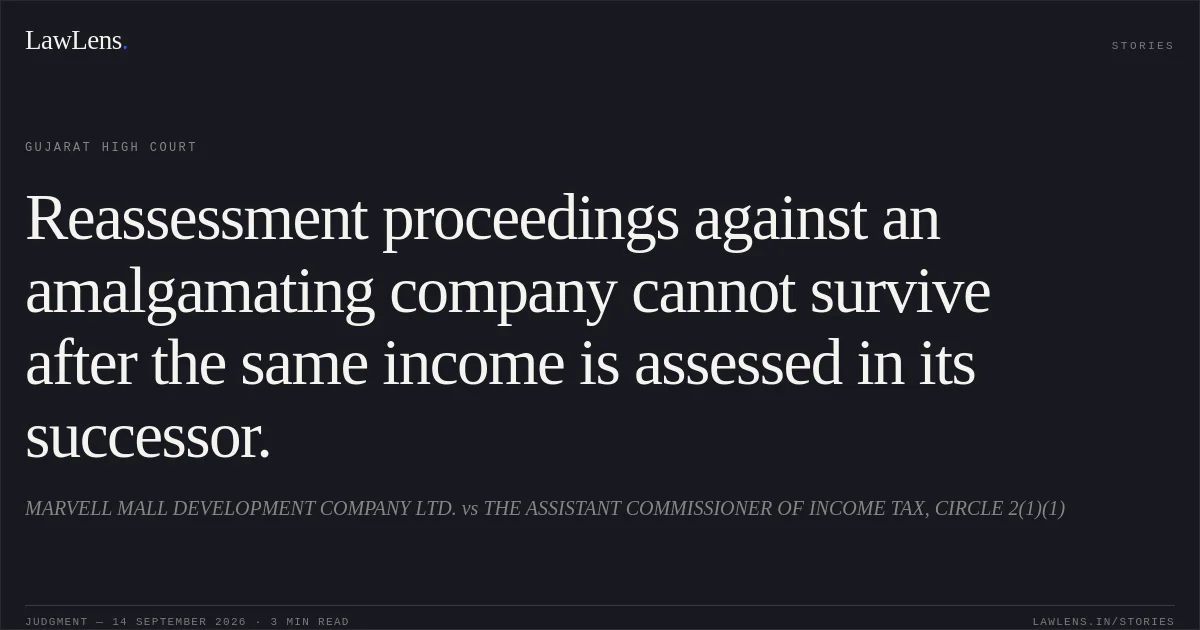
Whether the reassessment proceedings initiated under Section 148 in the name of the amalgamating company could survive after the Revenue assessed the same income, for the same assessment year, in the hands of the amalgamated company?
Source reference: pp.5–7, paras.6–9Whether a notice under Section 148 issued in the name of a company that had ceased to exist pursuant to amalgamation was legally valid?
Source reference: p.7, para.9The Court decided the first issue and expressly kept the second issue open.
Source reference: p.7, paras.9–10Law Applied
The Court applied Sections 147 and 148 of the Income Tax Act, 1961, governing reassessment proceedings, and Section 68 concerning unexplained credits.
Source reference: no citationIt relied on the principle that the same income cannot ordinarily be taxed twice, as recognised by the Supreme Court in Laxmipat Singhania v. Commissioner of Income Tax, (1969) 72 ITR 291 (SC).
Source reference: p.7, para.8It also applied the rule in Income Tax Officer v. Ch. Atchaiah, (1996) 218 ITR 239 (SC) that the Assessing Officer must assess income in the hands of the correct person and has no discretion to assess it in an incorrect person’s hands.
Source reference: p.7, para.8The Court noted, but did not decide, the principle in Principal Commissioner of Income Tax v. Maruti Suzuki (India) Ltd., (2019) 416 ITR 613 (SC) concerning the validity of proceedings initiated against a non-existent amalgamated or amalgamating company.
Source reference: p.2, para.2.2; p.7, para.9Reasoning
The Revenue initially issued the Section 148 notice in the name of the amalgamating company, which had ceased to exist before the notice was issued.
Source reference: no citationDuring the writ proceedings, however, the Revenue assessed the same ₹1.40 crore of share-application money, relating to the same assessment year and the same transactions, in the hands of the petitioner as successor to the amalgamating company.
Source reference: p.5, para.6The assessment order itself demonstrated that the Revenue consciously treated the petitioner as the proper assessee because of the amalgamation.
Source reference: p.6, para.7Applying the rule against double taxation and the requirement that income be assessed in the hands of the correct person, the Court held that the original reassessment proceedings had been overtaken by and merged into the assessment made against the amalgamated company.
Source reference: pp.6–7, paras.7–8Continuing both proceedings would create parallel reassessments concerning the same income for the same assessment year, including one against an entity that the Revenue itself accepted as non-existent.
Source reference: p.7, para.8Holding
The Court held that, since the very same income had already been assessed in the hands of the amalgamated company, the Section 148 notice dated 25 March 2019 issued in the name of Shalibhadra Finvest Services Private Limited could not survive.
The writ petition was allowed; the impugned notice and all consequential proceedings were quashed and set aside. Rule was made absolute, with no order as to costs.
Source reference: p.8, para.11The Court did not decide the separate question of whether a Section 148 notice issued in the name of a non-existent company is inherently invalid, and left all challenges to the reassessment and assessment order against the petitioner open for appropriate proceedings.
Source reference: p.7, paras.9–10Acts & Sections Cited
8 provisions across 1 statute referred to in this judgment. Linked provisions open on LawLens.
Income Tax Act, 19618
Original Court PDF
MARVELL MALL DEVELOPMENT COMPANY LTD.vsTHE ASSISTANT COMMISSIONER OF INCOME TAX, CIRCLE 2(1)(1)
Click to open original judgment
Original judgment, available to read, download and summarize on LawLens.in