Facts
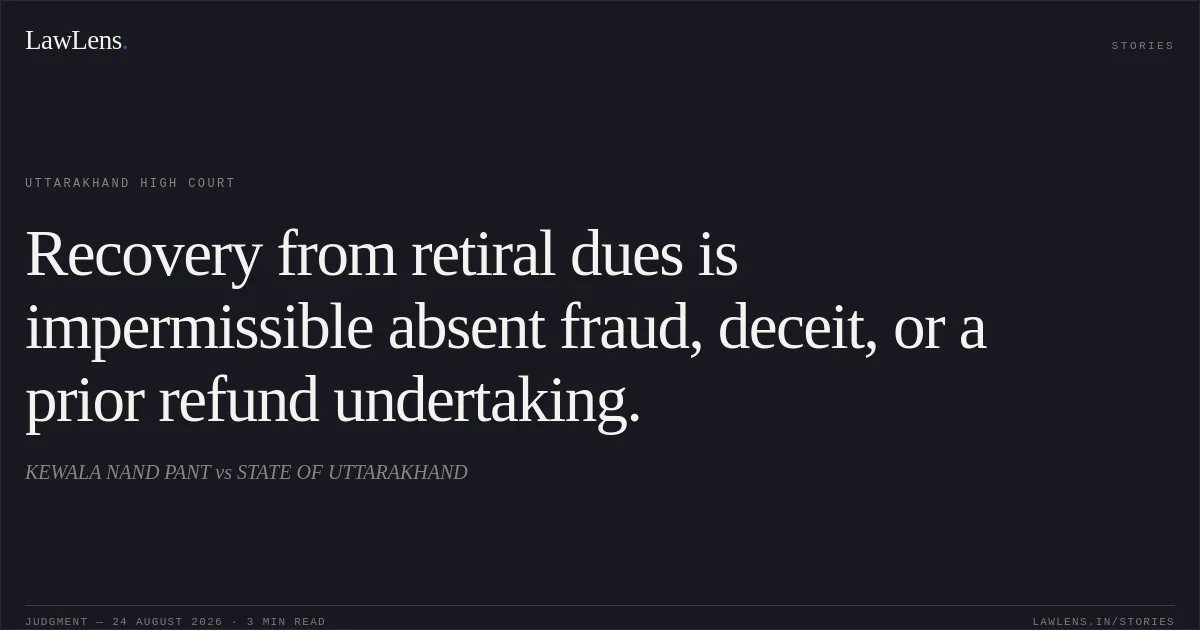
The petitions concerned a common challenge to recovery of alleged excess payments from the petitioners’ post-retiral dues.
Source reference: para. 1The petitioner, Kewala Nand Pant, was appointed as Lecturer (English) on an ad hoc basis with effect from 13 July 1989 at Kapkote Inter College, Bageshwar.
Source reference: para. 2After completing ten years of service, he was granted selection grade with effect from 13 July 1999 by order dated 25 January 2000.
Source reference: para. 2The institution was provincialised on 31 May 2005 and renamed Government Inter College, Kapkote.
Source reference: para. 2The petitioner was subsequently granted the promotional pay scale with effect from 13 July 2011 and retired from Government Inter College, Salong, Almora, on 31 March 2023, after taking the benefit of the session-end provision.
Source reference: para. 2After his retirement, the respondents sought to recover Rs. 5,19,001/- from his retiral dues on the ground that his ad hoc service could not be counted for granting selection and promotional grades.
Source reference: para. 1; para. 3Issues
1. Whether recovery of Rs. 5,19,001/- from the petitioner’s post-retiral dues, on the ground that his ad hoc service was not countable for selection and promotional grades, was legally sustainable
Source reference: para. 1; para. 32. Whether the petitioner’s case fell within either of the exceptions permitting recovery of excess payment—namely, fraud or deceit by the employee, or an undertaking to refund any inadmissible or excess payment
Source reference: para. 83. Whether the petitioners were entitled to release of their retiral dues, including any amount already recovered, if neither exception applied
Source reference: para. 8Law Applied
The Court considered Government Order dated 12 July 2002, which, according to the petitioners, required satisfactory service rather than exclusively regular service for grant of service benefits.
Source reference: para. 4It relied on the principles governing recovery of excess payments stated by the Supreme Court in State of Punjab v. Rafiq Masih, (2015) 4 SCC 334, particularly the protection ordinarily available against recovery from lower-level employees where the excess payment was not procured through fraud or misrepresentation.
Source reference: para. 5The Court also followed its earlier decision in WPSS No. 335 of 2023 dated 18 September 2025, directing that recovery could be sustained only if the employee was responsible for the excess payment through fraud or deceit, or had furnished an undertaking to refund any inadmissible or excess amount.
Source reference: paras. 6–8The validity of the Government Order dated 12 July 2002 had previously been upheld in WPSS No. 2602 of 2019, with the consequential Special Appeal and Special Leave Petition having been dismissed.
Source reference: para. 4Reasoning
The Court noted that the alleged recovery arose from service benefits granted by the competent authorities and that the petitioners disputed any fraud, misrepresentation, or personal fault.
Source reference: paras. 6–8Since the controversy was materially identical to that decided in WPSS No. 335 of 2023, the Court applied the two-part test formulated in that decision rather than finally determining the entitlement to selection or promotional grades in the writ petitions.
Source reference: paras. 6–8The competent authority was therefore directed to examine whether either the fraud/deceit exception or the undertaking-based exception applied.
Source reference: para. 8If neither circumstance existed, recovery from the petitioners’ retiral dues could not be sustained, particularly in light of the principles in Rafiq Masih and the petitioners’ status as Class III employees.
Source reference: para. 5; para. 8Holding
Both writ petitions were disposed of in terms of the judgment dated 18 September 2025 in WPSS No. 335 of 2023.
The competent authority was directed to determine whether either of the following applied: (i) the concerned petitioner was responsible for the excess payment by fraud, deceit, or similar conduct; or (ii) the petitioner had furnished an undertaking to refund any amount later found inadmissible or excessive.
Source reference: para. 8If neither condition applied, the petitioners’ entire retiral dues, including any amount already recovered, were to be released within ten weeks from presentation of a certified copy of the order.
Source reference: para. 8Original Court PDF
KEWALA NAND PANTvsSTATE OF UTTARAKHAND
Click to open original judgment
Original judgment, available to read, download and summarize on LawLens.in