Facts
The petitioner, a Headmaster in a Government Secondary School, Block Bamori, District Guna, retired on 30 November 2006.
Source reference: para. 1, p. 1At the time of processing his retiral benefits, the respondents allegedly found that his pay had been wrongly fixed and that he had received an excess amount of ₹19,572.
Source reference: paras. 2–3, pp. 1–2The alleged excess payment related to the period from 1 August 2001 to 30 November 2006.
Source reference: paras. 2–3, pp. 1–2The respondents ordered recovery of the amount without issuing a show-cause notice or affording the petitioner an opportunity of hearing.
Source reference: paras. 2–3, pp. 1–2The petitioner challenged the recovery and sought payment of pensionary benefits on the basis of his previously fixed pay.
Source reference: para. 1, p. 1The State contended that the excess payment resulted from erroneous pay fixation and was recoverable, and that the protection under State of Punjab v. Rafiq Masih (White Washer) was inapplicable.
Source reference: para. 4, p. 2Issues
Whether recovery of the alleged excess salary paid due to erroneous pay fixation could be made from the petitioner after his retirement, particularly without issuing a show-cause notice or granting an opportunity of hearing?
Source reference: paras. 3–4, pp. 1–2Whether the petitioner was protected from recovery under the principles laid down in State of Punjab v. Rafiq Masih (White Washer), in the absence of a specific undertaking given at the time of pay fixation?
Source reference: paras. 6–10, pp. 2–5Whether the respondents were required to refund the recovered amount with interest?
Source reference: para. 11, p. 6Law Applied
The Court applied the principles laid down by the Supreme Court in State of Punjab v. Rafiq Masih (White Washer), (2015) 4 SCC 334, under which recovery is ordinarily impermissible from retired employees, employees due to retire within one year, Group C and Group D employees, and where the excess payment has continued for more than five years; recovery is also impermissible where it would be inequitable, harsh or arbitrary.
Source reference: para. 7, pp. 2–4The Court relied on the Full Bench decision in State of Madhya Pradesh v. Jagdish Prasad Dubey, (2024) 2 MPLJ 198, which held that recovery may be made from salary or pensionary benefits on the basis of a valid undertaking or indemnity, subject to consideration of hardship and the limitations in Rafiq Masih, but that an undertaking obtained at the stage of retiral benefits for an old pay fixation cannot ordinarily be enforced.
Source reference: para. 6, pp. 2–3The Full Bench further held that recovery under Rules 65 and 66 of the relevant Rules is permissible only if the prescribed procedure is followed, and that an undertaking given for pay refixation is not enforceable unless shown to have been given voluntarily.
Source reference: para. 6, pp. 2–3The Court also relied on Jogeswar Sahoo v. District Judge, Cuttack, 2025 (3) MPLJ (SC) 25, concerning the impermissibility of recovery from retired non-gazetted employees absent fraud, misrepresentation and an opportunity of hearing.
Source reference: para. 8, p. 4The Court also relied on Ravindra Kumar Joshi v. State of Madhya Pradesh, W.P. No. 17831 of 2019, decided on 13 May 2024, holding that an undertaking not proved to have been voluntarily furnished cannot support recovery.
Source reference: para. 9, pp. 4–5Reasoning
The Court found that the alleged erroneous pay fixation commenced on 1 August 2001 and continued until the petitioner’s retirement on 30 November 2006, while no specific undertaking given by the petitioner at the time of the original pay fixation was produced on record.
Source reference: para. 10, p. 5Since the petitioner was already retired when recovery was ordered, and the alleged excess payment had continued for more than five years, the case fell within the protective principles of Rafiq Masih.
Source reference: paras. 7, 10–11, pp. 3–6The recovery was also procedurally defective because it was ordered without notice or an opportunity of hearing.
Source reference: paras. 3, 8 and 11, pp. 1–2, 4, 6The State’s assertion that the payment resulted from erroneous fixation did not establish fraud or misrepresentation by the petitioner and could not overcome the rule against harsh recovery from a retired employee.
Source reference: paras. 7–11, pp. 3–6In the absence of a voluntarily executed undertaking at the time of pay fixation, the respondents could not rely on an undertaking-based exception recognized in Jagdish Prasad Dubey.
Source reference: paras. 6, 9–10, pp. 2–5Holding
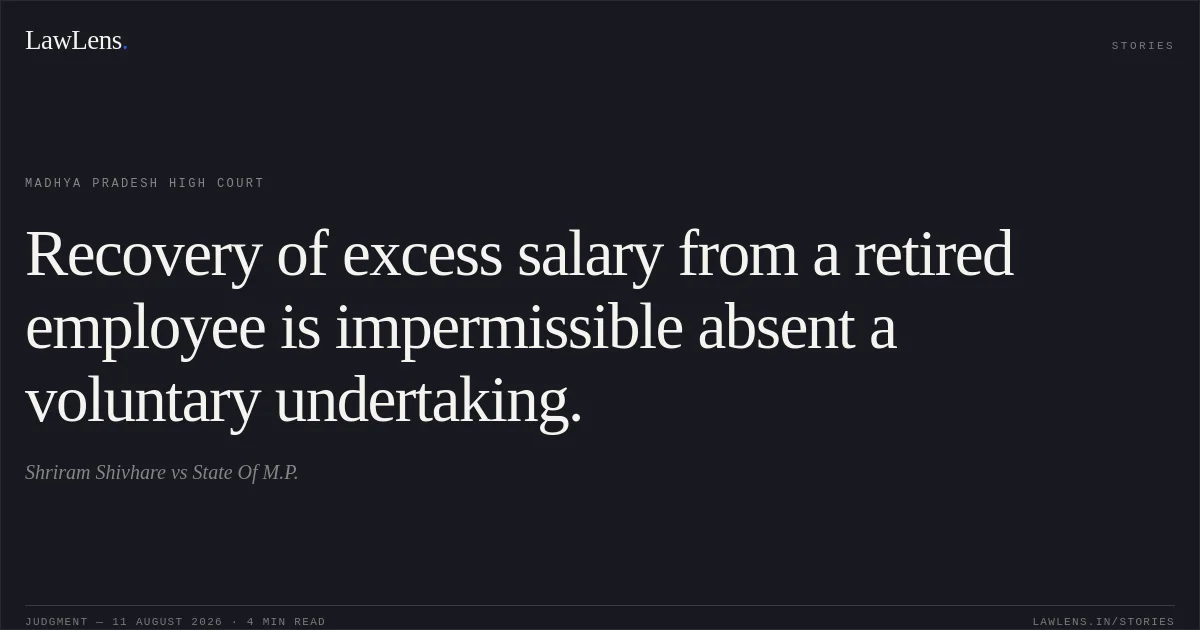
The Court held that the recovery of ₹19,572 from the petitioner was impermissible and set aside the impugned recovery order.
The respondents were directed to refund ₹19,572 to the petitioner, together with interest at 6% per annum from the date of retirement until actual payment, subject to the clarification that the petitioner would not be entitled to a refund if the amount had not in fact been recovered from his retiral dues.
Source reference: para. 11, p. 6The directions were to be complied with within 90 days from submission of a certified copy of the order, and the writ petition was accordingly disposed of.
Source reference: paras. 12–13, p. 6Original Court PDF
Shriram ShivharevsState Of M.P.
Click to open original judgment
Original judgment, available to read, download and summarize on LawLens.in