Facts
The respondent, an employee of East Central Railway, joined service as an Assistant Driver on 6 April 1989 and was subsequently promoted as a Weigh Clerk and then as a Goods Guard on 12 October 2002. He received two promotional benefits, with effect from 5 April 1996 and 12 October 2002 respectively.
Source reference: p.3The Railway administration thereafter granted him a third financial upgradation under the Modified Assured Career Progression (MACP) Scheme in Grade Pay of ₹4,200 with effect from 1 September 2008, instead of the correct date, 12 October 2012, being ten years after his last promotion.
Source reference: pp.2–4Upon detecting the error, the Railway administration revised his pay fixation and determined that an excess amount of ₹4,87,348 had been paid. By order dated 4 September 2023, it directed recovery of the amount in 19 monthly instalments from the respondent’s salary.
Source reference: pp.2, 4The respondent challenged the recovery before the Central Administrative Tribunal, Patna Bench, which allowed his Original Application No. 050/00755/2024 and quashed the recovery order dated 4 September 2023.
Source reference: p.2Issues
Whether the Railway administration could recover excess salary paid to the respondent due to its own erroneous grant of MACP financial upgradation, in the absence of fraud or misrepresentation by the respondent?
Source reference: pp.5, 12Whether recovery of ₹4,87,348 from the respondent’s salary was impermissible as arbitrary, inequitable, or unduly harsh under the principles laid down by the Supreme Court in cases concerning recovery of excess payments?
Source reference: pp.4–12Law Applied
The Court applied the settled principle that excess salary paid because of an employer’s bona fide mistake, wrong pay fixation, or erroneous interpretation of service rules ordinarily cannot be recovered where the employee has committed no fraud or misrepresentation.
Source reference: pp.5–8The Court relied on Shyam Babu Verma v. Union of India, (1994) 2 SCC 52; Sahib Ram v. State of Haryana, 1995 Supp. (1) SCC 80; B. Ganga Ram v. Regional Joint Director, (1997) 6 SCC 139; Bihar State Electricity Board v. Bijay Bahadur, (2000) 10 SCC 99; Punjab National Bank v. Manjeet Singh, (2006) 8 SCC 647; Purshottam Lal Das v. State of Bihar, (2006) 11 SCC 492; Col. B.J. Akkara v. Government of India, (2006) 11 SCC 709; Syed Abdul Qadir v. State of Bihar, (2009) 3 SCC 475; State of Punjab v. Rafiq Masih, (2015) 4 SCC 334; and Thomas Daniel v. State of Kerala, 2022 SCC OnLine SC 536.
Source reference: pp.5–11Under Syed Abdul Qadir and B.J. Akkara, recovery may be restrained where the excess payment resulted from the employer’s wrong calculation or interpretation and the employee neither misrepresented facts nor knew that the payment was excessive.
Source reference: pp.7–10Rafiq Masih identifies, inter alia, recovery from Group C/D employees, retired or imminently retiring employees, recovery relating to payments made for more than five years, and recovery that is otherwise harsh, arbitrary, or inequitable as impermissible circumstances.
Source reference: p.11Relief is grounded in equity and judicial discretion to prevent undue hardship, rather than in an absolute right of the employee.
Source reference: pp.7–10Reasoning
The Court found that the respondent’s third MACP benefit had been granted from 1 September 2008 instead of 12 October 2012 solely because of an administrative error in applying the applicable service rules.
Source reference: pp.3–5There was no allegation or finding that the respondent had made any misrepresentation or committed fraud, and the excess payment was attributable entirely to the Railway administration.
Source reference: p.5Applying the principles in Syed Abdul Qadir, B.J. Akkara, Thomas Daniel, and Rafiq Masih, the Court held that the employee could not fairly be made liable for an error committed by the employer, particularly where the excess payment had continued over a substantial period and recovery would cause hardship.
Source reference: pp.7–12The Court therefore rejected the Railway’s contention that recovery was permissible merely because the respondent had received salary in excess of his legal entitlement.
Source reference: p.4Holding
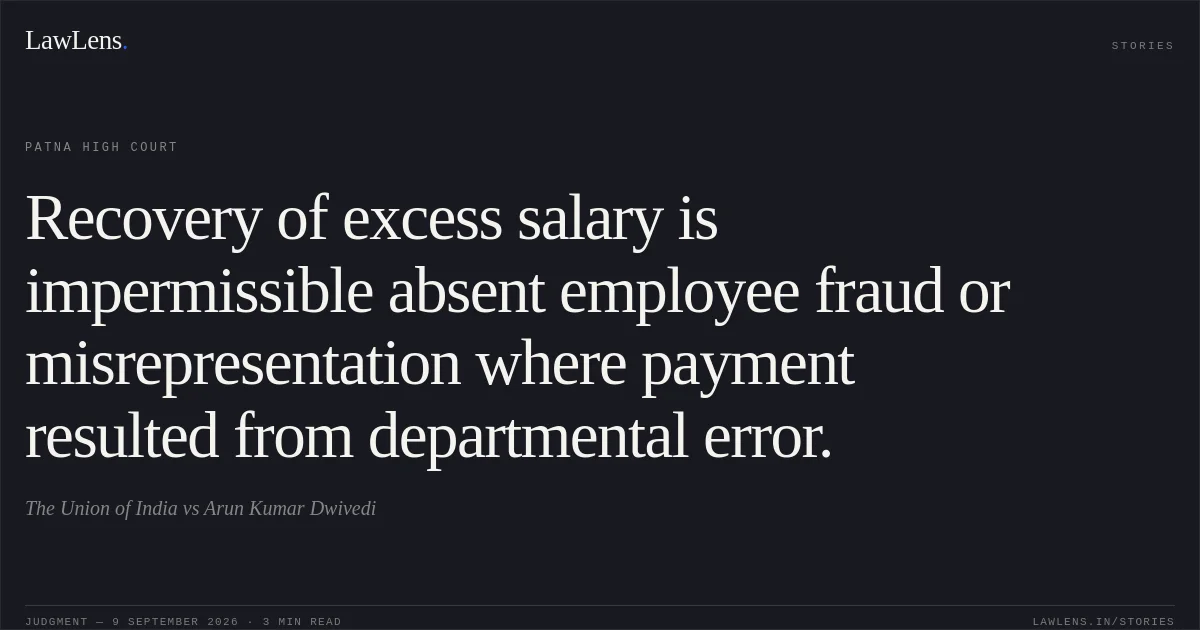
The Patna High Court held that recovery of ₹4,87,348 from the respondent was impermissible because the excess payment resulted from the Railway administration’s bona fide mistake and not from any fraud or misrepresentation by the respondent.
The Court found no infirmity in the Central Administrative Tribunal’s order dated 2 April 2026, which had quashed the recovery order.
Source reference: p.12The writ petition was consequently dismissed for lack of merit, and no recovery could be made from the respondent.
Source reference: p.12Original Court PDF
The Union of IndiavsArun Kumar Dwivedi
Click to open original judgment
Original judgment, available to read, download and summarize on LawLens.in