01Facts
The appellant, Krishna Bhagya Jala Nigam Limited (KBJNL), is the beneficiary for whose purpose the private respondents' lands were acquired.
¶ 3The appellant was not made a party before the Reference Court, which passed an award.
¶ 3The appellant challenged the award in W.P. No. 109895/2025.
¶ 3On 16.06.2026, the learned Single Judge quashed the award and remitted the matter to the Reference Court, subject to conditions in the operative portion.
¶ 3Conditions Nos. 4 to 9 required, among other things: impleadment of the beneficiary; liberty to file objections and cross-examine claimants; a direction to the Reference Court to inquire whether enhanced compensation had been paid for similarly placed lands; time-bound disposal; and deposit of 25% of the awarded compensation pending disposal.
quoted order · ¶ 3(iii)–(ix)The appellant filed the present writ appeal only against Conditions 4 to 9.
prayer · ¶ 3The unserved claimants had not been given notice of this appeal.
¶ 2Counsel for both sides noted that a co-ordinate Bench, in W.A. No. 100590/2026 c/w W.A. No. 100503/2026, had disposed of identical appeals without notice to the private respondents.
¶ 4In W.A. No. 100475/2026 (decided 06.08.2026), the co-ordinate Bench set aside Conditions iv–ix.
quoted order · ¶ 5, 802Issues
i.1. Whether the conditions (Nos. 4 to 9) imposed by the learned Single Judge while remitting the matter to the Reference Court are legally sustainable, or whether they unduly restrict the Reference Court's discretion.
¶ 3 · quoted order · ¶ 7–8ii.2. Whether notice to the unserved private respondents (original claimants) is required before the writ appeal is finally disposed of.
¶ 2 · ¶ 403Law Applied
The Court relied on Section 4 of the Karnataka High Court Act, 1961 as the basis for the writ appeal.
prayerThe judgment does not identify any specific provision of the Land Acquisition Act, 1894 or the Right to Fair Compensation Act, 2013.
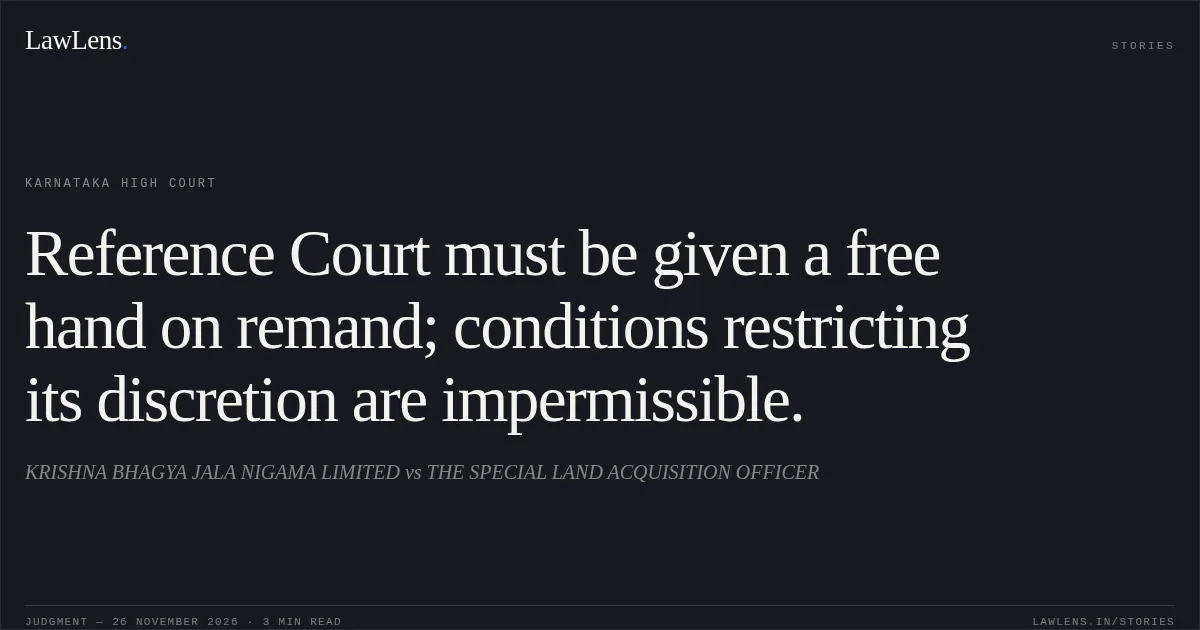
Where a writ petition succeeds solely on the legal ground that an award was passed in the absence of the beneficiary, the Reference Court must be "given a free hand to decide the matter in accordance with law," and conditions restricting its discretion are impermissible.
quoted order · ¶ 7 · ¶ 5The claimants' safeguard permits a matter to be heard finally without notice to unserved parties, with the Reference Court directed to issue notice thereafter.
¶ 2 · ¶ 7Provisions in the judgment · 1 · Linked ones open on LawLens
KARNATAKA HIGH COURT ACT, 1961 Section 4
04Reasoning
The appellant's only ground was the legal infirmity of an award passed without impleading the beneficiary. The learned Single Judge accepted that ground and quashed the award.
¶ 3Conditions 4 to 9 went further by prescribing the manner in which the Reference Court was to conduct the fresh proceedings, including the evidence to be inquired into, the deposit to be made, and the timelines for disposal.
quoted order · ¶ 3(iii)–(ix)Following W.A. No. 100475/2026, the Court held that such directions improperly restricted the Reference Court's discretion, since the writ petition was decided only on a legal ground.
quoted order · ¶ 7–8 · ¶ 5The Court followed the approach in W.A. No. 100590/2026 and affirmed the core remittal while removing the restrictive conditions.
¶ 6The unserved claimants' interests were protected because the matter could be disposed of finally without notice to them, and the Reference Court would issue notice to them when proceedings resume.
¶ 2 · ¶ 7The Court's approach avoids repetitive appellate proceedings on identical issues in companion appeals.
¶ 605Holding
The conditions restricting the Reference Court's discretion are not sustainable, and the Reference Court must decide the reference afresh in accordance with law.
¶ 6 · quoted order · ¶ 8Notice to the unserved respondents need not be served before final disposal of the writ appeal.
¶ 2 · ¶ 4The writ appeal is disposed of in terms of W.A. No. 100590/2026 c/w connected matter. The parties are directed to appear before the Reference Court on 16.12.2026. The Reference Court is directed to issue notice to the unserved parties and proceed in accordance with law. Pending I.As., if any, are disposed of as not surviving.
¶ 7 · ¶ 8Original Court PDF
KRISHNA BHAGYA JALA NIGAMA LIMITEDvsTHE SPECIAL LAND ACQUISITION OFFICER
Click to open original judgment
Original judgment, available to read, download and summarize on LawLens.in