01Facts
The appellant, Krishna Bhagya Jala Nigam Limited (KBJNL), is the beneficiary for whose benefit private lands were acquired. It was not impleaded before the Reference Court, which passed an award enhancing compensation to the private claimants.
¶ 3KBJNL challenged the award in W.P. No. 109918/2025 (LA-RES). By order dated 16.06.2026, the learned Single Judge quashed the award, remitted the matter to the Reference Court for impleadment of KBJNL, and imposed conditions (i)–(ix).
¶ 3 · pp. 5–7Conditions (iv)–(ix) permitted KBJNL to cross-examine and lead evidence, required the Reference Court to call for information on enhanced compensation paid to similarly placed landowners, fixed timelines (six months and one year), and directed KBJNL to deposit 25% of the awarded amount within two months.
pp. 5–7KBJNL appealed only against conditions 4 to 9.
p. 2A co-ordinate Bench, in W.A. No. 100475 of 2026 (06.08.2026), upheld the remand and impleadment directions but set aside conditions (iv)–(ix).
pp. 7–9, quoting the co-ordinate BenchThe parties agreed that the same course should apply here.
¶ 4 · ¶ 5The unserved private respondents were not required to be served at this stage.
¶ 202Issues
i.1. Whether the conditions (iv)–(ix) imposed by the learned Single Judge, which regulate evidence, comparative enhanced-compensation enquiries, deposit, and timelines before the Reference Court, are sustainable when the writ petition was allowed only on the legal ground of non-impleadment of the beneficiary.
¶ 3 · p. 8, quoting W.A. No. 100475/2026 · ¶ 7ii.2. Whether notice must be served on the unserved private respondents before the writ appeal is finally decided.
¶ 2 · ¶ 403Law Applied
The co-ordinate Bench decision in W.A. No. 100475 of 2026 (06.08.2026) holds that the Reference Court must be given a "free hand to decide the matter in accordance with law," and that a writ court cannot impose conditions restricting the Reference Court's discretion as to how a reference is decided where the only ground accepted is the legal defect of non-impleadment.
pp. 7–8, quoting paras 7–8Where the impugned order is affirmed in part, the remand and impleadment directions survive while the restrictive directions are set aside.
pp. 8, quoting paras 8–9Under the precedent's disposal approach, a Reference Court is to fix a date for appearance and issue notice to unserved parties.
pp. 10–11 · ¶ 7The power to hear the appeal is conferred by Section 4 of the Karnataka High Court Act, 1961.
p. 2The judgment does not identify any specific provision of the Land Acquisition Act, 1894 governing reference proceedings.
Provisions in the judgment · 1 · Linked ones open on LawLens
KARNATAKA HIGH COURT ACT, 1961 Section 4
04Reasoning
The single judge's remand was grounded solely on KBJNL's non-impleadment, which made the award legally unsustainable.
¶ 4 · p. 8, quoting W.A. No. 100475/2026 · ¶ 7Once that ground was accepted, conditions dictating the evidence to be led, the cross-examination permitted, the comparative data to be collected, the deposit to be made, and the timeline to be followed were held to restrict the Reference Court's discretion beyond what the legal defect justified.
p. 8Applying the co-ordinate Bench's reasoning, the Court treated the appeal as squarely covered and found no reason to take a different view.
¶ 5 · ¶ 6Notice to the unserved private respondents was dispensed with at this stage, subject to the Reference Court issuing notice later, so that the claimants' interests remain protected.
¶ 2 · ¶ 705Holding
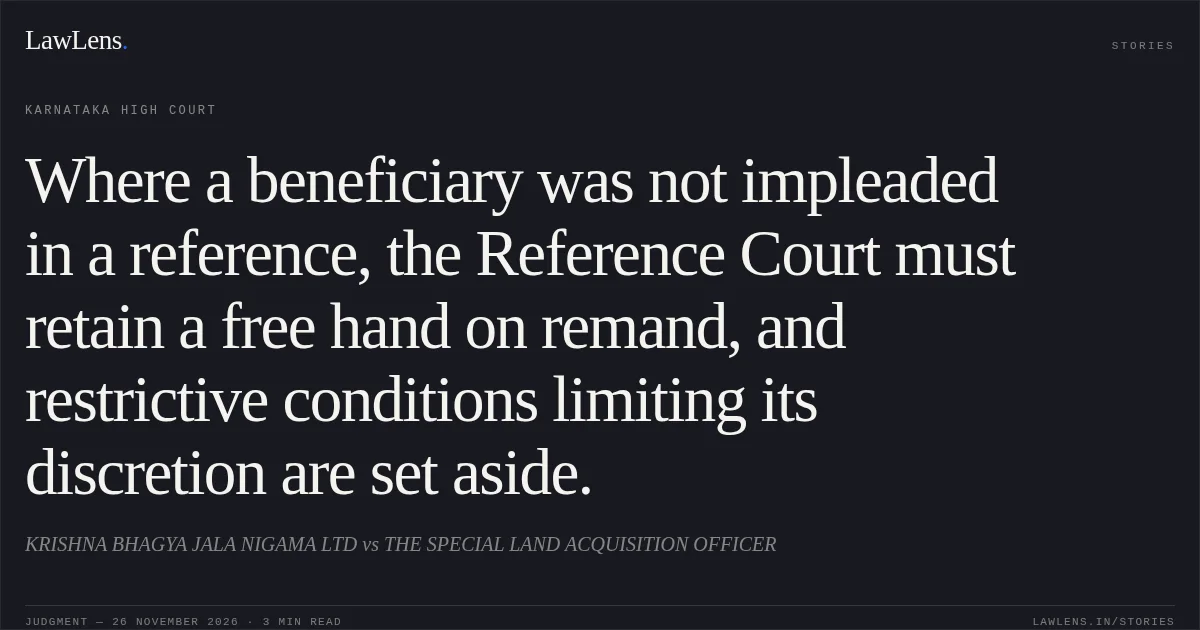
The remand and impleadment directions stand, but the restrictive conditions are not sustainable and are set aside, leaving the Reference Court free to decide the reference in accordance with law.
pp. 8–9 · ¶ 7, following W.A. No. 100475/2026The writ appeal is disposed of in terms of W.A. No. 100590/2026 and connected matters. Parties are to appear before the Reference Court on 16.12.2026, and the Reference Court is directed to issue notice to unserved parties and proceed in accordance with law. Pending I.As. are disposed of.
¶ 7 · ¶ 8Original Court PDF
KRISHNA BHAGYA JALA NIGAMA LTDvsTHE SPECIAL LAND ACQUISITION OFFICER
Click to open original judgment
Original judgment, available to read, download and summarize on LawLens.in