01Facts
The appellant, Krishna Bhagya Jala Nigam Ltd. (KBJNL), is the beneficiary for whose benefit the private respondents' lands were acquired.
¶ 3The appellant was not impleaded in the Reference Court proceedings, which ended in an award.
¶ 3The appellant challenged the award in W.P. No. 108688/2025.
¶ 3On 16.06.2026, the learned Single Judge quashed the award and remanded the matter, imposing conditions (i) to (ix).
¶ 3 · pp. 5–7Conditions (iii) (impleadment of the beneficiary) and the related directions were retained. Conditions (iv) to (ix) covered cross-examination and evidence by the beneficiary, a verification exercise on enhanced compensation paid to similarly placed landowners, deposit of 25% of the award amount, and time limits for disposal.
pp. 5–7The appellant appealed only against conditions 4 to 9.
p. 2 · ¶ 3In connected Writ Appeal No. 100590/2026 and Writ Appeal No. 100503/2026, a Division Bench had already set aside conditions (iv) to (ix), leaving the remand intact.
¶ 4The Division Bench's reasoning in that matter, following W.A. No. 100475/2026 (06.08.2026), is quoted at length.
¶ 4 · pp. 4–10Respondents 3 to 5 (the claimants and bank manager) had not been served.
¶ 2Both counsel sought a similar disposal of the present appeal.
¶ 502Issues
i.1. Whether the learned Single Judge was justified in imposing conditions 4 to 9, which restrict the Reference Court's discretion, where the writ petition raised only the legal ground that the award was passed without the beneficiary being heard.
¶ 4 (quoting WA 100475/2026 · ¶ 7) · p. 8ii.2. Whether the writ appeal could be finally disposed of without issuing notice to the unserved private respondents, in view of the safeguard for the claimants.
¶ 2 · ¶ 4 (quoting para. 2)iii.3. Whether the remand order and the direction to implead the beneficiary should be upheld, with a fixed date for the parties before the Reference Court.
¶ 4 (quoting paras. 8, 12) · ¶ 6–703Law Applied
Section 4 of the Karnataka High Court Act, 1961, under which the writ appeal was filed.
p. 2A Reference Court must be given a free hand to decide the reference in accordance with law. Conditions that restrict the manner in which the Reference Court decides a reference exceed the scope of a writ court's relief where the writ challenge is purely legal.
¶ 4 (quoting W.A. No. 100475/2026 · ¶ 7)A remand order may direct impleadment of a necessary party and fix a timeline for disposal, while directions regulating the Reference Court's evidentiary process and deposit are set aside.
¶ 4 (quoting paras. 8–9, 12)The matter may be finally heard without notice where a safeguard is provided for unserved claimants.
¶ 2 · ¶ 4 (quoting para. 2)Provisions in the judgment · 1 · Linked ones open on LawLens
KARNATAKA HIGH COURT ACT, 1961 Section 4
04Reasoning
The writ petition was founded solely on the legal contention that the award was passed without the beneficiary, which was a necessary party.
¶ 3 · ¶ 4 (quoting para. 7)Once the Single Judge accepted that ground, it was not appropriate to add conditions governing cross-examination, evidence, deposit, and verification of compensation paid to other landowners, because these conditions limited the Reference Court's discretion over how the reference was to be decided.
¶ 4 (quoting para. 7)The Court followed the co-ordinate bench, upholding the quashing of the award and the impleadment direction, but setting aside conditions 4 to 9.
¶ 5 · ¶ 4 (quoting para. 8)Because the same issue was settled in connected appeals and the unserved claimants were protected by the safeguard that the Reference Court would issue notice, the Court declined to await service.
¶ 2 · ¶ 605Holding
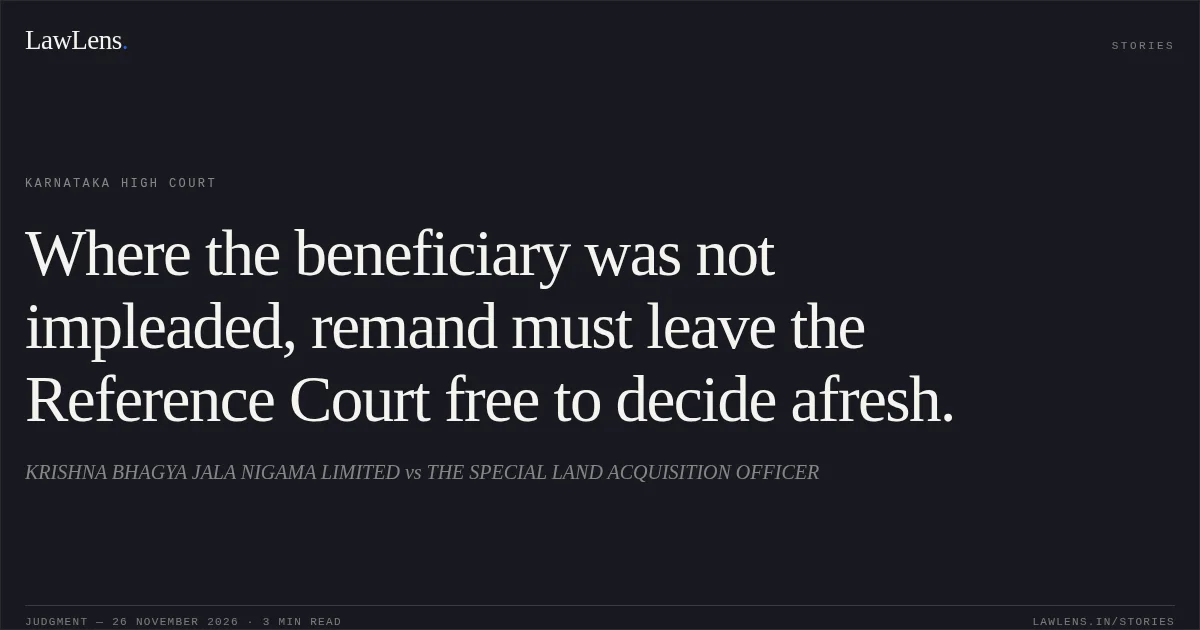
The Reference Court must decide the reference afresh with a free hand, and conditions 4 to 9 of the learned Single Judge's order are not sustainable.
¶ 4 (quoting paras. 7–8, 12(iii)) · ¶ 5–6The remand to the Reference Court, the quashing of the award, and the impleadment of the beneficiary (conditions i to iii) stand. The parties are to appear before the Reference Court on 16.12.2026 without awaiting further notice, and the Reference Court is directed to issue notice to unserved parties and proceed in accordance with law. Pending I.As. stand disposed of. The writ appeal is disposed of in terms of the order in W.A. No. 100590/2026 and connected matters.
¶ 7 · ¶ 8Original Court PDF
KRISHNA BHAGYA JALA NIGAMA LIMITEDvsTHE SPECIAL LAND ACQUISITION OFFICER
Click to open original judgment
Original judgment, available to read, download and summarize on LawLens.in