Facts
The applicant, Pitambar Sahoo, aged about 45 years, has been working as a casual employee (MTS) in the Office of the Principal Commissioner of Income Tax, Sambalpur, since April 1, 1998, for a period of 28 years.
Source reference: p.1-2The respondents did not dispute his continuous service.
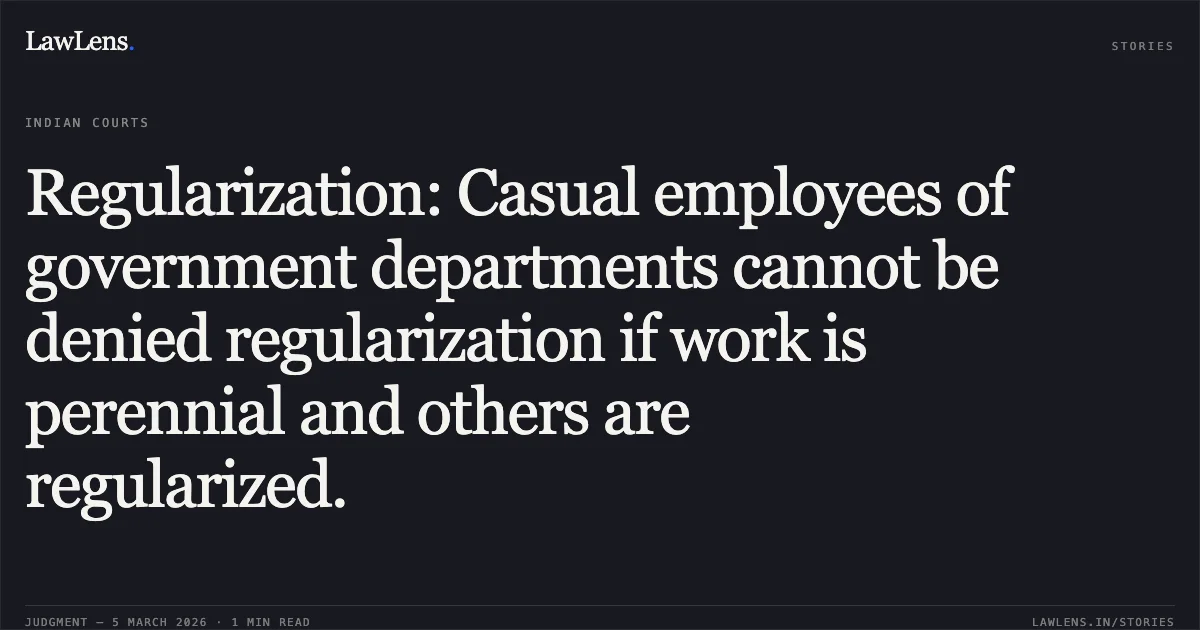
Source reference: p.2The applicant sought regularization of his service and consequential benefits, claiming discrimination as 18 casual workers in Bhubaneswar Commissionerate were regularized on March 4, 2011, and 64 similar casual workers in Lucknow Commissionerate were regularized retrospectively from January 22, 2010, vide order dated February 17, 2025.
Source reference: p.2The respondents contested the application, arguing its non-maintainability before the Central Administrative Tribunal (CAT) as the applicant was not a civil post holder and was not engaged through a selection process or against a sanctioned post.
Source reference: p.2-3They also contended that the applicant did not complete 10 years of continuous engagement as of April 10, 2006, unlike the 18 casual laborers who were regularized.
Source reference: p.3-4Issues
Whether an Original Application filed by a casual employee seeking regularization is maintainable before the Central Administrative Tribunal?
Source reference: p.2-3Whether the applicant, engaged on a casual basis, is entitled to regularization and consequential financial benefits, despite not being engaged through a formal selection process or against a sanctioned post?
Source reference: p.3, p.7Law Applied
The Tribunal primarily relied on Section 14 of the Administrative Tribunals Act, 1985, which grants CAT jurisdiction over service matters, including those of casual employees.
Source reference: p.5It further applied the principle of *stare decisis* and Article 141 of the Indian Constitution, emphasizing that Supreme Court judgments are binding on all courts in India and that similarly situated individuals must be treated alike to prevent discrimination under Article 14 of the Constitution of India.
Source reference: p.19-20Precedents from the Hon’ble Apex Court were extensively cited, including *Deptt. of Telecommunications v. Keshab Deb* (2008 INSC 592) regarding CAT's jurisdiction over casual employees.
Source reference: p.5-6For regularization, the Tribunal relied upon *Jaggo v. Union of India and Others* (2024 SCC OnLine SC 3826), *Dharam Singh & Others Vs. State of U.P & Another* (Civil Appeal No.8558 of 2018), *Shripal and Anr. vrs. Nagar Nigam, Ghaziabad* (2025 SCC OnLine SC 221), *Bhola Nath Vs State of Jharkhand and Ors* (2026 SCC Online SC 129), and *Pawan Kumar Vs Union of India* (2026 INSC 156), which clarified that *Umadevi (Supra)* does not shield against regularization of long-serving employees performing perennial tasks, distinguishing between illegal and irregular appointments.
Source reference: p.7-19These judgments established that long-term "ad hocism" and outsourcing as a proxy for permanent work, denying basic parity, are unsustainable practices.
Source reference: p.8Reasoning
The Tribunal first addressed the maintainability issue by rejecting the respondents' argument, citing *Deptt. of Telecommunications v. Keshab Deb*.
Source reference: p.5-7The Supreme Court in *Keshab Deb* held that under Section 14 of the A.T. Act, 1985, CAT has jurisdiction over service matters, including those of casual employees classified as workmen under the Industrial Disputes Act, 1947.
Source reference: p.5-6The Calcutta High Court, in *Awadhesh Singh –vs- Union of India and others*, affirmed this, stating CAT can entertain cases filed by casual employees seeking regularization in Civil Posts.
Source reference: p.6-7Consequently, the Tribunal overruled the respondents' objection.
Source reference: p.7On the issue of regularization, the Tribunal extensively cited various Supreme Court judgments, including *Jaggo*, *Dharam Singh*, *Shripal*, *Bhola Nath*, and *Pawan Kumar*.
Source reference: p.7-19These rulings unequivocally held that *Umadevi (Supra)* should not be used to deny regularization to employees who have rendered long years of continuous service, performing essential and perennial functions, even if initially engaged irregularly or outsourced.
Source reference: p.8-19The Supreme Court emphasized that the State, as a constitutional employer, cannot perpetuate precarious employment where work is permanent.
Source reference: p.8, p.12It was noted that outsourcing to replace terminated casual workers performing the same tasks highlights the perennial nature of the work.
Source reference: p.16-17The court in *Pawan Kumar* explicitly stated that similarly situated employees cannot be discriminated against, making the *Jaggo* decision applicable to similar cases in Income Tax Department.
Source reference: p.16, p.19Given the applicant's 28 years of uninterrupted service and the regularization of other casual workers in similar roles, the Tribunal found the applicant’s case aligned with these precedents.
Source reference: p.20Holding
The OA is allowed.
The Central Administrative Tribunal (CAT), Cuttack Bench, concludes that the OA filed by the casual employee seeking regularization is maintainable and the applicant is entitled to regularization.
Source reference: p.7, p.20The respondents are directed to issue an order regularizing the applicant and granting him all consequential benefits, strictly in accordance with the law laid down by the Hon’ble Apex Court in *Jaggo*, *Dharam Singh*, *Bhola Nath*, and *Pawan Kumar*.
Source reference: p.20-21This regularization is to be effective from the date other similarly situated casual workers were regularized.
Source reference: p.20The compliance order must be issued within 90 days from the date of receipt of this order.
Source reference: p.21Acts & Sections Cited
2 provisions across 1 statute referred to in this judgment. Each provision opens on LawLens.
Administrative Tribunals Act, 19852
Original Court PDF
Pitambar Sahoo v. Union of India and Others O.A.No. 260/00226 of 2025
Click to open original judgment
Original judgment, available to read, download and summarize on LawLens.in