Facts
The applicant, a former Railway Guard, was removed from service on 30.09.1991 for unauthorized absence of 310 days
Source reference: para. 2, 5His appeal was dismissed as time-barred in 1995, but on revision, the Revisional Authority quashed the removal on 06.03.1997 due to the non-supply of the inquiry report and remitted the matter back to the Disciplinary Authority (DA)
Source reference: para. 2.1, 13The applicant was reinstated on 31.03.1997
Source reference: para. 2.1Although the inquiry report was subsequently served in 1998, the proceedings were never formally concluded
Source reference: para. 2.1In 2007, the applicant was compulsorily retired following fresh disciplinary proceedings for subsequent unauthorized absences
Source reference: para. 2.2, 5.5The applicant approached the Tribunal in O.A. No. 959/2018 seeking service benefits for the period of his initial removal (1991–1997).
Source reference: no citationPursuant to the Tribunal's direction to decide his representation, the respondents issued an undated impugned order (communicated in 2024) treating the 2055-day period (03.10.1991 to 21.05.1997) as Extraordinary Leave (EOL) without pay
Source reference: para. 15, 16Issues
1. Whether the applicant is entitled to full pay, allowances, and the counting of service for the period he was ousted from service due to a removal order that was later quashed on procedural grounds
Source reference: para. 82. Whether the administrative decision to treat the intervening period as Extraordinary Leave (EOL) suffers from arbitrariness or procedural infirmity
Source reference: para. 12.2Law Applied
The Tribunal relied on the principle that judicial review is confined to the decision-making process, not the decision itself, per State of U.P. v. Maharaja Dharmander Prasad Singh (1989)
Source reference: para. 12It further applied the limitations on interfering with disciplinary conclusions established in Union of India v. P. Gunasekaran (2014)
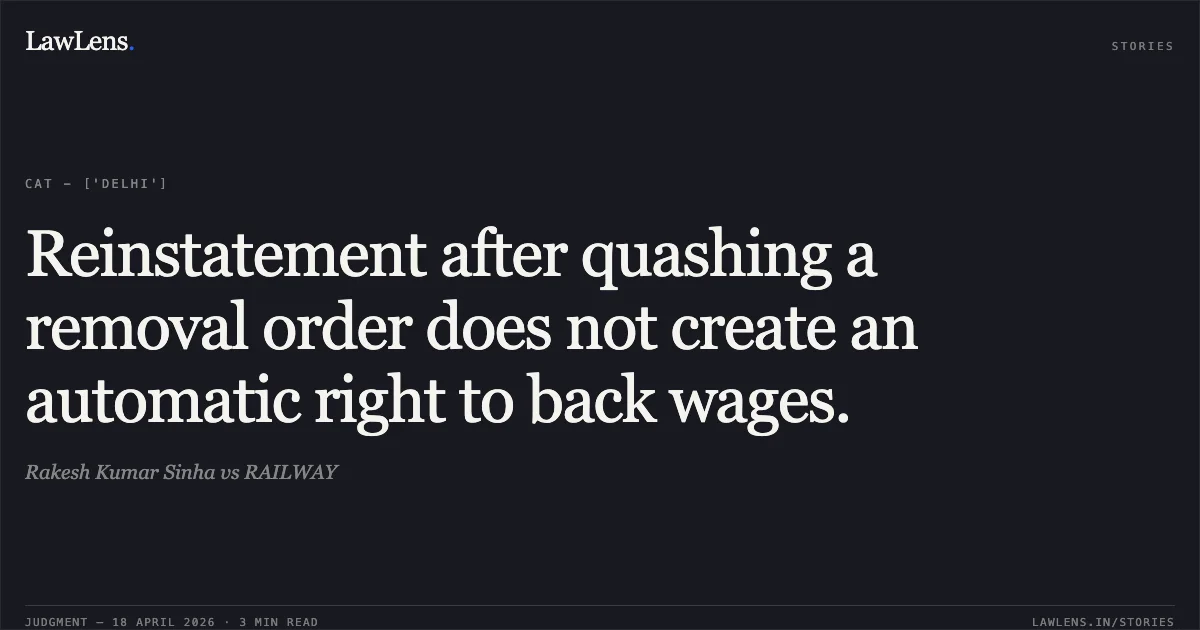
Source reference: para. 12.1Regarding service benefits, the Tribunal cited Managing Director, ECIL v. B. Karunakar (1993), holding that relief following the non-supply of an inquiry report is not automatic
Source reference: para. 12.3State of Kerala v. E. K. Bhaskaran Pillai (2007), which clarified that "no work, no pay" is the general rule and back wages are not a matter of right
Source reference: para. 12.4Statutory authority was drawn from Rule 32 of the CCS (Leave) Rules, 1972, regarding the grant and retrospective commutation of absence into EOL
Source reference: para. 16Reasoning
The Tribunal found that the quashing of the original removal order in 1997 was based purely on a technicality—the non-supply of the inquiry report—rather than an exoneration on the merits of the unauthorized absence
Source reference: para. 13Reviewing the applicant’s original Service Book, the Tribunal noted that the respondents had consciously decided to treat the 2055-day absence as EOL
Source reference: para. 16Under Rule 32(6) of the CCS (Leave) Rules, the competent authority is empowered to retrospectively commute periods of absence into EOL
Source reference: para. 16The Tribunal reasoned that since EOL only counts as qualifying service for pension under specific conditions (e.g., medical reasons or scientific studies), and the applicant met none of these, the period could not be counted for increments or pension
Source reference: para. 17, 17.1Applying the "no work, no pay" doctrine, the Tribunal concluded that the applicant failed to prove the decision was arbitrary, as the respondents exercised their discretion within the statutory framework of leave rules
Source reference: para. 12.2, 18Holding
The Tribunal dismissed the O.A., holding that the applicant was not entitled to back wages or service benefits for the period in question
The court held that the respondents’ decision to treat the 2055-day period as Extraordinary Leave (EOL) was a valid exercise of administrative discretion under the CCS (Leave) Rules and did not warrant judicial interference
Source reference: para. 16, 18No order as to costs was made
Source reference: para. 21Acts & Sections Cited
2 provisions across 2 statutes referred to in this judgment. Each provision opens on LawLens.
Administrative Tribunals Act, 19851
Indian Contract Act, 18721
Original Court PDF
Rakesh Kumar SinhavsRAILWAY
Click to open original judgment
Original judgment, available to read, download and summarize on LawLens.in