Facts
The Municipal Corporation of Greater Mumbai (“MCGM”) invited bids in January 1997 for the supply, erection and commissioning of 130 low-speed floating aerators at the Bhandup and Ghatkopar lagoons. M/s Hubert B.V. was the lowest bidder, while Gammon India Limited (“GIL”) was the second-lowest bidder. MCGM initially accepted GIL’s bid on 11 June 1998, although Hubert B.V.’s bid was less than 50% of GIL’s bid. Hubert B.V. challenged the award before the Bombay High Court. Pursuant to the Court’s order, an independent consultant found Hubert B.V.’s bid acceptable, following which MCGM agreed to award the contract to Hubert B.V. and subsequently terminated GIL’s contract by letter dated 6 September 1999
Source reference: pp. 3–4; paras. 5–6GIL raised several claims before the Arbitral Tribunal, including costs of tendering, staff and establishment expenses, design fees, loss of profits, bank-guarantee charges and interest. The Tribunal rejected Claims 1, 5, 6 and 8, but allowed Claims 4 and 12, awarding Rs. 15,09,515 with interest at 9% per annum from 6 September 1999
Source reference: pp. 4–6; para. 4GIL filed Arbitration Petition No. 481 of 2006 challenging the rejection of Claims 1, 5, 6 and 8, while MCGM filed Arbitration Petition No. 463 of 2006 challenging the grant of Claims 4 and 12
Source reference: pp. 2–3; paras. 2–4Issues
Whether the Arbitral Tribunal’s rejection of GIL’s Claims 1, 5, 6 and 8 disclosed patent illegality or otherwise warranted interference under Section 34 of the Arbitration and Conciliation Act, 1996?
Source reference: pp. 9–15; para. 9Whether the Tribunal was justified in rejecting the claim for loss of profits after finding that MCGM was responsible for awarding the contract to GIL and that GIL was not at fault?
Source reference: pp. 10–15; para. 9(c)Whether the Tribunal’s award of bank-guarantee charges under Claim 4 and interest under Claim 12 was liable to be set aside under Section 34?
Source reference: pp. 15–16; para. 9(e)–(f)Whether the Court could partially set aside the Arbitral Award in respect of an individual and severable claim?
Source reference: pp. 16–18; paras. 10–11Law Applied
The Court applied Section 34 of the Arbitration and Conciliation Act, 1996, in its pre-2015-amendment form, under which an arbitral award could be set aside for, inter alia, patent illegality.
Source reference: pp. 12–14; para. 9(c)Relying on Associate Builders v. Delhi Development Authority, the Court held that an award may be interfered with where it is based on no evidence, ignores vital evidence, considers irrelevant material, or adopts an interpretation of the contract that no fair-minded or reasonable person could adopt; however, the Court cannot act as an appellate court or reassess factual findings
Source reference: pp. 12–14; para. 9(c)The Court further relied on Gayatri Balasamy v. ISG Novasoft Technologies Limited for the principle that an award may be set aside in part where the valid and invalid portions are legally and practically severable
Source reference: pp. 16–17; para. 10Relying on National Highways Authority of India v. Trichy Thanjavur Expressway Ltd., the Court held that separate claims arising from the same contract may constitute independent, self-contained determinations capable of surviving independently
Source reference: pp. 17–18; para. 11Reasoning
The Court upheld the Tribunal’s rejection of Claims 1, 5 and 6.
Source reference: no citationClaim 1 was governed by the contractual clause requiring bidders to bear the costs of preparing and submitting bids irrespective of the outcome; the Tribunal’s interpretation of that clause was a permissible contractual interpretation and disclosed no patent illegality
Source reference: p. 9; para. 9(a)Claim 5 involved staff salaries, travel and establishment expenses, and the Tribunal’s factual finding that the relevant staff was already employed elsewhere could not be reappreciated under Section 34
Source reference: p. 10; para. 9(b)Claim 6 was rightly rejected because GIL had not paid the design fees claimed from M/s Smith and Loveless
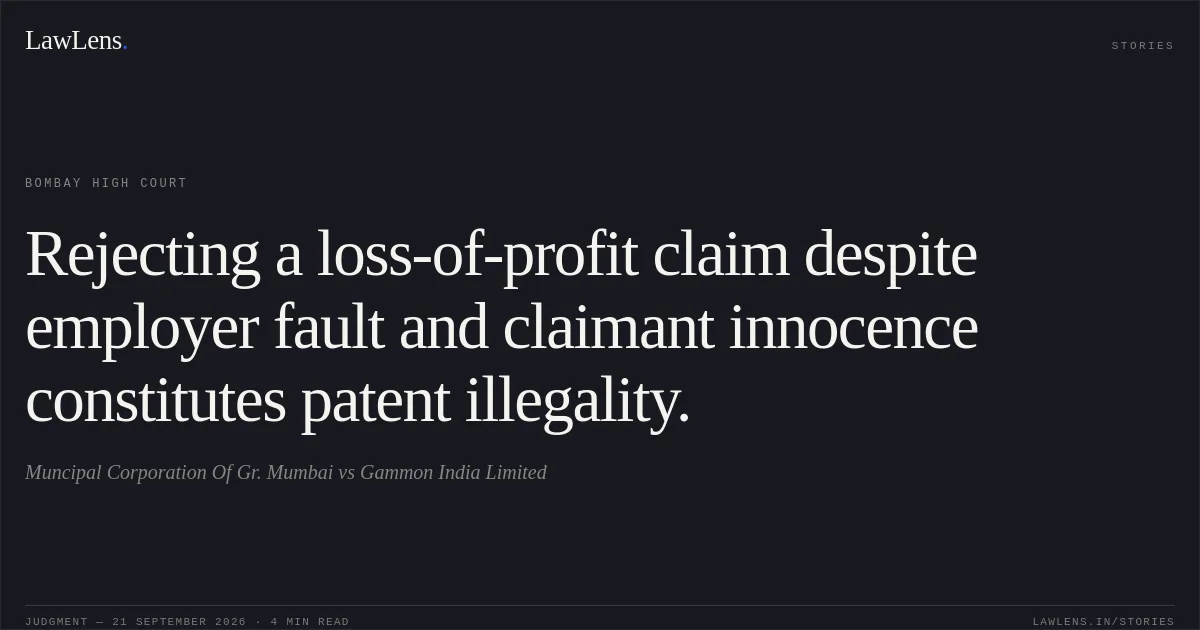
Source reference: p. 15; para. 9(d)However, the rejection of Claim 8 was inconsistent with the Tribunal’s own findings.
Source reference: pp. 10–15; para. 9(c)The Tribunal had held that MCGM was responsible for awarding the contract to GIL, that GIL had committed no wrongdoing, and that termination followed from circumstances attributable to MCGM.
Source reference: pp. 10–15; para. 9(c)Having reached those findings, the Tribunal could not reject the entire loss-of-profit claim merely because the claimed percentage appeared excessive or because the precise quantum had not been established.
Source reference: pp. 10–15; para. 9(c)The proper course was to determine the extent, if any, of the recoverable loss.
Source reference: pp. 10–15; para. 9(c)The complete rejection of the claim therefore amounted to patent illegality
Source reference: pp. 10–15; para. 9(c)As to Claims 4 and 12, the Court found no error in awarding the normal bank-guarantee charges despite the absence of bank receipts.
Source reference: pp. 15–16; para. 9(e)–(f)The Tribunal considered the claimed rates reasonable and awarded the corresponding interest under Claim 12.
Source reference: pp. 15–16; para. 9(e)–(f)These determinations were not shown to be perverse or patently illegal
Source reference: pp. 15–16; para. 9(e)–(f)Since Claim 8 was distinct and severable from the other claims, it could be set aside without disturbing the valid portions of the Award
Source reference: pp. 16–18; paras. 10–11Holding
Arbitration Petition No. 463 of 2006 filed by MCGM was dismissed, and the awards under Claims 4 and 12 were maintained
Arbitration Petition No. 481 of 2006 filed by GIL was partly allowed: the rejection of Claim 8 was set aside for patent illegality, while the rejection of Claims 1, 5 and 6 was upheld
Source reference: pp. 14–15, 18; para. 12The Court did not quantify or directly award loss of profits; it stated that GIL could pursue such remedies as were available in law concerning Claim 8
Source reference: p. 18; para. 12MCGM’s request for a stay was refused in both petitions
Source reference: p. 19; para. 13Acts & Sections Cited
3 provisions across 1 statute referred to in this judgment. Each provision opens on LawLens.
Arbitration and Conciliation Act, 19963
Original Court PDF
Muncipal Corporation Of Gr. MumbaivsGammon India Limited
Click to open original judgment
Original judgment, available to read, download and summarize on LawLens.in