Facts
The respondents applied under Order VII Rule 11 of the Code of Civil Procedure, 1908 (CPC), seeking rejection of the petitioner’s plaint.
Source reference: para. 4.2The trial court rejected their application. The respondents challenged that order in Misc. Civil Appeal No. 26 of 2022, and the appellate court passed the order challenged in this Article 227 petition.
Source reference: para. 4.2The High Court found that the trial court had neither rejected the plaint nor passed a decree when it refused the application.
Source reference: para. 10.1Issues
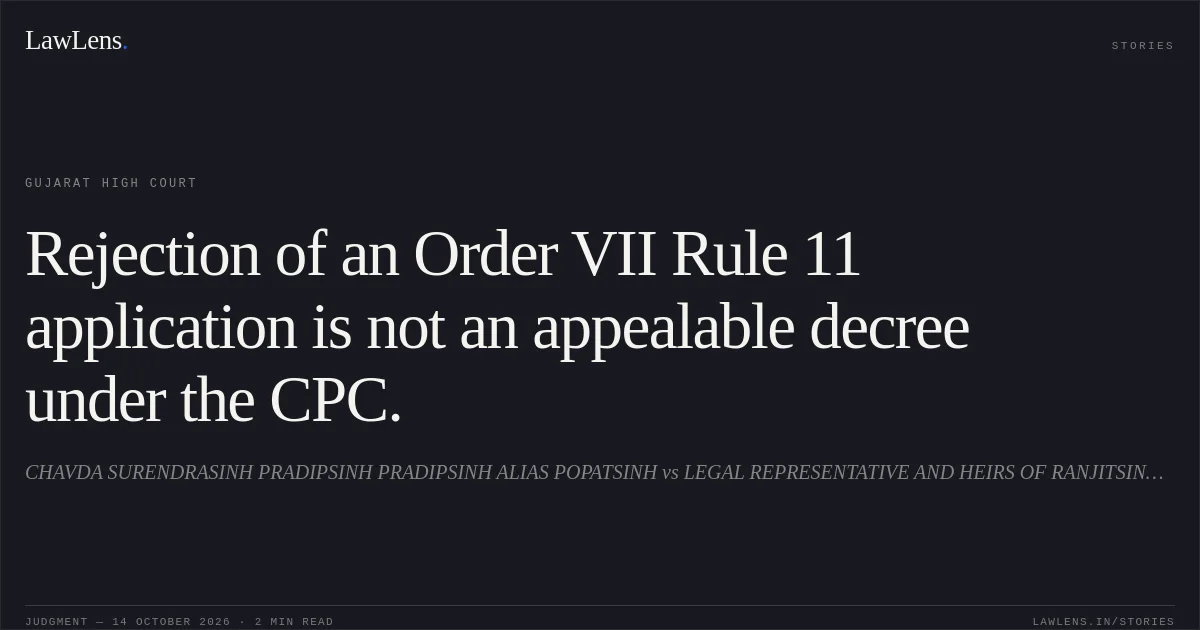
Whether an order rejecting an application under Order VII Rule 11 CPC is appealable, such that the appellate court had jurisdiction to hear the respondents’ appeal.
Source reference: paras. 10.1–10.3Whether the availability of a statutory appeal against the appellate court’s order precluded the High Court from exercising its jurisdiction under Article 227 where that order was passed without jurisdiction.
Source reference: paras. 11–12Law Applied
Section 2(2) CPC defines a decree to include rejection of a plaint. An order allowing an Order VII Rule 11 application and rejecting the plaint is therefore appealable; an order refusing such an application does not itself amount to a decree and is not appealable on that basis.
Source reference: para. 10.2Under Article 227 of the Constitution, the High Court may intervene where a court has acted without jurisdiction; the existence of an alternative remedy does not, by itself, bar that intervention in such circumstances. The Court cited Whirlpool Corporation v. Registrar of Trade Marks, Mumbai & Ors., (1998) 8 SCC 1, and PHR Invent Educational Society v. UCO Bank and Others, (2024) 6 SCC 579, in support of the alternative-remedy principle.
Source reference: para. 12Reasoning
The appeal before the District Court challenged the trial court’s refusal to reject the plaint. Because that refusal neither rejected the plaint nor resulted in a decree under Section 2(2) CPC, the High Court held that no appeal lay and the appellate court lacked jurisdiction to entertain it.
Source reference: paras. 10.1–10.3Since the impugned order was jurisdictionally invalid, the petitioner’s potential remedy by way of second appeal did not prevent the High Court from exercising its supervisory jurisdiction under Article 227.
Source reference: paras. 11–13Holding
The High Court held that Misc. Civil Appeal No. 26 of 2022 was not maintainable and that the appellate court’s order was without jurisdiction.
It allowed the petition, quashed and set aside the order dated 26 September 2025, made the rule absolute to that extent, and disposed of the connected civil application as not surviving. No order as to costs was made.
Source reference: paras. 15–16Acts & Sections Cited
2 provisions across 1 statute referred to in this judgment. Each provision opens on LawLens.
Code of Civil Procedure, 19082
Original Court PDF
CHAVDA SURENDRASINH PRADIPSINH PRADIPSINH ALIAS POPATSINHvsLEGAL REPRESENTATIVE AND HEIRS OF RANJITSINH BALDEVSINH
Click to open original judgment
Original judgment, available to read, download and summarize on LawLens.in