01Facts
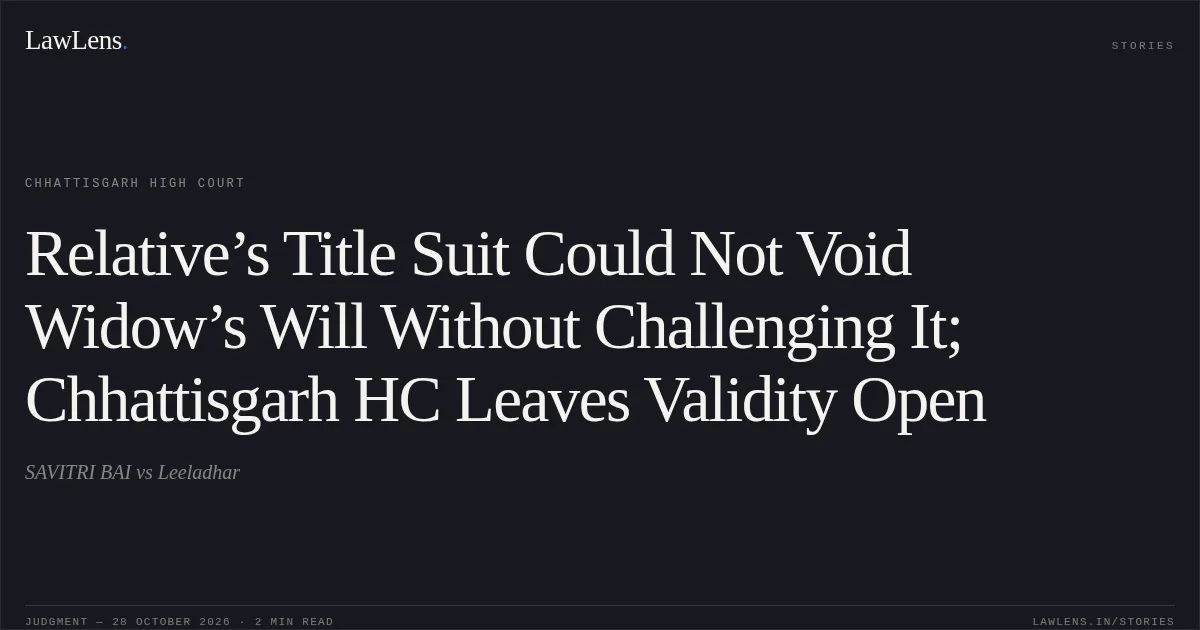
The dispute concerned land claimed by Pyare Lal as successor to Kanti Bai, widow of Gangdev, who died issueless.
¶ 3–7, 13–16Defendant Leeladhar claimed the property as Kanti Bai’s adopted son under a registered adoption deed and as beneficiary under her Will dated 2 July 1995.
¶ 3–7, 13–16The plaintiff sought, among other reliefs, a declaration of title and a declaration that the adoption deed was void, but did not plead or seek relief concerning the Will.
¶ 3–7, 13–16The Trial Court did not grant the title relief, but declared both the adoption deed and the Will null and void.
¶ 3–7, 13–16The First Appellate Court set aside the Trial Court’s finding concerning the Will.
¶ 3–7, 13–16The plaintiffs appealed under Section 100 CPC.
¶ 3–7, 13–1602Issues
i.1. Whether the First Appellate Court’s decision that the Will could not be declared null and void in the absence of a claim for its cancellation was perverse
¶ 16ii.2. Whether the Will’s due execution, attestation and validity were proved by its propounder in accordance with Section 68 of the Indian Evidence Act, 1872
¶ 1603Law Applied
Order VII Rule 7 CPC requires the relief claimed to be specifically stated, though a court may grant unclaimed relief where it is incidental or connected to the principal relief and is just and proper; it cannot grant relief beyond the claim
¶ 31–32 · Bachhaj Nahar v. Nilima Mandal, cited at para. 19 · Rajendra Tiwary v. Basudeo Prasad, cited at para. 30A Will must be proved in accordance with Section 63 of the Indian Succession Act, 1925, read with Section 68 of the Indian Evidence Act, 1872
¶ 26The Court also referred to Bachhaj Nahar and Rajendra Tiwary on the scope of unclaimed relief, and to authorities including Dhani Ram v. Shiv Singh, B. Venkatamuni v. C.J. Ayodhya Ram Singh, S.R. Srinivasa v. S. Padmavathamma and Madhukar D. Shende v. Tarabai Aba Shedage concerning proof of Wills
¶ 20–26Provisions in the judgment · 2 · Linked ones open on LawLens
Code of Civil Procedure, 1908 Section 100
Indian Succession Act, 1925 Section 63
04Reasoning
The Will was not mentioned in the plaint, and the plaintiff sought no relief in respect of it.
¶ 27–36Moreover, the Trial Court had not granted the principal relief of declaration of title; its declaration invalidating the Will therefore went beyond the relief claimed.
¶ 27–36The Trial Court also did not examine whether, if Kanti Bai died intestate, other persons might have been entitled to succeed to the property.
¶ 27–36The First Appellate Court was therefore justified in setting aside the finding that the Will was null and void.
¶ 27–36The High Court did not decide whether the Will was duly executed or proved under Sections 63 and 68, because a separate suit concerning the Will was pending before the First District Judge, Balod.
¶ 3705Holding
The Court answered the first issue against the appellants and upheld the First Appellate Court’s decision setting aside the Trial Court’s finding concerning the Will.
¶ 36–40It left the question of the Will’s due execution and proof open for determination in the pending separate suit.
¶ 36–40The second appeal was dismissed with costs, and the First Appellate Court’s judgment and decree were affirmed.
¶ 36–40Original Court PDF
SAVITRI BAIvsLeeladhar
Click to open original judgment
Original judgment, available to read, download and summarize on LawLens.in