Facts
The appellants, belonging to reserved categories, participated in the Teachers Aptitude and Intelligence Test, 2022 (TAIT) for teacher recruitment in Maharashtra
Source reference: para. 2To be eligible for TAIT, candidates had to pass the Teacher Eligibility Test (TET). Per NCTE guidelines and State Government Resolutions (GRs) dated 13.02.2013 and 23.08.2013, general category candidates required 60% to pass TET, while reserved category candidates were granted a 5% relaxation (55% qualifying mark)
Source reference: paras. 20-22Although the appellants secured higher marks in the TAIT examination than the last selected general category candidate, they were excluded from the open/unreserved merit list dated 25.02.2024
Source reference: para. 7The State justified this exclusion based on a communication dated 25.02.2024, asserting that candidates who availed relaxation in the qualifying TET could not migrate to the open category
Source reference: para. 25-26The High Court of Bombay dismissed the appellants' writ petitions, relying on Government of NCT of Delhi v. Pradeep Kumar (2019) to hold that such migration would confer an unfair advantage
Source reference: para. 9Issues
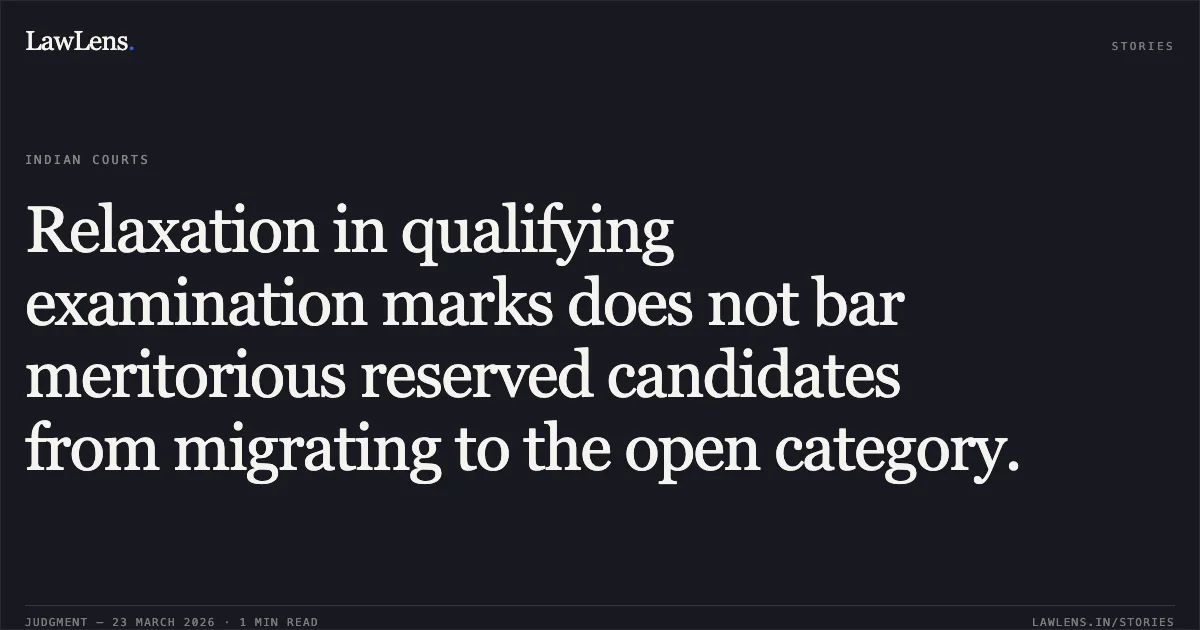
Whether reserved category candidates who avail of relaxation in a qualifying examination (TET) to become eligible for the main selection process (TAIT) are entitled to migrate to the open/unreserved category based on merit secured in the main examination.
Source reference: para. 4Law Applied
The Court applied the principle that relaxation in a qualifying examination merely enables entry into the "zone of consideration" and does not affect inter se merit in the final selection, as established in Jitendra Kumar Singh v. State of U.P.
Source reference: para. 13Relaxation in a qualifying examination merely enables entry into the "zone of consideration" and does not affect inter se merit in the final selection, as established in Vikas Sankhala v. Vikas Kumar Agarwal.
Source reference: para. 14The Court further clarified that migration is permissible unless expressly prohibited by Recruitment Rules or employment notifications
Source reference: para. 19The Court distinguished Government of NCT of Delhi v. Pradeep Kumar, noting it applies only where candidates fail to fulfill essential eligibility criteria
Source reference: para. 15, 30The Court also referenced Union of India v. Sajib Roy, which holds that migration depends on the specific statutory scheme or the silence thereof
Source reference: para. 16Reasoning
The Court reasoned that TET is a mandatory prerequisite/eligibility test, whereas TAIT is the competitive examination used to determine final merit
Source reference: paras. 23-24Under Clause 9 of the NCTE guidelines, states are expressly permitted to grant concessions in TET scores
Source reference: para. 20The Court observed that the 5% relaxation in TET merely created a "level playing field" by allowing reserved candidates to compete in the main TAIT examination, where no relaxation was granted and all candidates were evaluated on uniform standards
Source reference: para. 28The Court found the High Court’s reliance on Pradeep Kumar misplaced; in that case, candidates were ineligible because they lacked valid OBC certificates for the specific territory and failed the general qualifying standard, whereas here, the relaxation was a valid part of the eligibility framework
Source reference: para. 30-31Since the recruitment notification for TAIT-2022 did not expressly prohibit migration, and the appellants were more meritorious in the final exam, their exclusion was deemed unlawful
Source reference: para. 32Holding
The Court held that in the absence of an express statutory bar, reserved category candidates who qualify for the main examination via relaxed eligibility standards are entitled to migrate to the general category if their final merit score is higher than the last selected general candidate
The Supreme Court allowed the appeals and quashed the High Court judgment dated 14.02.2025
Source reference: para. 33The respondents were directed to include the appellants (and impleaded petitioners with identical claims) in the merit list based on their higher marks
Source reference: para. 33-35Acts & Sections Cited
2 provisions across 1 statute referred to in this judgment. Each provision opens on LawLens.
Right of Children to Free and Compulsory Education Act, 20092
Original Court PDF
ChayavsThe State Of Maharashtra
Click to open original judgment
Original judgment, available to read, download and summarize on LawLens.in