Facts
The deceased, Sujata, married Sunil Kumar (Appellant 2) on 22.11.2010. Within one and a half years of marriage, she was allegedly subjected to harassment and physical abuse for additional dowry (motorcycle and fan) by her husband and in-laws, Ram Rati (Appellant 1, mother-in-law) and Babulal (Appellant 3, father-in-law).
Source reference: p. 2-3On 13.05.2012, Sujata sustained 90% burn injuries and was admitted to Civil Hospital, Lucknow.
Source reference: p. 3, 12Her dying declaration (Ex. Ka-12) was recorded by an Executive Magistrate on the same day, wherein she specificially alleged that Ram Rati poured kerosene on her and set her ablaze following an assault by all three appellants.
Source reference: p. 15-16Sujata succumbed to septicemia resulting from the burns on 04.06.2012.
Source reference: p. 4, 12The trial court convicted the appellants under Sections 498-A, 304-B IPC, and Section 3/4 of the Dowry Prohibition Act, sentencing Ram Rati to life imprisonment and the others to 20 years rigorous imprisonment.
Source reference: p. 2Issues
1. Whether the prosecution proved the ingredients of "dowry death" under Section 304-B IPC and whether the dying declaration (Ex. Ka-12) was reliable enough to form the sole basis of conviction.
Source reference: para 42, 57, 1022. Whether the cause of death (septicemia) being a delayed complication of burn injuries breaks the causal link between the appellants' acts and the victim's death.
Source reference: para 88-893. Whether the sentences of life imprisonment and 20 years rigorous imprisonment were proportionate to the nature of the offence and individual culpability.
Source reference: para 115, 122Law Applied
Section 304-B (Dowry Death) and Section 498-A (Cruelty) of the IPC, alongside the mandatory presumption under Section 113-B of the Indian Evidence Act regarding dowry deaths occurring within seven years of marriage.
Source reference: para 42, 52The principles in Kushal Rao v. State of Bombay and Laxman v. State of Maharashtra, which establish that a voluntary, truthful declaration recorded by a Magistrate with a medical fitness certificate can be the sole basis for conviction without corroboration.
Source reference: para 56-57, 93The "Theory of Causation" as applied in Maniklal Sahu v. State of Chhattisgarh, holding that septicemia resulting from fatal burns does not absolve the accused.
Source reference: para 88-89The principles in Union of India v. V. Sriharan and Hariom v. State of Haryana, affirming the High Court’s power to commute life sentences to fixed terms in non-"rare" 304-B cases.
Source reference: para 118, 120Reasoning
The Court found that the prosecution successfully established all four ingredients of Section 304-B: the death occurred within seven years of marriage, was caused by burns (non-normal), and evidence from PW-1 and PW-3 proved harassment for dowry "soon before death".
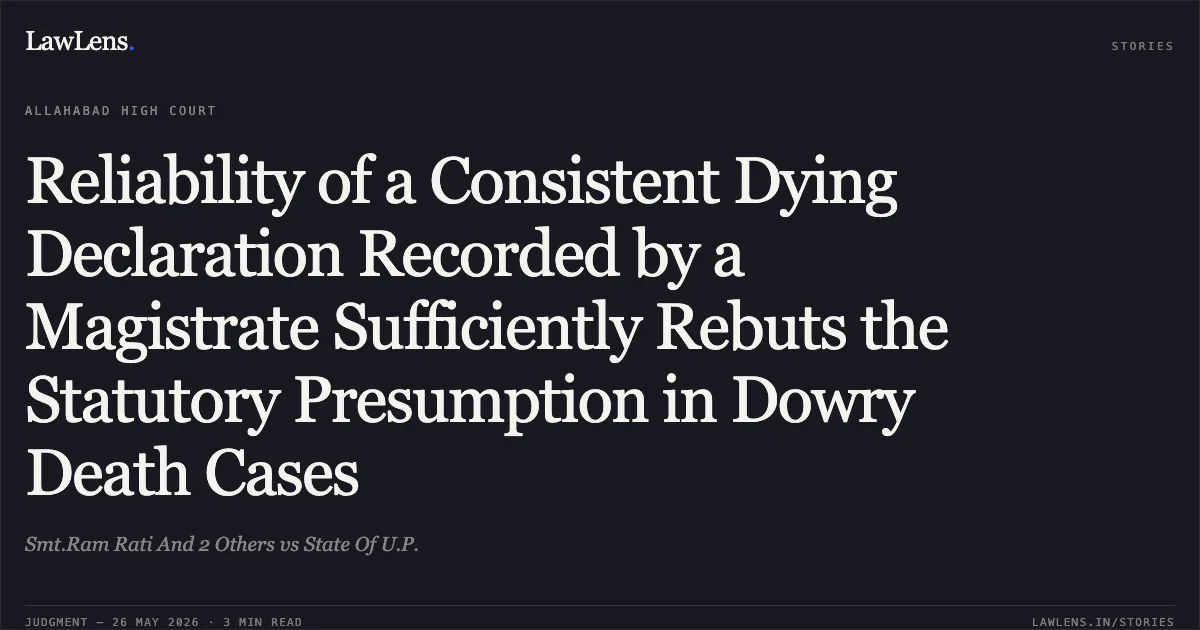
Source reference: para 45, 59, 103The dying declaration (Ex. Ka-12) was deemed highly reliable as it was recorded by an independent Executive Magistrate (PW-9) following a fitness certification by a doctor (PW-4); the court noted that the deceased was "fully conscious and oriented" at the time.
Source reference: para 32-34, 102The court rejected the defense's "delayed death" argument, ruling that 90% burns create a direct causal sequence to septicemia and death.
Source reference: para 90While the conviction was upheld based on the failue of the appellants to rebut the statutory presumption under Section 113-B, the court scrutinized the sentencing, observing that the trial court provided no reasons for awarding the maximum penalty and noted that 304-B cases should only attract life imprisonment in the "rarest" instances.
Source reference: para 104, 114, 118, 122Holding
The Court dismissed the appeal regarding the conviction, affirming the guilt of all appellants under Sections 498-A, 304-B IPC, and 3/4 DP Act.
The Court allowed the appeal on the point of sentencing. Applying the principle of proportionality, the Court commuted Ram Rati’s life sentence to the period already undergone (approx. 15 years) and reduced the 20-year sentences of Sunil Kumar and Babulal to the periods already undergone (approx. 10 and 9 years respectively).
Source reference: para 125, 126-127Acts & Sections Cited
15 provisions across 3 statutes referred to in this judgment. Each provision opens on LawLens.
Indian Penal Code, 18607
Code of Criminal Procedure, 19735
Original Court PDF
Smt.Ram Rati And 2 OthersvsState Of U.P.
Click to open original judgment
Original judgment, available to read, download and summarize on LawLens.in