Facts
The petitioner is a life convict who had completed 19 years, 6 months, and 1 day of actual imprisonment and 25 years, 11 months, and 29 days including remission as of April 2025.
Source reference: p.4Seeking premature release under Sections 432, 433, and 433-A of the Cr.P.C. and the Assam Government’s Office Memorandum (OM) dated 06.10.2015, the petitioner moved the court due to administrative delays.
Source reference: p.4During pendency, the State produced minutes from a State Level Review Board meeting held on 19.03.2026, which revealed a "wholesale" rejection of several proposals.
Source reference: p.5The Board had decided to only recommend "exceptional cases" such as terminal illness, effectively ignoring the petitioner’s individual conduct and reports.
Source reference: p.5-6Issues
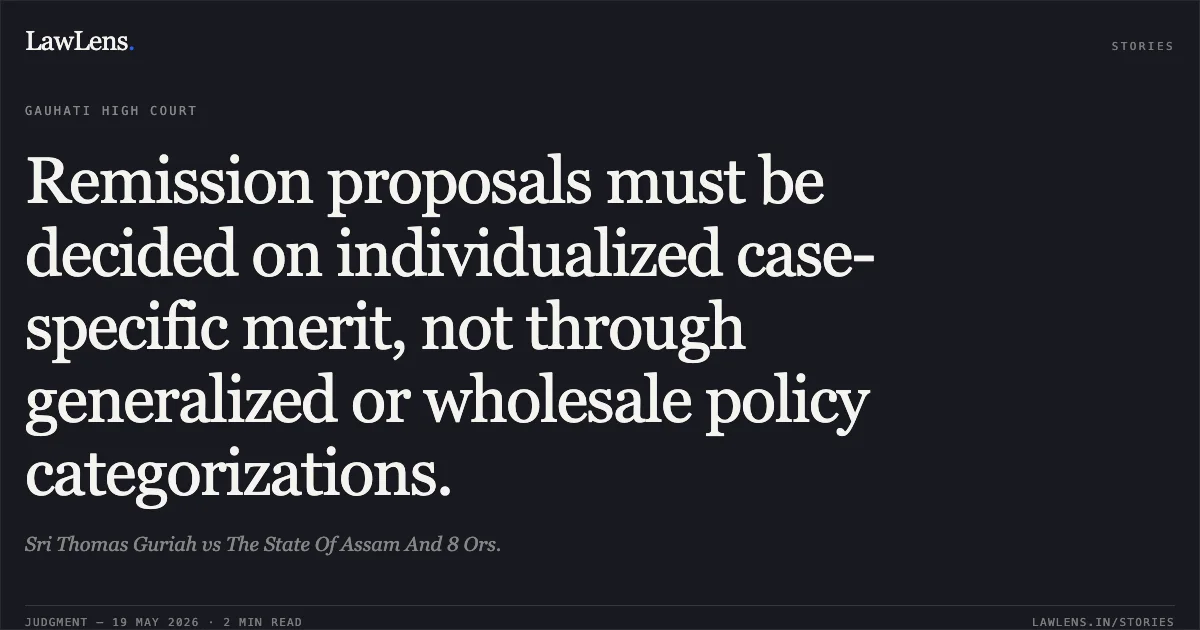
1. Whether the State Level Review Board's generalized/wholesale rejection of remission proposals, without individualized assessment, is legally sustainable.
Source reference: p.6, 122. Whether a convict has a legitimate expectation for fair and reasoned consideration of remission based on existing State policies.
Source reference: p.11Law Applied
Sections 432, 433, and 433-A of the Cr.P.C. and Article 161 of the Constitution.
Source reference: p.7Assam Government Office Memorandum dated 06.10.2015, specifically Clause-8, which mandates that remission proposals must be decided "case-by-case on merit" and not in a "wholesale manner".
Source reference: p.9Bilkis Yakub Rasool v. Union of India (2024) regarding the necessity of delineated reasons for grant or refusal.
Source reference: p.12Dwarka Nath v. ITO (1966) regarding the wide powers of a Writ Court to remedy injustice regardless of procedural technicalities.
Source reference: p.13-14Reasoning
The court found that the Review Board failed to exercise its jurisdiction correctly by adopting a "wholesale approach" rather than an individualized assessment.
Source reference: p.6Although the petitioner had earned significant remission (1830 days) and maintained satisfactory conduct, the Board's minutes showed no specific discussion of his case.
Source reference: p.11The Board unilaterally restricted remissions to "exceptional categories" (e.g., cancer patients), which the court held was a misconstruction of the 2015 OM.
Source reference: p.10The court reasoned that as long as the 2015 OM is operative, the State cannot ignore its own identifiable parameters.
Source reference: p.11The lack of recorded reasons in the rejection order violated the "live link" between material facts and legal conclusions, rendering the process arbitrary and a violation of Articles 14 and 21.
Source reference: p.11-12Holding
The court allowed the petition in part, holding that the petitioner’s claim for remission did not receive a fair or reasoned individualized consideration.
The court directed the respondent authorities to reconsider the petitioner's case afresh and independently, strictly per the 2015 OM and uninfluenced by the Board's generalized observations, within three months.
Source reference: p.14Acts & Sections Cited
3 provisions across 2 statutes referred to in this judgment. Each provision opens on LawLens.
Code of Criminal Procedure, 19732
Bharatiya Nagarik Suraksha Sanhita, 20231
Original Court PDF
Sri Thomas GuriahvsThe State Of Assam And 8 Ors.
Click to open original judgment
Original judgment, available to read, download and summarize on LawLens.in