01Facts
The petitioner, a Constable (GD) in the 58th Battalion of the CRPF, was found absent from the Unit Headquarters on 13 May 2014 and remained unauthorisedly absent for 68 days, from 14 May to 20 July 2014.
p. 3 · ¶ 4–5An FIR and proceedings for issuance of a warrant of arrest were initiated against him.
p. 3 · ¶ 4A departmental charge memorandum dated 9 September 2014 alleged desertion, prolonged unauthorised absence, and disobedience of lawful orders under Section 11(1) of the CRPF Act, 1949.
p. 5 · ¶ 10–11The petitioner pleaded guilty to both charges, but the Enquiry Officer nevertheless recorded evidence and afforded him an opportunity to cross-examine witnesses and present a defence.
p. 6 · ¶ 13During the enquiry, the petitioner committed further periods of unauthorised absence—43 days from 13 September to 26 October 2014 and 17 days from 5 to 21 December 2014.
pp. 6–7 · ¶ 14–15The charges were held proved, and the disciplinary authority removed him from service with immediate effect on 4 March 2015.
p. 7 · ¶ 16His statutory appeal and revision were rejected on 13 May 2015 and 13 November 2015, respectively.
p. 7 · ¶ 17Before the High Court, the petitioner did not challenge the enquiry procedure or allege denial of natural justice; he challenged only the proportionality of the punishment.
pp. 7–8 · ¶ 1802Issues
i.1. Whether the punishment of removal from service imposed upon the petitioner for desertion, repeated unauthorised absence, and disobedience of lawful orders was so disproportionate to the proved misconduct as to warrant interference under Article 226 of the Constitution.
pp. 7–8 · ¶ 18–19ii.2. Whether the disciplinary, appellate, and revisional authorities acted perversely or irrationally in concluding that the petitioner was unfit to be retained in the CRPF.
pp. 10–11 · ¶ 28–3203Law Applied
The Court applied Article 226 of the Constitution, holding that judicial review does not ordinarily extend to reappreciation of disciplinary findings or substitution of the Court’s view on punishment, unless the penalty is so disproportionate that it shocks the Court’s conscience.
pp. 7–8 · ¶ 19, 29Section 11(1) of the CRPF Act, 1949, read with Rule 27 of the CRPF Rules, 1955, authorises disciplinary action and permits the imposition of removal from service.
p. 5 · ¶ 11 · p. 10 · ¶ 28Section 10 treats absence without leave or without sufficient cause as a less heinous offence, while Section 9(f) recognises desertion by a member of the Force on active duty as a heinous offence.
pp. 8–10 · ¶ 20, 27Relying on Union of India v. Ghulam Mohd. Bhat, (2005) 13 SCC 288, State of U.P. v. Ashok Kumar Singh, (1996) 1 SCC 302, Mithilesh Singh v. Union of India, (2003) 3 SCC 309, and Union of India v. P. Gunasekaran, (2015) 2 SCC 610, the Court reiterated that indiscipline by members of an armed or disciplined force must be dealt with sternly and that punishment may be interfered with only where it is outrageously or shockingly disproportionate.
p. 8 · ¶ 20–21 · p. 10 · ¶ 29Provisions in the judgment · 3 · Linked ones open on LawLens
Central Reserve Police Force Act, 1949 Section 11Section 10Section 9
04Reasoning
The Court found that the misconduct was not an isolated instance of absence but comprised an initial 68-day desertion, a further 43-day absence during the disciplinary proceedings, and another 17-day absence after leave, coupled with failure to obey directions to report for duty.
pp. 8–9 · ¶ 22–23The petitioner had also pleaded guilty to both charges, and his explanations based on personal and family circumstances were considered but found insufficient.
p. 9 · ¶ 24Given the CRPF’s status as an armed force, the Court held that discipline, obedience to lawful orders, and availability for duty were fundamental requirements, making prolonged and repeated absence particularly grave.
p. 9 · ¶ 26Although the petitioner was at an early stage of service, that circumstance could not mitigate the repeated nature of his misconduct and continued disregard of discipline.
p. 9 · ¶ 25Since removal was statutorily permissible, the enquiry was procedurally fair, and the authorities had considered the petitioner’s defence and relevant circumstances, the punishment did not meet the high threshold of being irrational, outrageous, or conscience-shocking.
pp. 10–11 · ¶ 28–3205Holding
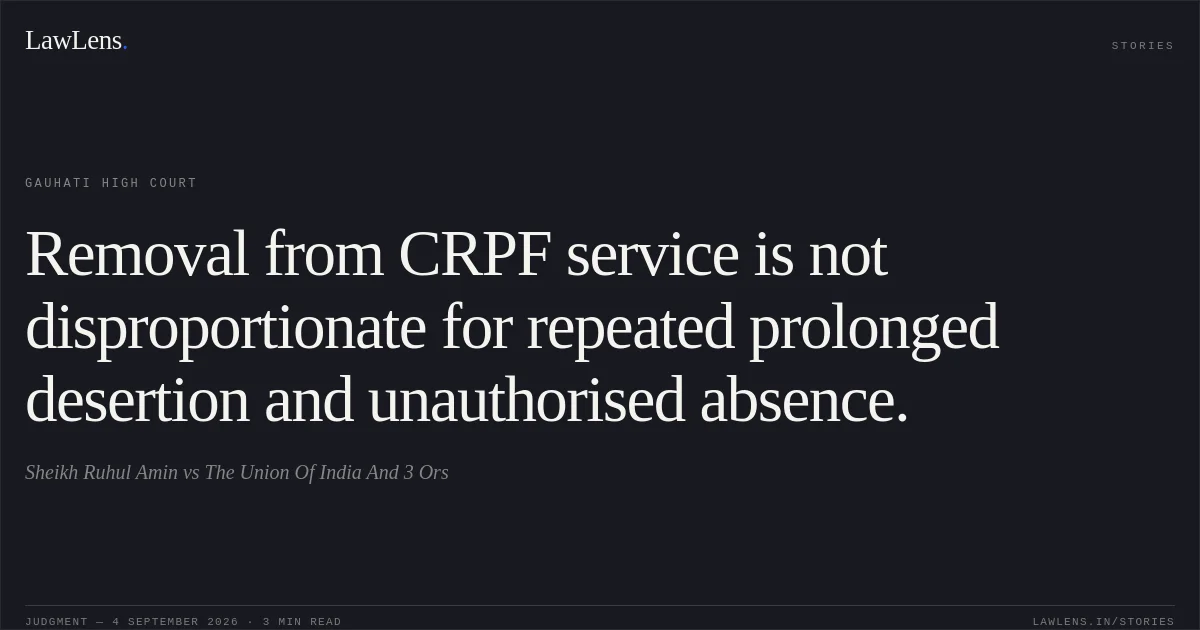
The High Court held that removal from service was not shockingly disproportionate to the petitioner’s proved desertion, repeated unauthorised absence, and disobedience of lawful orders.
p. 11 · ¶ 33It found no perversity, procedural illegality, or irrationality in the orders of the disciplinary, appellate, or revisional authorities.
pp. 11–12 · ¶ 32–34The writ petition was dismissed, the impugned removal order dated 4 March 2015 and the appellate and revisional orders dated 13 May 2015 and 13 November 2015 were upheld, and there was no order as to costs.
p. 12 · ¶ 34–35Original Court PDF
Sheikh Ruhul AminvsThe Union Of India And 3 Ors
Click to open original judgment
Original judgment, available to read, download and summarize on LawLens.in