Facts
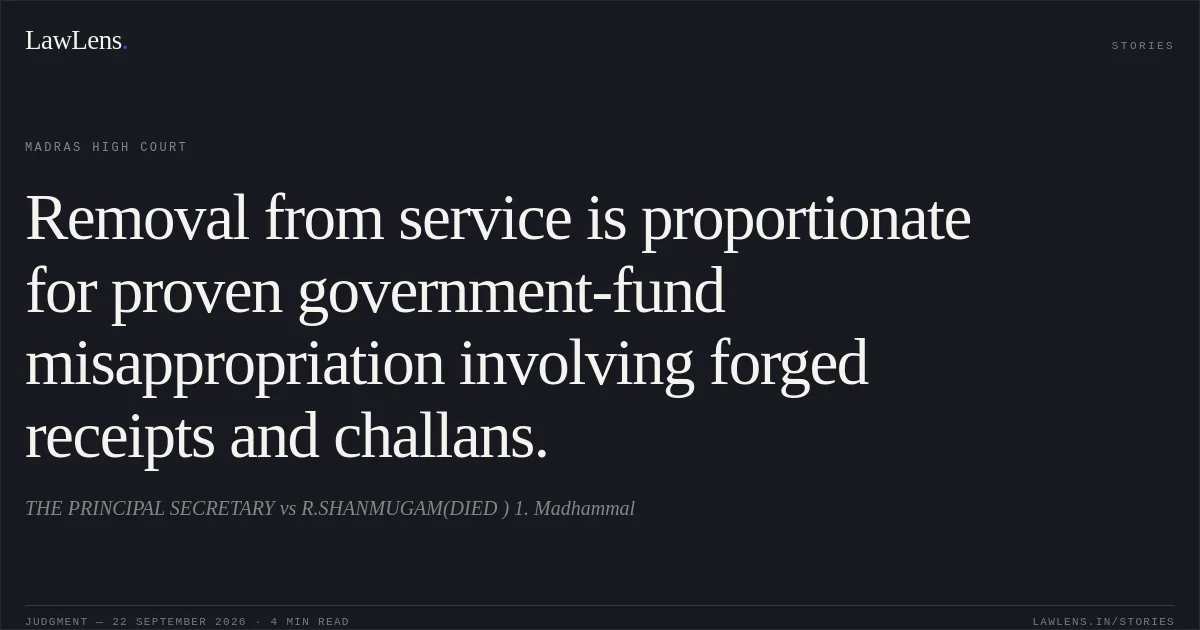
R. Shanmugam, a Village Assistant, was entrusted with amounts collected towards land revenue, additional water cess and 2C tree tax during 2005–2008. The amount of ₹80,940 was allegedly not remitted into the Government Treasury or bank. Instead, he was accused of misappropriating the funds and producing bogus receipts and challans bearing forged bank seals and signatures.
Source reference: p.2A criminal case was registered under Sections 408, 467, 468, 471 and 472 of the IPC, and departmental proceedings were simultaneously initiated.
Source reference: pp.2–3Charges were framed under Rule 17(b) of the Tamil Nadu Civil Services (Discipline and Appeal) Rules. Following a departmental enquiry, the charges of misappropriation and forgery were held proved. The disciplinary authority imposed the penalty of removal from service, and the appellate authority dismissed Shanmugam’s appeal.
Source reference: p.3In a writ petition, the learned Single Judge set aside the removal order and modified the punishment to compulsory retirement, primarily finding that the appellate authority had not adequately considered the employee’s grounds and noting that he was no longer alive when the final order was passed.
Source reference: p.4Issues
Whether the departmental enquiry and the consequential orders complied with the principles of natural justice and the procedure prescribed under Rule 17(b) of the Tamil Nadu Civil Services (Discipline and Appeal) Rules?
Source reference: pp.5–7Whether the findings of misappropriation and forgery were supported by evidence and were vitiated by perversity warranting judicial review?
Source reference: pp.5–7Whether the appellate authority’s order was legally invalid merely because it did not expressly address every ground raised by the delinquent employee?
Source reference: pp.4, 7Whether the punishment of removal from service was disproportionate to the proved misconduct?
Source reference: pp.7–8Whether the pendency or outcome of the parallel criminal proceedings affected the validity of the departmental disciplinary proceedings?
Source reference: p.5Law Applied
The Court applied Rule 17(b) of the Tamil Nadu Civil Services (Discipline and Appeal) Rules, which governs major-penalty disciplinary proceedings and requires compliance with procedural fairness and natural justice.
Source reference: pp.3, 6Judicial review in disciplinary matters is limited to examining whether natural justice was followed, whether the findings are based on some evidence, whether the governing statutory rules were complied with, whether the findings are perverse, and whether the penalty is disproportionate to the proved misconduct.
Source reference: p.5Departmental proceedings are distinct from criminal prosecution; while criminal conviction requires proof beyond reasonable doubt, departmental misconduct may be established on the basis of preponderance of probabilities, and the outcome of a criminal case does not ordinarily determine the departmental proceeding.
Source reference: p.5A disciplinary or appellate authority need not give elaborate reasons where it agrees with the findings under challenge; detailed reasons are particularly necessary where it disagrees with those findings.
Source reference: p.7In cases involving misappropriation of Government funds and forgery, the gravity of the misconduct may justify removal from service, and misplaced sympathy or judicial leniency is inappropriate.
Source reference: pp.7–8Reasoning
The Court found that the departmental enquiry was conducted after charges were framed under Rule 17(b), that Shanmugam was given an opportunity to participate and defend himself, and that the enquiry officer examined the statements of Revenue Officials and Village Administrative Officers and scrutinised the relevant documents.
Source reference: p.6The findings that he had failed to remit Government funds and had fabricated receipts and challans using forged bank seals and signatures were therefore based on material evidence and were not perverse.
Source reference: pp.6–7The disciplinary authority independently considered the defence and accepted the enquiry findings, while the appellate authority recorded and considered the employee’s explanations and the conclusions of the enquiry officer and disciplinary authority.
Source reference: p.7Consequently, the appellate order could not be invalidated merely because it did not separately discuss every contention in detail.
Source reference: p.7The Court also held that the criminal proceedings did not control the departmental proceedings, since the latter operated on the lower standard of preponderance of probabilities.
Source reference: p.5Given that the misconduct involved deliberate misappropriation of public funds accompanied by forgery, the punishment of removal was proportionate and did not warrant interference under Article 226.
Source reference: pp.7–8Holding
The Division Bench held that the disciplinary proceedings complied with the applicable rules and principles of natural justice, that the findings of misconduct were supported by evidence, that the appellate authority’s order was legally sufficient, and that removal from service was not disproportionate to the grave misconduct proved.
The writ appeal was allowed, the Single Judge’s order dated 14 March 2022 in W.P. No. 14127 of 2013 was set aside, and the original punishment of removal from service was restored. No costs were awarded, and the connected miscellaneous petition was closed.
Source reference: p.8Acts & Sections Cited
5 provisions across 1 statute referred to in this judgment. Each provision opens on LawLens.
Indian Penal Code, 18605
Original Court PDF
THE PRINCIPAL SECRETARYvsR.SHANMUGAM(DIED ) 1. Madhammal
Click to open original judgment
Original judgment, available to read, download and summarize on LawLens.in