Facts
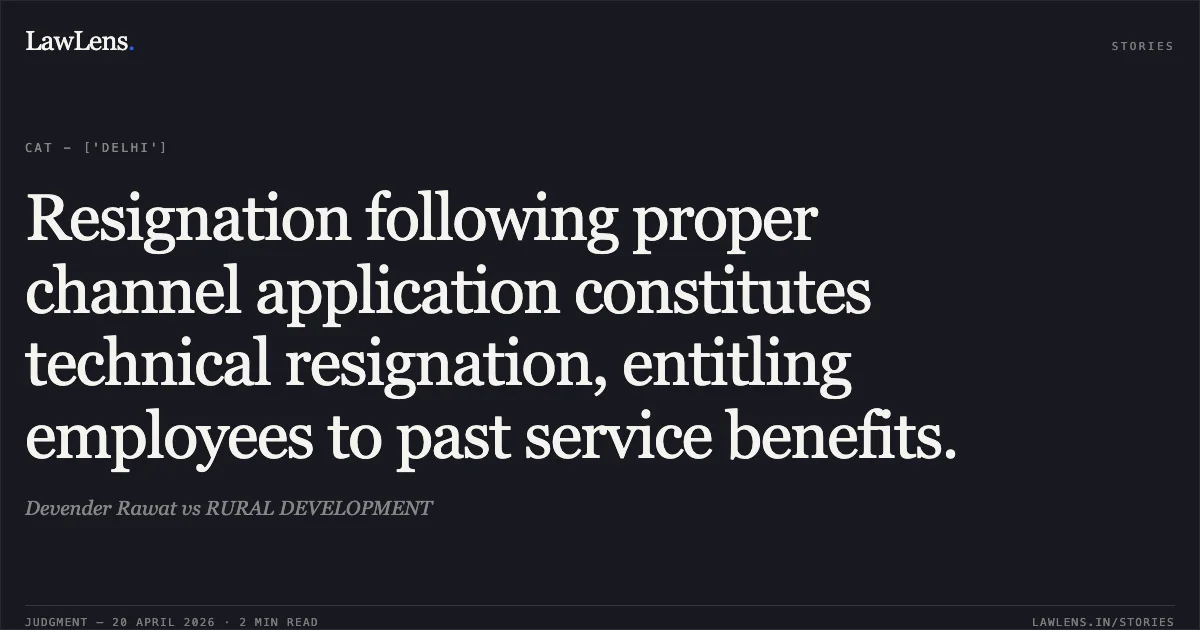
The applicant, an Executive Secretary at the National Institute of Rural Development & Panchayati Raj (NIRDPR), applied for the post of Private Secretary in the Ministry of Rural Development (Respondent No. 1) through the proper channel in response to an advertisement
Source reference: p. 3Respondent No. 2 (NIRDPR) forwarded his application and provided vigilance clearance
Source reference: p. 4Upon his selection, Respondent No. 2 initially refused to relieve him and subsequently issued a communication dated 23.02.2021, asserting that "technical resignation" was inapplicable under DoP&T OM dated 17.08.2016
Source reference: p. 4, 7The applicant was directed to submit a regular resignation and an undertaking that he would not claim any lien
Source reference: p. 4The applicant complied under direction but later sought to have his past service counted for benefits, which was denied via an impugned order dated 24.06.2025
Source reference: p. 2, 4Issues
1. Whether the resignation submitted by the applicant, following an application through the proper channel and subsequent selection, qualifies as a "technical resignation" under DoP&T guidelines
Source reference: p. 42. Whether the benefits of past service can be denied to an employee of an autonomous organization who moves to a government department through the proper channel
Source reference: p. 5, 8Law Applied
Para 2.1.1 of the DoP&T Office Memorandum (OM) dated 17.08.2016, which stipulates that resignation is a "technical formality" when a government servant applies through the proper channel for a post in another department and is selected
Source reference: p. 8The rule specifies that the benefit of past service is admissible even if the word "Technical" is not mentioned in the resignation letter
Source reference: p. 8The Tribunal also relied on its previous decision in Harish Kumar v. Union of India & Ors. (O.A. 1649/2019), which integrated the Supreme Court’s view that employees of autonomous bodies should not be unfairly distinguished from other government organizational employees regarding service benefits
Source reference: p. 10Reasoning
The Tribunal observed that the applicant met all criteria for technical resignation as he applied through the proper channel with the respondents' knowledge and clearance
Source reference: p. 6, 8It found that Respondent No. 2’s communication dated 23.02.2021—which claimed technical resignation was not applicable—was a misinterpretation of the DoP&T OM
Source reference: p. 10The OM explicitly protects employees who apply through the proper channel, ensuring that administrative reasons for resignation do not lead to the forfeiture of past service benefits
Source reference: p. 8-9The court further reasoned, following the Harish Kumar precedent, that once an application is forwarded and the employee is relieved, the respondent cannot later unilaterally withdraw or modify the nature of that relief to the prejudice of the employee without following principles of natural justice
Source reference: p. 10Consequently, the requirement for a "regular" resignation and an undertaking to waive lien was held to be arbitrary
Source reference: p. 11Holding
The Tribunal allowed the O.A. and set aside the impugned orders dated 24.06.2025 and 12.09.2023. It held that the applicant’s resignation must be treated as a "technical resignation" for all purposes.
The Tribunal directed the respondents to grant the applicant all consequential benefits, including the counting of past service and payment of leave encashment, within eight weeks from the receipt of the order. No order as to costs was made.
Source reference: p. 11Acts & Sections Cited
1 provisions across 1 statute referred to in this judgment. Each provision opens on LawLens.
Administrative Tribunals Act, 19851
Original Court PDF
Devender RawatvsRURAL DEVELOPMENT
Click to open original judgment
Original judgment, available to read, download and summarize on LawLens.in