Facts
The applicant was appointed as an Assistant Engineer (Electrical) on an adhoc basis on March 4, 1992
Source reference: p. 2In a previous writ petition (CW No. 1523/1997), the Delhi High Court directed on December 19, 2001, that the applicant be considered for regularization against a sanctioned post "as and when the same is available" and that his past service be counted for future promotion
Source reference: p. 3Consequently, the respondent (DTC) regularized the applicant’s service on October 15, 2010, effective from January 22, 2009—the date a regular vacancy became available
Source reference: p. 4, 8He was later promoted to Senior Manager (Electrical) on December 1, 2012
Source reference: p. 4The applicant filed the present Original Application (O.A.) challenging a rejection letter dated July 29, 2015, seeking retrospective regularization from 1992 and consequential benefits, including ACP/MACP, alleging discrimination compared to another employee, Shri V.N. Patil
Source reference: p. 2, 4-5Issues
1. Whether the applicant is entitled to retrospective regularization from the date of his initial adhoc appointment on March 4, 1992
Source reference: para. 5(i)2. Whether the denial of retrospective regularization constitutes illegal discrimination vis-à-vis similarly placed employees like Shri V.N. Patil
Source reference: para. 5(ii)3. Whether the applicant is entitled to ACP/MACP benefits by counting his adhoc service prior to regularization
Source reference: para. 5(iii)Law Applied
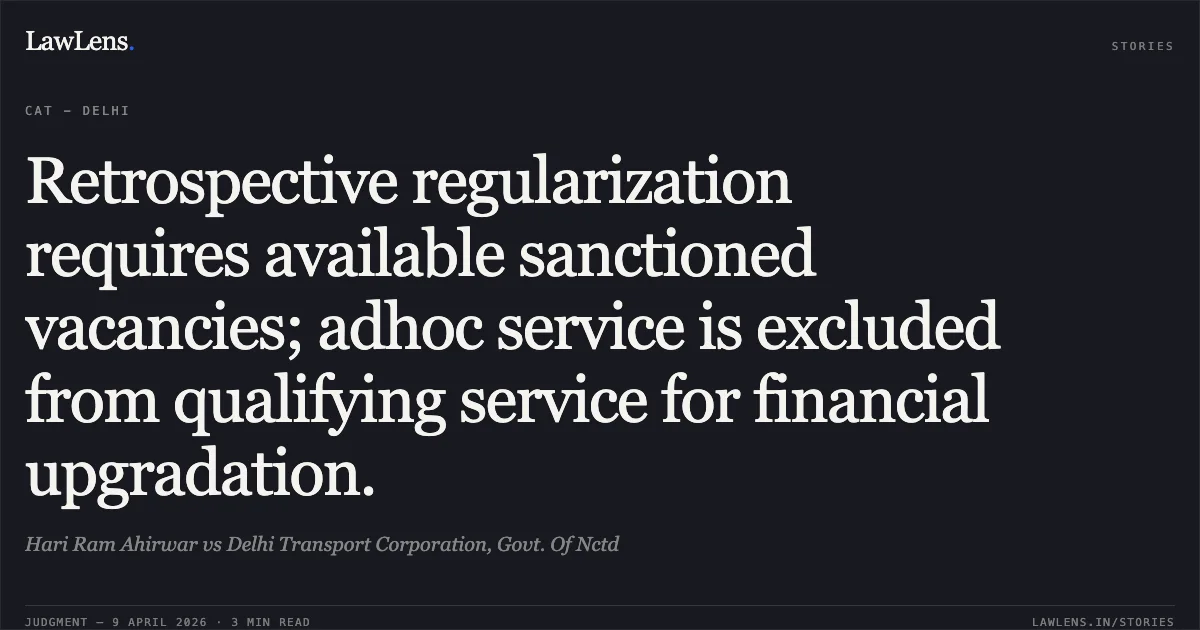
The Tribunal applied the principle that regularization in government service is contingent upon the availability of a sanctioned, regular vacancy
Source reference: para. 7It further relied on the legal standard for parity under Article 14, which requires identical factual circumstances; the principle of equality cannot be invoked where material distinctions exist between employees
Source reference: para. 8, 11Regarding financial upgradation, the Tribunal applied the service rule that adhoc or contract service does not qualify for benefits under the ACP or MACP Schemes and cannot be reckoned for such purposes unless regularized
Source reference: para. 10Reasoning
The Tribunal found that at the time of the applicant's adhoc appointment in 1992, no sanctioned regular vacancy existed
Source reference: para. 7Per the 2001 High Court direction, regularization was only required once a post became available, which occurred on January 22, 2009
Source reference: para. 7-8The Tribunal distinguished the case of Shri V.N. Patil, noting that Patil was regularized retrospectively because a regular vacancy had existed at the time of his initial appointment, whereas no such vacancy existed for the applicant
Source reference: para. 8, 3.2Regarding promotion, the Tribunal noted that the DTC had already complied with the High Court's mandate by counting the applicant’s past service to grant him a promotion to Senior Manager in 2012
Source reference: para. 9Regarding financial upgradation, the Tribunal reasoned that since adhoc service cannot be counted for MACP and the applicant’s regular service only commenced in 2009, he did not complete the requisite 10-year qualifying period post-promotion before his retirement in 2020
Source reference: para. 10Holding
The Tribunal dismissed the O.A., holding that the applicant failed to establish a legal right to retrospective regularization
The court answered that: (1) retrospective regularization is not permissible in the absence of a sanctioned vacancy at the time of initial appointment; (2) no discrimination occurred as the cited parity lacked identical factual foundations; and (3) adhoc service cannot be reckoned for ACP/MACP benefits
Source reference: para. 10-11The respondents' actions were found to be legally justified and in substantial compliance with previous judicial directions
Source reference: para. 11No order as to costs was made
Source reference: para. 12Original Court PDF
Hari Ram AhirwarvsDelhi Transport Corporation, Govt. Of Nctd
Click to open original judgment
Original judgment, available to read, download and summarize on LawLens.in