Facts
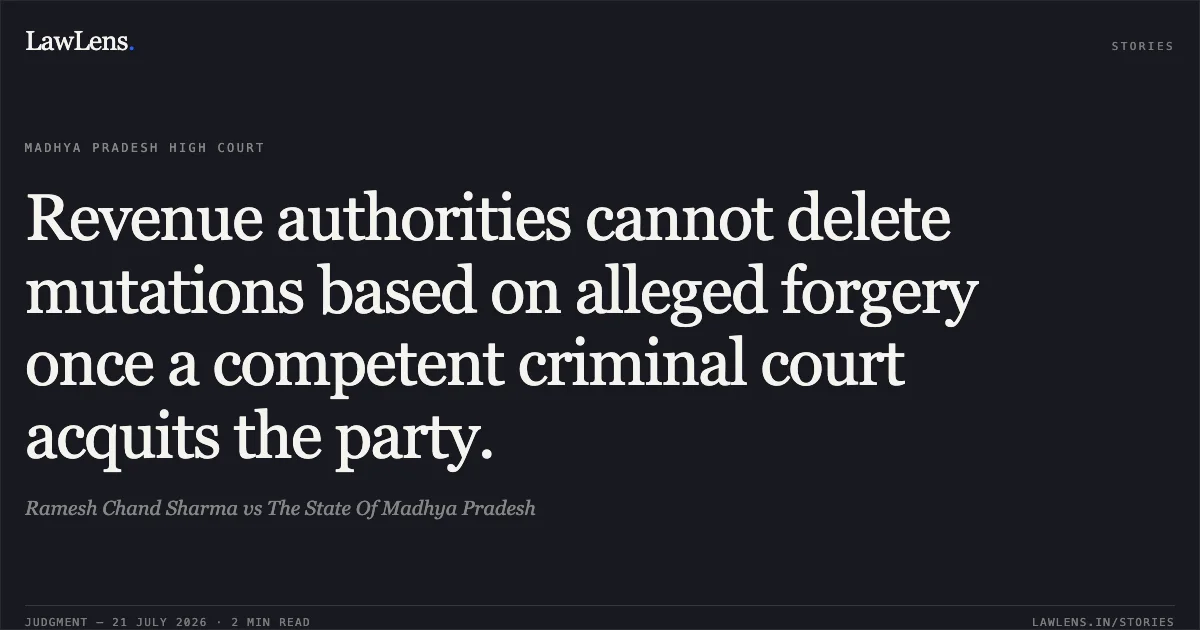
The petitioner was granted a Patta (land allotment) for agricultural land (Survey No. 1654/Min/1, Village Mohana) on 11.01.1985.
Source reference: p. 2After his name was deleted from revenue records without justification, he filed WP No. 4984/2007, resulting in an order dated 05.01.2009 by the Additional Tehsildar restoring his name.
Source reference: p. 2However, on 16.03.2009, the same authority again deleted his name and initiated criminal proceedings alleging the Patta was forged.
Source reference: p. 2In 2014, the Sessions Court acquitted the petitioner, finding the prosecution failed to prove forgery.
Source reference: p. 3Despite this acquittal, the Sub-Divisional Officer (19.08.2020) and the Commissioner (21.10.2021) dismissed the petitioner’s appeals, affirming the deletion of his name.
Source reference: p. 3-4The petitioner subsequently challenged these orders under Article 226/227.
Source reference: no citationIssues
Whether the revenue authorities could maintain the deletion of the petitioner's name based on allegations of forgery after a competent criminal court had acquitted the petitioner of the same charges.
Source reference: p. 5Whether the summary deletion of the petitioner's name from revenue records without notice or hearing violated the principles of natural justice and the Madhya Pradesh Land Revenue Code.
Source reference: p. 3, 5Law Applied
The Court primarily applied the principles of natural justice and the procedural requirements for mutating/deleting revenue entries under the Madhya Pradesh Land Revenue Code, 1959.
Source reference: p. 3The Court relied on the doctrine that once the foundation of an administrative action (in this case, the allegation of forgery) is negated by a competent judicial finding (the acquittal by the Sessions Court), the consequential administrative orders cannot be sustained.
Source reference: p. 5The court emphasized the exercise of extraordinary jurisdiction under Articles 226 and 227 of the Constitution of India to correct arbitrary and illegal administrative actions.
Source reference: p. 4Reasoning
The Court reasoned that the 16.03.2009 order was predicated entirely on the allegation that the petitioner's Patta was forged.
Source reference: p. 5The judgment dated 24.07.2014 in Sessions Trial No. 51/2011 explicitly held that the prosecution failed to establish forgery, thereby removing the "very foundation" of the revenue department's case.
Source reference: p. 5The Court found that the appellate authorities (SDO and Commissioner) committed a legal error by "mechanically" affirming the lower authority's orders without considering the legal impact of the acquittal.
Source reference: p. 5The court noted the procedural lapse where the petitioner’s name was deleted without a show-cause notice or an opportunity to be heard, rendering the proceedings void ab initio.
Source reference: p. 3Holding
The Court allowed the writ petition, quashing the impugned orders dated 16.03.2009, 19.08.2020, and 21.10.2021.
The Court held that because the allegation of forgery did not survive the criminal court's scrutiny, the revenue entries must reflect the petitioner's title.
Source reference: p. 5The Court restored the order dated 05.01.2009 and directed the respondents to restore the petitioner's name in the revenue records and carry out consequential entries within eight weeks.
Source reference: p. 5-6Acts & Sections Cited
4 provisions across 1 statute referred to in this judgment. Each provision opens on LawLens.
Indian Penal Code, 18604
Original Court PDF
Ramesh Chand SharmavsThe State Of Madhya Pradesh
Click to open original judgment
Original judgment, available to read, download and summarize on LawLens.in