01Facts
The appellants (plaintiffs) claim ownership of 69.5 kanals in Khasra Nos. 1097 and 1098, Village Chaterhama, under 24 registered sale deeds.
¶ 2, 6They allege that the respondent (defendant), a former director of G.D. Housing and Estate Developers Pvt. Ltd., unlawfully occupied about 700 kanals, including their land, and that about 300 kanals remain in his illegal possession.
¶ 2, 5They further allege that his musclemen obstruct them from visiting, planting trees, or fencing the land.
¶ 2, 5The defendant contends that he holds the land through power of attorneys from landowners and through sale deeds executed by a cooperative society, and that the plaintiffs' mutations and sale deeds are sham and unsupported by revenue records.
¶ 8–11The trial court dismissed the plaintiffs' Order 39 Rules 1 and 2 CPC application, finding suppression of WP(C) No. 1264/2023, an admission of the defendant's possession, no prima facie case, the suit's non-maintainability without a prayer for possession, and a balance of convenience against the plaintiffs.
¶ 12–13The writ petition had been withdrawn after a committee report dated 26.09.2024.
¶ 21The plaintiffs appealed under FAO No. 17/2026.
¶ 1402Issues
i.1. Whether the trial court's finding that the plaintiffs admitted the defendant's possession over the suit land is perverse.
¶ 18–20ii.2. Whether the plaintiffs' non-disclosure of the withdrawn writ petition amounts to material suppression warranting refusal of interim relief.
¶ 21–22iii.3. Whether the suit is non-maintainable for want of a prayer for possession, and whether the plaintiffs have made out a prima facie case in light of the committee report's doubts on their sale deeds and mutations.
¶ 23–26iv.4. Whether the balance of convenience lies in refusing injunction, given the defendant's third-party sales.
¶ 2703Law Applied
Order 39 Rules 1 and 2 CPC, under which an appellate court interferes with an interim order only where the discretion is arbitrary, perverse, or contrary to settled legal principles.
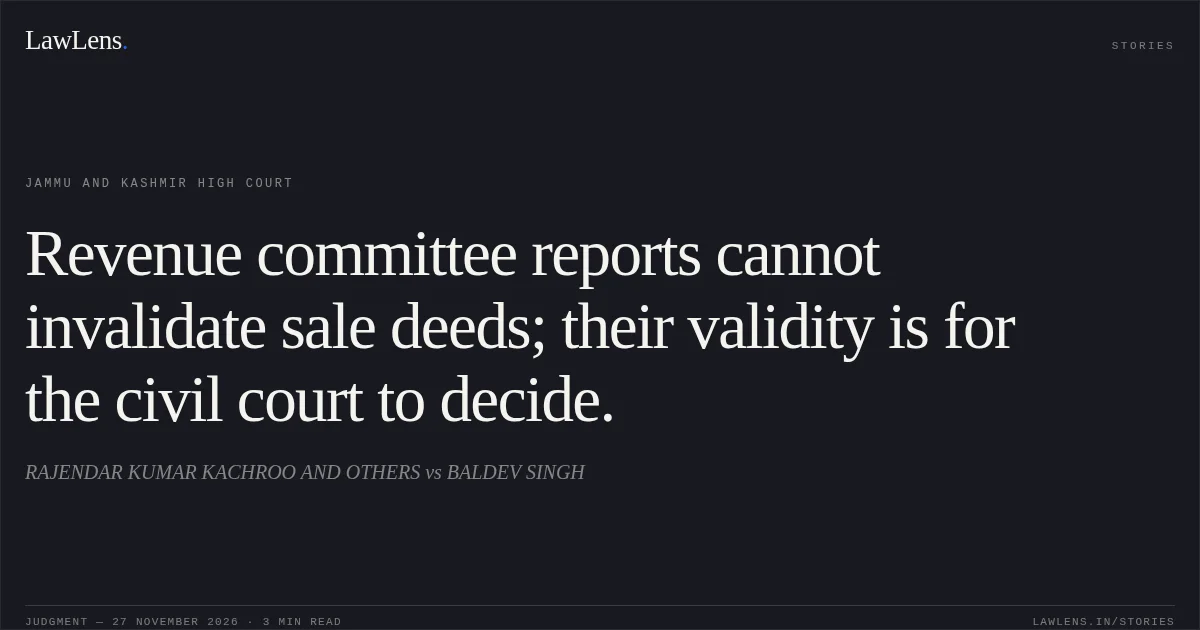
¶ 16Revenue committees lack jurisdiction to declare sale deeds invalid; that question is for the civil court.
¶ 25A duly registered sale deed is the recognised mode of transfer of immovable property, whereas a power of attorney is not a mode of transfer.
¶ 27A fact is material to suppression only if it bears upon the outcome of the suit.
¶ 22No specific precedents are cited in the judgment.
Provisions in the judgment · 1
the Act (alias, unresolved) Section 5
04Reasoning
The court found the trial court's admission finding perverse. The plaint and the writ petition only allege obstruction of access, not that the defendant occupies the suit land.
¶ 18–20The writ petition was withdrawn after a fresh committee report superseded the earlier report, and the later report still cast a cloud on the plaintiffs' title. The writ was therefore not material to the suit's outcome.
¶ 21–22Possession and maintainability raised triable issues, and nothing on record showed the plaintiffs were out of possession, so the trial court's prima facie finding was premature.
¶ 23The committee's doubts about the sale deeds and missing mutations could not determine validity, since the civil court must decide title. The mutations were admittedly recorded in the Parat Patwar, and their absence from scanned records was not conclusive.
¶ 25–26On balance of convenience, the plaintiffs' registered sale deeds outweigh the defendant's power-of-attorney claim. Permitting third-party interests would cause irreparable prejudice to the plaintiffs.
¶ 2705Holding
The court held that the plaintiffs had not admitted the defendant's possession, that the writ non-disclosure was not material, that the suit was not prima facie non-maintainable, and that the balance of convenience favoured the plaintiffs.
¶ 18–27The impugned order was perverse and illegal, and the appeal was allowed and the trial court's order set aside. The defendant was restrained from creating any third-party interest in the 69.5 kanals in Khasra Nos. 1097 and 1098 until final disposal of the suit. The order is limited to a restraint on third-party interests and does not grant a full injunction against the defendant's possession.
¶ 28Original Court PDF
RAJENDAR KUMAR KACHROO AND OTHERSvsBALDEV SINGH
Click to open original judgment
Original judgment, available to read, download and summarize on LawLens.in