01Facts
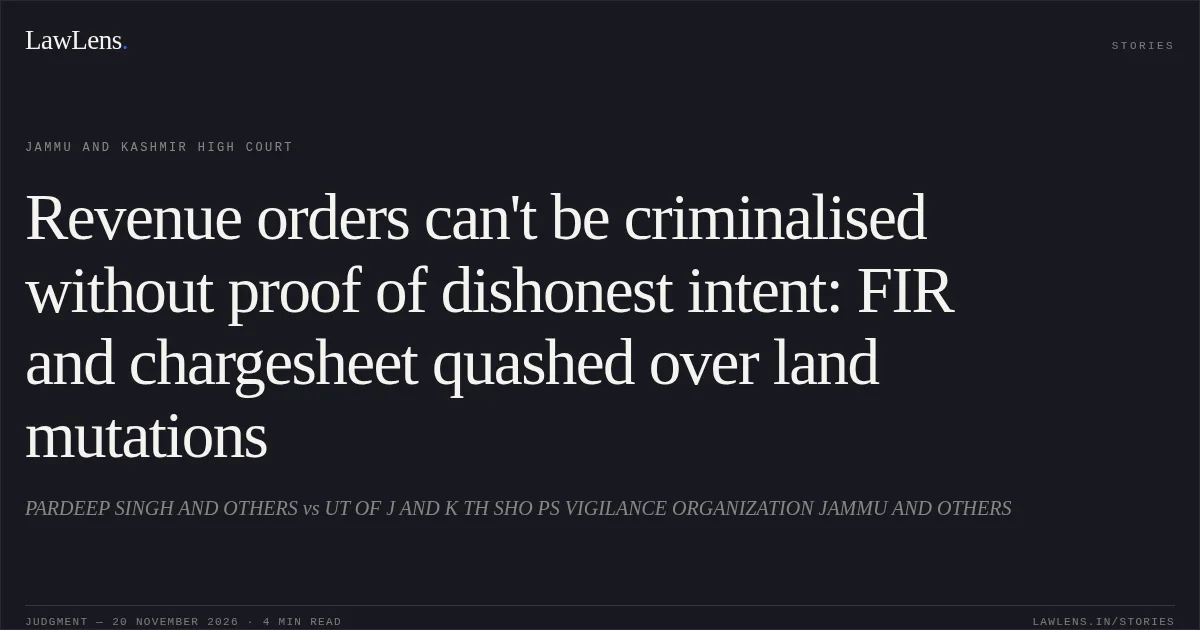
The petitioners sought quashing of FIR No. 03/2014 (Vigilance Organization, Jammu, now ACB) and the resulting charge sheet for offences under Section 5(1)(d) r/w 5(2) of the Prevention of Corruption Act and Sections 420, 467, 468, 471 and 120-B RPC, pending before the Special Judge, Doda.
¶ 1The complaint alleged that 60 kanals 16 marlas of Khasra No. 2772/583-min, shown as government land since 1971, was fraudulently mutated in the petitioners' favour for monetary consideration, despite the land lying within the alignment of the Kishtwar–Sinthan Road.
¶ 2The investigating agency found the land to be Shamilat Deh, in which proprietors held proportionate shares. It alleged that revenue officials (a Tehsildar, Girdawar and Patwaris) conspired with the petitioners and made exclusive entries in the petitioners' favour, changing the land's status in 2003 and attesting mutations in 2010, although petitioners Kuljeet Singh and Pradeep Singh were born in 1977 and 1964 respectively.
¶ 3Charge sheet was filed against the petitioners and officials.
¶ 4The petitioners relied on mutation orders dated 30.03.2010, which the Additional Deputy Commissioner, Kishtwar upheld in appeal on 08.12.2021.
¶ 5The private respondents obtained a reference judgment dated 05.10.2023 from the Principal District Judge, Kishtwar, holding the mutations manipulated; that judgment is stayed in RFA No. 40/2023, which is pending.
¶ 10–11, 14The Divisional Commissioner, in the private respondents' appeal, expressed no opinion on the merits and deferred to the pending civil proceedings.
¶ 13The official respondents reiterated the charge sheet allegations; private respondents filed no reply.
¶ 702Issues
i.1. Whether the FIR and charge sheet under the PC Act and IPC can be sustained where the mutation orders underlying the prosecution have been upheld by the appellate revenue authority, and the validity of those mutations is sub judice before civil and revenue forums.
¶ 9, 12–15ii.2. Whether mere attestation of mutations by revenue officers, absent material showing dishonest or mala fide intention, pecuniary gain or prior meeting of minds, attracts criminal liability.
¶ 16, 19iii.3. Whether the prosecution constitutes an abuse of the process of law warranting quashing.
¶ 2003Law Applied
The Court relied on the criminal provisions invoked in the FIR, namely Section 5(1)(d) r/w 5(2) of the Prevention of Corruption Act and Sections 420, 467, 468, 471 and 120-B RPC, which require proof of dishonest or corrupt conduct and criminal conspiracy.
¶ 1The Court applied the principle that statutory and quasi-judicial authorities are bound to err, and their orders may be the subject of criminal investigation only where they are shown to have been passed with dishonest or mala fide intention, gathered from surrounding circumstances.
¶ 16The Court applied the principle that mutation orders are amenable to scrutiny by appellate and revisional authorities, so that attestation alone, without evidence of dishonest intention, does not attract the PC Act.
¶ 19The Court applied the doctrine that criminal proceedings constituting an abuse of process are liable to be quashed.
¶ 20No precedents are cited in the judgment. Section 4 of the Land Acquisition Act is referenced as the notification relevant to the timing analysis.
¶ 17Provisions in the judgment · 6 · Linked ones open on LawLens
Prevention of Corruption Act, 1988 Section 5
Indian Penal Code, 1860 Section 420Section 467Section 468Section 471
Tripura Land Revenue and Land Reforms Act, 1960 Section 4
04Reasoning
The validity and legality of the mutations, which the prosecution alleges were manipulated, is actively in dispute before the revenue appellate and revisional forums, the Reference Court (stayed), and this Court in RFA No. 40/2023. Different authorities have taken differing views, and the final position is awaited.
¶ 15The Divisional Commissioner's order did not decide the merits.
¶ 13Applying the mala fide test, the Court held that the timing did not support the prosecution's inference: the Sehat-i-Kasht entry (2003) and the mutations (30.03.2010) preceded the Section 4 notification (03.12.2010), so it was "far-fetched" to infer that they were made to obtain compensation, unless foresight of future acquisition was assumed.
¶ 17The entry that petitioners were in possession since 1971 was, though contestable as to minors, a possible and plausible view explained by the Additional Deputy Commissioner and not a gross illegality.
¶ 18The Court further noted that the investigation disclosed no allegation of illegal gratification, and no material showing a prior meeting of minds. Accepting the prosecution's logic would render the appellate authority that upheld the mutations a co-conspirator, which the Court termed preposterous.
¶ 1905Holding
The Court held that mere attestation of mutations, without material showing dishonest intention, does not attract the PC Act or other penal provisions, and that lodging the FIR and filing the charge sheet against the petitioners was an abuse of process of law.
¶ 19–20The petition is allowed, and the impugned FIR No. 03/2014 and the consequential charge sheet are quashed insofar as they concern the petitioners.
¶ 21Original Court PDF
PARDEEP SINGH AND OTHERSvsUT OF J AND K TH SHO PS VIGILANCE ORGANIZATION JAMMU AND OTHERS
Click to open original judgment
Original judgment, available to read, download and summarize on LawLens.in