Facts
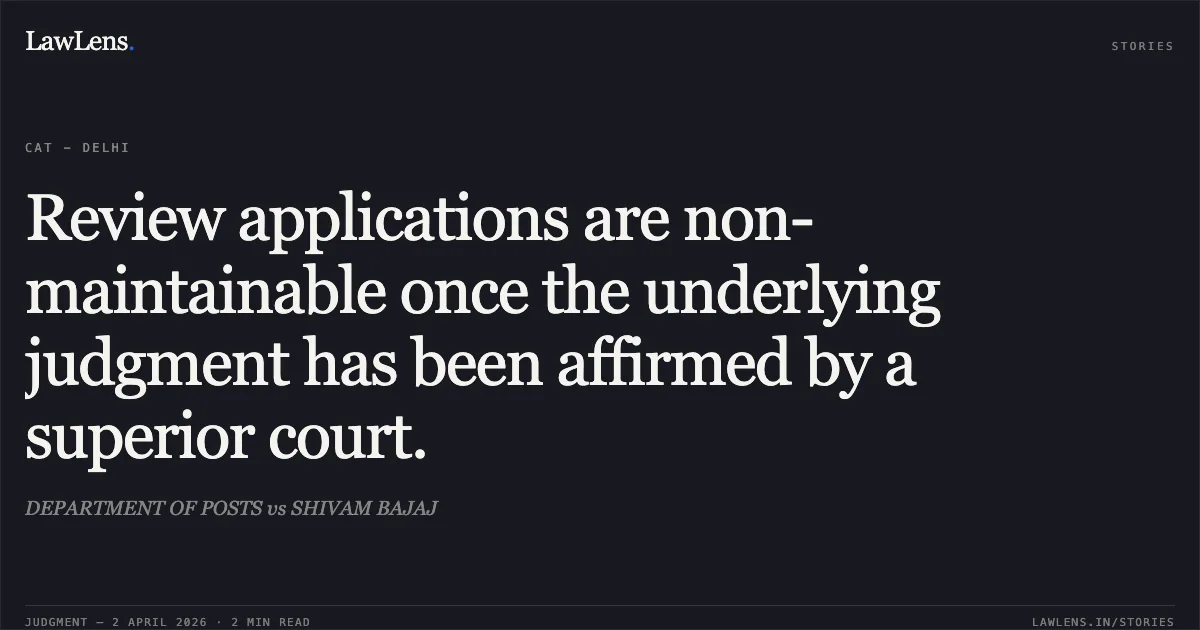
The Review Applicants (Union of India) sought a review of the Tribunal's order dated October 16, 2025, which had ruled in favor of the Respondent, a Postal Assistant
Source reference: p. 2, para. 3Along with the Review Application (RA), the applicants filed MA No. 979/2026 seeking condonation of a 46-day delay in filing, citing administrative processing time
Source reference: p. 3, para. 5The Applicants contended that the Respondent had concealed material facts in the original proceedings
Source reference: p. 3, para. 6However, the Respondent argued that identical RAs arising from the same common judgment had already been dismissed by the Tribunal on February 10, 2026, following the dismissal of similar challenges by the High Courts of Delhi and Punjab & Haryana
Source reference: p. 3-4, para. 7Issues
1. Whether the delay of 46 days in filing the Review Application should be condoned.
Source reference: p. 3, para. 52. Whether there are sufficient grounds to review the order dated October 16, 2025, particularly in light of the High Court of Delhi upholding the Tribunal's prior common judgments on the same subject matter.
Source reference: p. 6, para. 15; p. 6, para. 8Law Applied
The court applied the principle of judicial discipline regarding identical matters and the doctrine of merger.
Source reference: no citationIt relied on the precedent set in Union of India & Ors. v. Sanjeev Kumar & Anr. (W.P.(C) 15248/2022), where the Delhi High Court held that termination based on negative CFSL reports where authorship was not established is unsustainable
Source reference: p. 6, para. 13This was further reinforced by the Supreme Court’s dismissal of the Special Leave Petition against the Sanjeev Kumar judgment on December 16, 2024
Source reference: p. 6, para. 13Additionally, the court noted the Union of India’s policy decision dated April 17, 2025, to reinstate candidates in cases where CFSL reports were inconclusive
Source reference: p. 6, para. 13Reasoning
The Tribunal first addressed the procedural delay, condoning the 46-day lapse as it was deemed bona fide and administrative rather than willful
Source reference: p. 3, para. 5On the merits of the RA, the Tribunal observed that the underlying legal issue—termination based on inconclusive CFSL reports—had been exhaustively litigated.
Source reference: no citationThe Tribunal noted that the Delhi High Court, in Union of India & Ors. v. Avinash Kumar & Anr., had already upheld the Tribunal’s common order, specifically citing the Sanjeev Kumar precedent and the Government’s own policy to reinstate such candidates
Source reference: p. 6, para. 13-14The Tribunal reasoned that since the High Court had already affirmed the correctness of the original order, the present RA lacked fresh grounds and constituted a "misuse of the process of law"
Source reference: p. 6, para. 15Consequently, the Tribunal found no reason to diverge from its previous dismissal of identical RAs
Source reference: p. 6, para. 8Holding
The Tribunal allowed MA No. 979/2026 and condoned the delay in filing.
However, the Review Application (RA No. 37/2026) was dismissed, as the original judgment had already been upheld by the High Court and no new grounds for review were established
Source reference: p. 6, para. 8No order as to costs was made
Source reference: p. 7, para. 9Original Court PDF
DEPARTMENT OF POSTSvsSHIVAM BAJAJ
Click to open original judgment
Original judgment, available to read, download and summarize on LawLens.in