Facts
The petitioner was engaged as a Sikshya Sahayak in February 2004.
Source reference: p. 2–10, 25The State maintained that his engagement followed a government circular dated 26 September 2003, rather than the earlier advertisement dated 25 March 2003.
Source reference: p. 2–10, 25In Hrusikesh Bindhani v. State of Odisha, the High Court had quashed engagements made pursuant to that circular.
Source reference: p. 2–10, 25The petitioner’s challenge to his 2018 disengagement was dismissed by a Single Judge, and the Division Bench dismissed his writ appeal on 13 August 2024, finding that his initial selection was against an unadvertised post and that he had continued under interim orders.
Source reference: p. 2–10, 25He sought review, relying, among other matters, on the earlier advertisement, his in-service training and provisional placement in a later selection list.
Source reference: p. 11–14Issues
1. Whether the petitioner established a ground under Section 114 and Order 47 Rule 1 CPC to review the order dismissing his writ appeal.
Source reference: p. 15–17, 24–262. Whether the petitioner’s contentions concerning the advertisement, his training and his provisional selection disclosed an error apparent on the face of the record or otherwise justified review.
Source reference: p. 24–26Law Applied
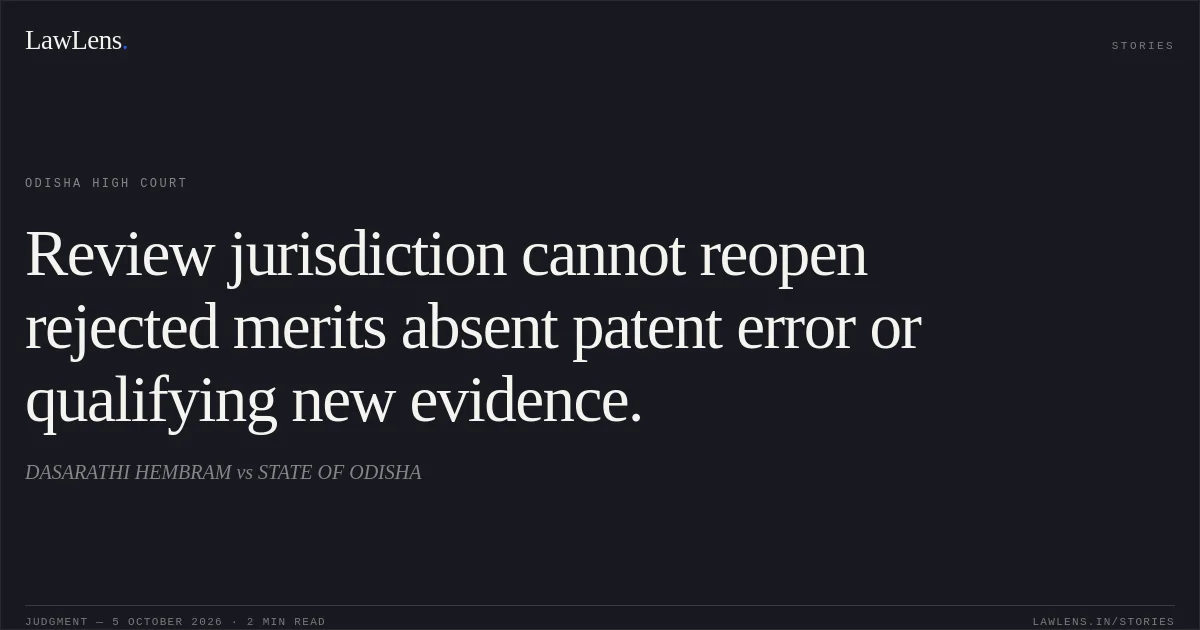
Section 114 and Order 47 Rule 1 of the Code of Civil Procedure, 1908 permit review on discovery of new and important matter or evidence unavailable despite due diligence, an error apparent on the face of the record, or another sufficient reason analogous to those grounds.
Source reference: p. 15–17An apparent error must be manifest without extended reasoning; review is not an appeal in disguise and cannot be used to reargue rejected submissions or reassess evidence.
Source reference: p. 18–23The Court applied these principles from Meera Bhanja v. Nirmala Kumari Choudhury, Kamlesh Verma v. Mayawati, Malleeswari v. K. Suguna and Board of Control for Cricket in India v. Netaji Cricket Club.
Source reference: p. 18–24Reasoning
The Court found that the petitioner’s grounds concerning the 2003 advertisement, his engagement, training and provisional placement went to the merits and had been raised in the earlier proceedings; they did not identify a manifest error in the appellate order.
Source reference: p. 24–26The order had concluded that the petitioner’s initial engagement was against an unadvertised post, that the relevant engagements had been declared null and void, and that he continued only by virtue of interim orders.
Source reference: p. 10–11, 25The later review decision concerning another employee did not assist the petitioner, because it arose from that employee’s individual facts not considered in the earlier batch judgment.
Source reference: p. 26Reconsidering the petitioner’s account of his selection would therefore exceed the limited review jurisdiction.
Source reference: p. 24–26Holding
The Court held that no ground for review had been established.
The Court dismissed the review petition without costs. The order dated 13 August 2024 dismissing the writ appeal remained undisturbed.
Source reference: p. 26–27Acts & Sections Cited
2 provisions across 1 statute referred to in this judgment. Each provision opens on LawLens.
Code of Civil Procedure, 19082
Original Court PDF
DASARATHI HEMBRAMvsSTATE OF ODISHA
Click to open original judgment
Original judgment, available to read, download and summarize on LawLens.in