Facts
The applicant challenged an acquittal order originally passed by the Chief Judicial Magistrate, Amreli, in 2019.
Source reference: p. 1This acquittal had subsequently been upheld by the Sessions Judge, Amreli, in a 2022 Criminal Appeal.
Source reference: p. 1The applicant then moved the High Court of Gujarat under its revisional jurisdiction to contest the appellate court's decision to confirm the acquittal.
Source reference: p. 2Issues
1. Whether a criminal revision application is maintainable against an appellate judgment that confirmed a trial court’s order of acquittal.
Source reference: p. 22. Whether the High Court can re-appreciate evidence under its revisional jurisdiction to overturn concurrent findings of acquittal.
Source reference: p. 6Law Applied
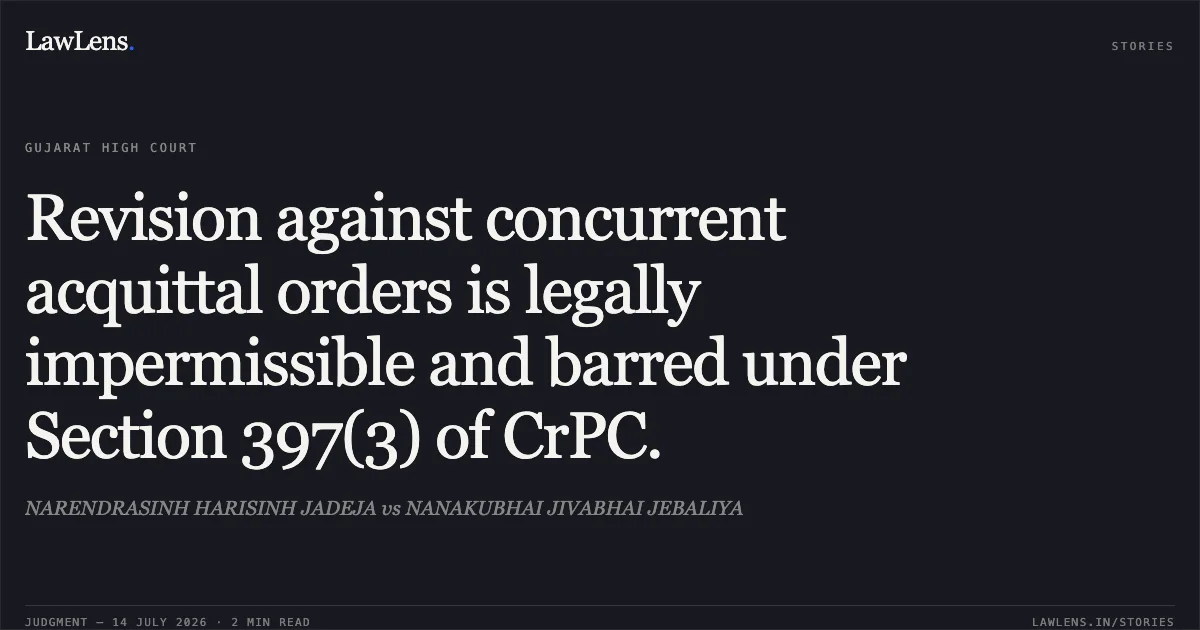
Section 397(3) of the Code of Criminal Procedure, which bars a second revision application by the same person.
Source reference: p. 3The principle from Amit Kapoor v. Ramesh Chander, establishing that revisional jurisdiction is limited to examining the legality and propriety of an order rather than acting as a second appeal.
Source reference: p. 3Section 401(3) prohibits converting an acquittal into a conviction through revision and that such powers should only be used in exceptional cases of manifest illegality or miscarriage of justice as per Bindeshwari Prasad Singh v. State of Bihar and Sheetala Prasad v. Sri Kant.
Source reference: p. 4-6Reasoning
The Court reasoned that the applicant was essentially seeking a second revision, which is expressly prohibited by statute.
Source reference: p. 2-3Justice Pinto observed that the revisional forum cannot be converted into a second appellate stage for the re-appreciation of evidence.
Source reference: p. 2Since two lower courts had already concurrently found the evidence insufficient for conviction, the High Court determined it could only interfere if the findings were perverse, unreasonable, or lacked any evidentiary basis.
Source reference: p. 6-7The Court found that the applicant failed to demonstrate any "exceptional circumstances" or "manifest illegality" that would justify exercising its limited revisional powers.
Source reference: p. 6Holding
The High Court held that the Revision Application was not maintainable as it sought to challenge a confirmed acquittal without showing any jurisdictional error or gross injustice.
The application was rejected at the threshold, the rule was discharged, and any interim relief was vacated.
Source reference: p. 7Acts & Sections Cited
3 provisions across 1 statute referred to in this judgment. Each provision opens on LawLens.
Code of Criminal Procedure, 19733
Original Court PDF
NARENDRASINH HARISINH JADEJAvsNANAKUBHAI JIVABHAI JEBALIYA
Click to open original judgment
Original judgment, available to read, download and summarize on LawLens.in