Facts
The petitioners’ seed godowns were seized on 25.10.2012 under the Essential Commodities Act, 1955. Following an auction order, the "Drumikaran" process was conducted on 08.01.2013
Source reference: p. 2Subsequently, authorities alleged that the seals were tampered with and goods were missing, leading to an FIR under Sections 454, 457, 380, and 201 of the IPC
Source reference: p. 2Upon investigation, the trial court discharged the petitioners on 18.03.2015, finding no prima facie case
Source reference: p. 2The State challenged this via revision; the Revisional Court allowed the State's petition on 24.03.2018, set aside the discharge, and directed arrest warrants against the petitioners
Source reference: para. 1, 2.4Issues
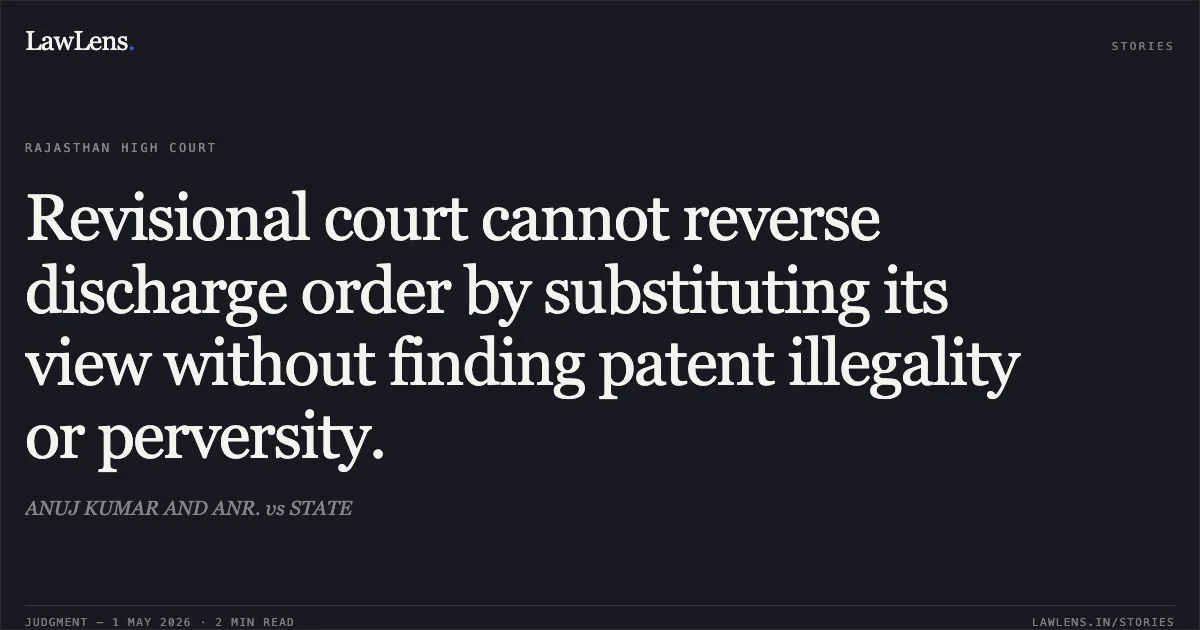
1. Whether the Revisional Court exceeded its jurisdiction by substituting its own view for that of the Trial Court without finding patent illegality or perversity
Source reference: p. 32. Whether there existed sufficient material to meet the threshold of "grave suspicion" required to frame charges under Sections 454, 457, 380, and 201 IPC
Source reference: p. 11-12Law Applied
The Court applied Sections 397 and 401 of the CrPC regarding revisional jurisdiction, noting it is supervisory, not appellate
Source reference: p. 12It relied on the distinction between "mere suspicion" and "grave suspicion," where only the latter justifies a trial
Source reference: p. 11The Court cited Union of India v. Prafulla Kumar Samal, establishing that a judge must sift evidence to find a prima facie case and not act as a mere "post office"
Source reference: p. 5, 9It further referred to Kanti Bhadra Shah v. State of West Bengal, noting that while detailed reasons aren't required for framing charges, the order must reflect a conscious application of mind
Source reference: p. 6, 8Finally, it integrated principles from Reema v. State of Rajasthan regarding the mandatory nature of procedural safeguards under the BNSS (analogous to CrPC)
Source reference: p. 3-4Reasoning
The High Court found that the Revisional Court's order was "cursory, omnibus, and bereft of any demonstrable application of judicial mind"
Source reference: p. 12The Court reasoned that the Revisional Court failed to identify any specific perversity or illegality in the Trial Court’s discharge order and instead simply substituted its own conclusion
Source reference: p. 12Applying the doctrine of "grave suspicion," the Court observed that there was "not an iota of evidence" suggesting the petitioners committed trespass or theft
Source reference: p. 12-13The Court emphasized that forcing individuals to face trial without a foundational factual nexus to the crime infringes upon the right to liberty
Source reference: p. 13It concluded that the Revisional Court failed to conduct an independent analysis of the material to justify reversing a well-reasoned discharge
Source reference: p. 12Holding
The High Court allowed the revision petition and set aside the Revisional Court’s order dated 24.03.2018
It held that the Revisional Court had transgressed its limits by reversing the discharge in the absence of patent illegality
Source reference: p. 3, 12The Trial Court’s order dated 18.03.2015, which discharged the petitioners of all charges, was affirmed
Source reference: p. 13All pending stay petitions were disposed of
Source reference: p. 13Original Court PDF
ANUJ KUMAR AND ANR.vsSTATE
Click to open original judgment
Original judgment, available to read, download and summarize on LawLens.in