Facts
The Petitioner (tenant) challenged the eviction order dated 28.01.2026 passed by the Additional Rent Controller (ARC), East District, Karkardooma.
Source reference: para 1The Respondent No. 1 (landlord) filed the eviction petition under Section 14(1)(e) of the Delhi Rent Control (DRC) Act, 1958, seeking possession of a shop at WB-33, Shakarpur Extension, to start a sanitary business.
Source reference: para 37The Petitioner contested the petition on three primary grounds: lack of a landlord-tenant relationship (claiming the Respondent's brother was the landlord), availability of suitable alternate accommodation in properties WB-33 and WB-17, and absence of a bona fide requirement due to the Respondent's old age and health.
Source reference: paras 2, 4The ARC rejected these contentions and passed the eviction order.
Source reference: para 1Issues
1. Whether the High Court, under its revisional jurisdiction, can interfere with the ARC’s findings of fact regarding ownership and bona fide requirement in the absence of manifest error?
Source reference: paras 7, 92. Whether the lack of exclusive ownership or the physical condition of alternate premises (being in a narrow lane) disqualifies them as "suitable alternate accommodation" under Section 14(1)(e) of the DRC Act?
Source reference: paras 29, 36Law Applied
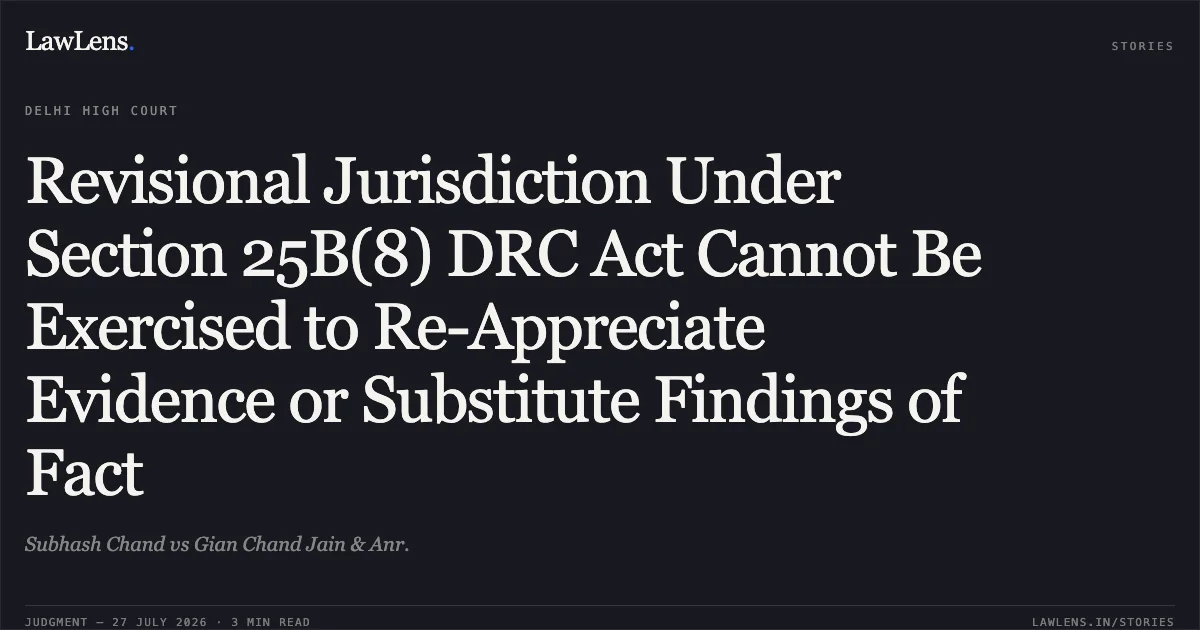
The Court applied Section 25-B(8) of the DRC Act, 1958, which provides a limited revisional jurisdiction focused on the "legality and propriety" of the decision-making process rather than acting as a full appeal.
Source reference: para 7It relied on Abid-Ul-Islam v. Inder Sain Dua (2022) to establish that the High Court cannot substitute its own view for that of the Rent Controller unless there is an error apparent on the face of the record.
Source reference: para 9Regarding ownership, it applied Ramesh Chand v. Uganti Devi (2009), which holds that for DRC purposes, a landlord need only show a better title than the tenant and that they receive rent for their own benefit.
Source reference: para 20The court applied the principle that the "landlord is the best judge" of their own requirements and business expediency.
Source reference: para 29Reasoning
The Court found that the ARC’s decision-making process was thorough and supported by evidence.
Source reference: no citationRegarding ownership, the ARC correctly noted that a relinquishment deed dated 19.08.2016 established the Respondent’s interest in the property, and since the Petitioner’s mother was originally a tenant under the Respondent’s mother, the landlord-tenant relationship was established via succession.
Source reference: paras 18, 21On the issue of alternate accommodation, the Court upheld the ARC's finding that the vacant shops in WB-33 were less suitable because they were located in a 15-foot lane, whereas the suit shop was an "L-shaped corner shop" on a 20-foot road.
Source reference: para 29For property WB-17, the ARC rightly determined the shops were not "exclusively available" as they were jointly owned with other family members and currently occupied by others.
Source reference: paras 33-36Regarding bona fide need, the Court reasoned that the Respondent’s desire to utilize his 40 years of experience cannot be dismissed due to old age or financial security, noting that "the wings of ambition cannot be clipped merely because of age".
Source reference: para 40Holding
The High Court dismissed the Revision Petition, holding that there was no jurisdictional error, perversity, or manifest illegality in the ARC’s order.
The Court affirmed that the Respondent established a bona fide requirement and lacked suitable alternate accommodation.
Source reference: para 15The Petitioner’s attempt to seek a fresh appraisal of facts was deemed impermissible under the restrictive scope of Section 25B(8) of the DRC Act. All pending applications were disposed of accordingly.
Source reference: paras 18, 21Acts & Sections Cited
1 provisions across 1 statute referred to in this judgment. Each provision opens on LawLens.
delhi rent control act, 19581
Original Court PDF
Subhash ChandvsGian Chand Jain & Anr.
Click to open original judgment
Original judgment, available to read, download and summarize on LawLens.in