Facts
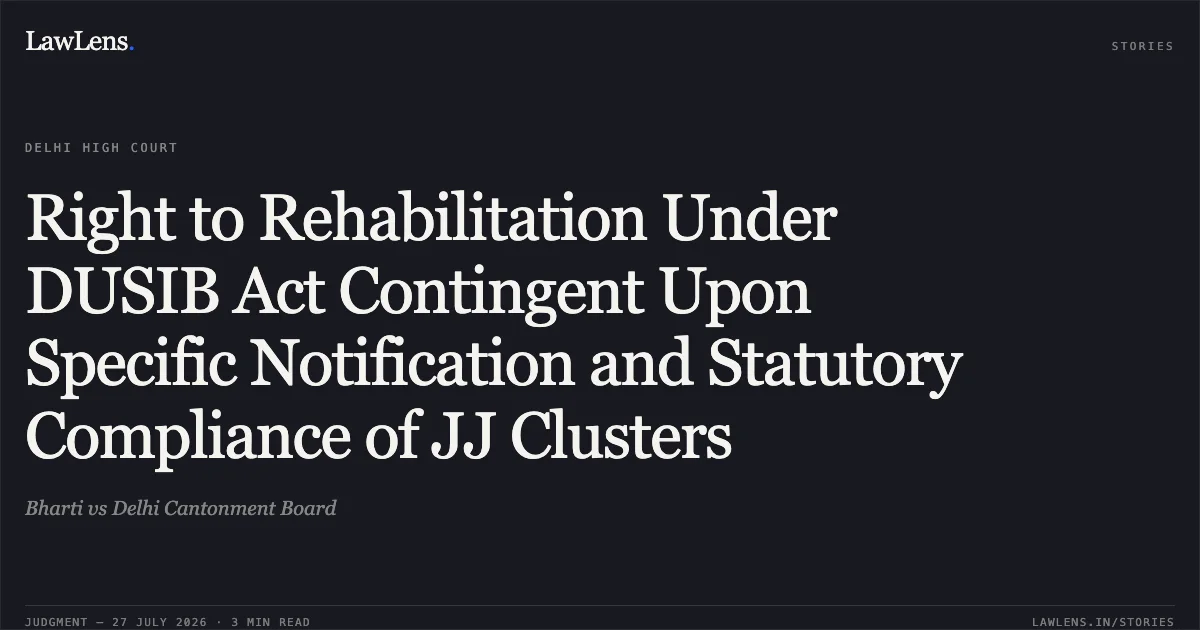
The Petitioner challenged an Order dated 08.07.2026 passed by the Estate Officer, Delhi Cantonment Board (DCB). The order rejected the Petitioner’s claim over premises at 24 Qtrs., Jhuggi, Sadar Bazar, Delhi Cantt., and ordered eviction
Source reference: p. 1-2The Petitioner contended that her dwelling unit formed part of a notified "Jhuggi Jhopri Cluster" (JJ Cluster) and sought protection from coercive action and rehabilitation under the Delhi Urban Shelter Improvement Board (DUSIB) Act, 2010
Source reference: p. 2The Petitioner relied on documents like a ration card and Aadhaar card to prove long-term occupation and argued that separation from a recognized cluster by a ten-metre road should not disqualify her from benefits
Source reference: p. 2-3Issues
1. Whether the Petitioner’s dwelling unit satisfies the statutory definition of a "jhuggi" or "jhuggi jhopri basti" under Sections 2(f) and 2(g) of the DUSIB Act so as to entitle her to rehabilitation
Source reference: para 1, 122. Whether an independent structure separated by a public road can be deemed an "extension or adjunct" of a notified cluster under the proviso to Section 2(g)
Source reference: para 4, 15, 273. Whether the principles of rehabilitation laid down in Ajay Maken v. Union of India dispense with the statutory requirement of a notification under the DUSIB Act
Source reference: para 3, 31Law Applied
Section 2(g) of the DUSIB Act, 2010, which defines a "jhuggi jhopri basti" as a group of at least fifty households existing as of 31.03.2002 and notified by the Board
Source reference: para 21Vaishali (Minor) v. Union of India, which held that statutory protection is unavailable without such notification
Source reference: para 13, 25Dinesh Singh v. DDA, establishing that a cluster must be among the 675 clusters identified by DUSIB to qualify for rehabilitation
Source reference: para 14, 26Aftab Alam v. DUSIB, which interpreted "nearby areas" in the proviso to Section 2(g) to mean only contiguous or adjacent extensions, not structures separated by major roads
Source reference: para 15, 27Ajay Maken v. Union of India requires a determination of eligibility but does not override the statutory criteria of the DUSIB Act
Source reference: para 10, 31Reasoning
The court found that the subject premises consisted of only three illegal structures, failing the statutory requirement of fifty households under Section 2(g) of the DUSIB Act
Source reference: para 22, 24The court rejected the argument for "attachment" to a nearby notified cluster under the proviso to Section 2(g), reasoning that the subject unit was separated by a substantial public road, meaning it was neither contiguous nor an adjunct to a recognized basti
Source reference: para 27-28Regarding the Petitioner's reliance on Ajay Maken, the court clarified that while the law protects dwellers from arbitrary eviction, it does not grant a right to rehabilitation if the structure does not meet the legal definition of a notified JJ cluster
Source reference: para 31-33The documents presented (Aadhaar, Election ID) only proved occupation, not a legal right to rehabilitation under the specific DUSIB policy
Source reference: para 34The court upheld the Estate Officer's finding that the Petitioner was a "mere trespasser" on government land with no claim to adverse possession
Source reference: para 35Holding
The court answered the issues in the negative, holding that the Petitioner was not entitled to rehabilitation as the subject premises were not part of a notified JJ basti and did not meet the criteria for attachment
The court held that Ajay Maken does not dispense with statutory prerequisites under the DUSIB Act
Source reference: para 31Consequently, the High Court declined to interfere with the Estate Officer's order under Articles 226/227, finding no jurisdictional error or perversity. The Writ Petition was dismissed
Source reference: para 36-38Acts & Sections Cited
5 provisions across 2 statutes referred to in this judgment. Linked provisions open on LawLens.
Delhi Urban Shelter Improvement Board Act, 20104
Public Premises (Eviction Of Unauthorised Occupants) Act, 19711
Original Court PDF
BhartivsDelhi Cantonment Board
Click to open original judgment
Original judgment, available to read, download and summarize on LawLens.in