Facts
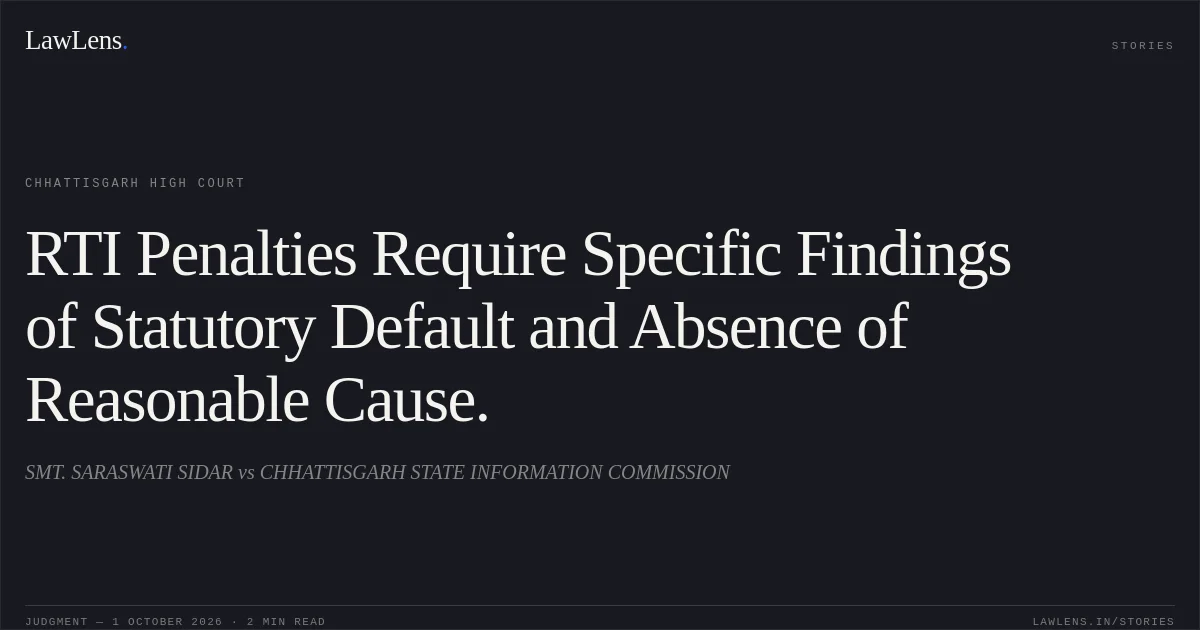
Respondent No. 4 sought certified copies of the cash book concerning a Gram Panchayat Sarpanch’s income and expenditure, from the date of his posting until the date of the RTI application.
Source reference: para. 2The petitioner, then the Public Information Officer (PIO), responded within the prescribed period that the request should specify the relevant financial year and subject matter.
Source reference: para. 11The First Appellate Authority upheld that response and directed respondent No. 4 to submit a clear and specific application.
Source reference: para. 11In the ensuing second appeal, the State Information Commission imposed a penalty of ₹25,000 on the petitioner under Section 20(1) of the Right to Information Act, 2005.
Source reference: paras. 12, 19The petitioner challenged the penalty by writ petition.
Source reference: no citationIssues
Whether the State Information Commission could impose the maximum penalty under Section 20(1) of the RTI Act when the PIO had responded to the original application within the prescribed period and the Commission had not recorded the requisite statutory findings.
Source reference: paras. 13, 19–20Whether dissatisfaction with the manner in which an RTI application was handled, without a finding of a statutory default and absence of reasonable cause, was sufficient to impose a penalty under Section 20(1).
Source reference: paras. 20–22Law Applied
Section 20(1) of the RTI Act authorises a penalty when a PIO commits a specified default, including failure to furnish information without reasonable cause or mala fide denial of a request; the Commission must consider the PIO’s explanation and the circumstances of the alleged default.
Source reference: paras. 14, 20In Manohar S/o Manikrao Anchule v. State of Maharashtra, (2012) 13 SCC 14, the Supreme Court held that penalty provisions carrying civil consequences must be construed strictly and applied consistently with natural justice.
Source reference: paras. 15–16Nitin Singhvi v. Chhattisgarh State Information Commission, 2023 SCC OnLine Chh 6061, and T.A. Khan v. State of Chhattisgarh, 2026 SCC OnLine Chh 8128, reiterate that penalty is not automatic: the Commission must record a clear finding of the relevant statutory default and lack of reasonable cause; negligence or delay alone is insufficient.
Source reference: paras. 16–17, 22Reasoning
The petitioner had replied to the RTI application within the prescribed period and explained why she considered the request insufficiently specific; the First Appellate Authority also directed the applicant to submit a clearer application.
Source reference: paras. 11, 18The Commission’s order did not categorically find that the petitioner had deliberately or mala fide denied information, knowingly supplied incorrect or misleading information, obstructed its supply, or failed to act without reasonable cause.
Source reference: paras. 19–20Applying the strict approach required by Manohar and the principles in Nitin Singhvi and T.A. Khan, the Court held that dissatisfaction with the PIO’s handling of the request, without the necessary statutory findings, could not sustain the maximum penalty.
Source reference: paras. 21–22Holding
The Court held that the penalty of ₹25,000 was unsustainable and quashed and set aside the impugned order insofar as it imposed that penalty.
The penalty was annulled, and no recovery was to be made pursuant to it.
Source reference: para. 24The Court clarified that it had examined only the legality of the penal action; the writ petition was allowed, with no order as to costs.
Source reference: para. 25Acts & Sections Cited
3 provisions across 1 statute referred to in this judgment. Each provision opens on LawLens.
Right to Information Act, 20053
Original Court PDF
SMT. SARASWATI SIDARvsCHHATTISGARH STATE INFORMATION COMMISSION
Click to open original judgment
Original judgment, available to read, download and summarize on LawLens.in