Facts
The petitioner, Secretary of Gram Panchayat Sarvani, challenged an order dated 3 January 2024 passed by the Chhattisgarh State Information Commission imposing a penalty upon him under Section 20(1) of the Right to Information Act, 2005 (“RTI Act”).
Source reference: para. 1He contended that the Commission had imposed the penalty without recording a categorical finding that the failure to provide information was deliberate, conscious, and mala fide, as required by the statutory scheme.
Source reference: para. 2The State Information Commission argued that the petitioner’s conduct demonstrated a deliberate and conscious failure to supply the requested documents and that mala fide intent could be inferred from the record, even in the absence of a formal finding.
Source reference: para. 3Issues
Whether a penalty under Section 20(1) of the RTI Act can be imposed without the State Information Commission recording a categorical finding, supported by reasons, that the Public Information Officer deliberately and mala fide withheld or delayed the information.
Source reference: paras. 2, 5–7Whether the penalty imposed upon the petitioner by the Commission was legally sustainable in the absence of such an explicit finding.
Source reference: paras. 7–8Law Applied
The Court applied Section 20(1) of the Right to Information Act, 2005, holding that the imposition of penalty or recommendation of disciplinary action requires a categorical and reasoned finding that the failure to provide information resulted from the deliberate and mala fide conduct of the Public Information Officer.
Source reference: para. 5Mere presumption or inference by the State Information Commission, without a recorded finding supported by cogent reasons, cannot satisfy the statutory precondition for penalty.
Source reference: para. 6The Court also relied upon the principles stated in the Division Bench judgment dated 12 June 2023 in W.A. No. 215 of 2020 and the order dated 10 August 2026 in W.P.C. No. 5304 of 2026, as cited by the petitioner.
Source reference: para. 2Reasoning
The Court found that the Commission’s order did not record reasons or a specific finding establishing that the information had been withheld because of the petitioner’s mala fide intent, deliberate delay, or ill motive.
Source reference: para. 7It rejected the argument that such intent could merely be inferred from the record, emphasizing that where the statute prescribes a condition for imposing penalty, that condition must be expressly addressed and supported by reasons in the order itself.
Source reference: para. 6Since the necessary finding was absent, the penalty could not be sustained in law.
Source reference: paras. 5–8Holding
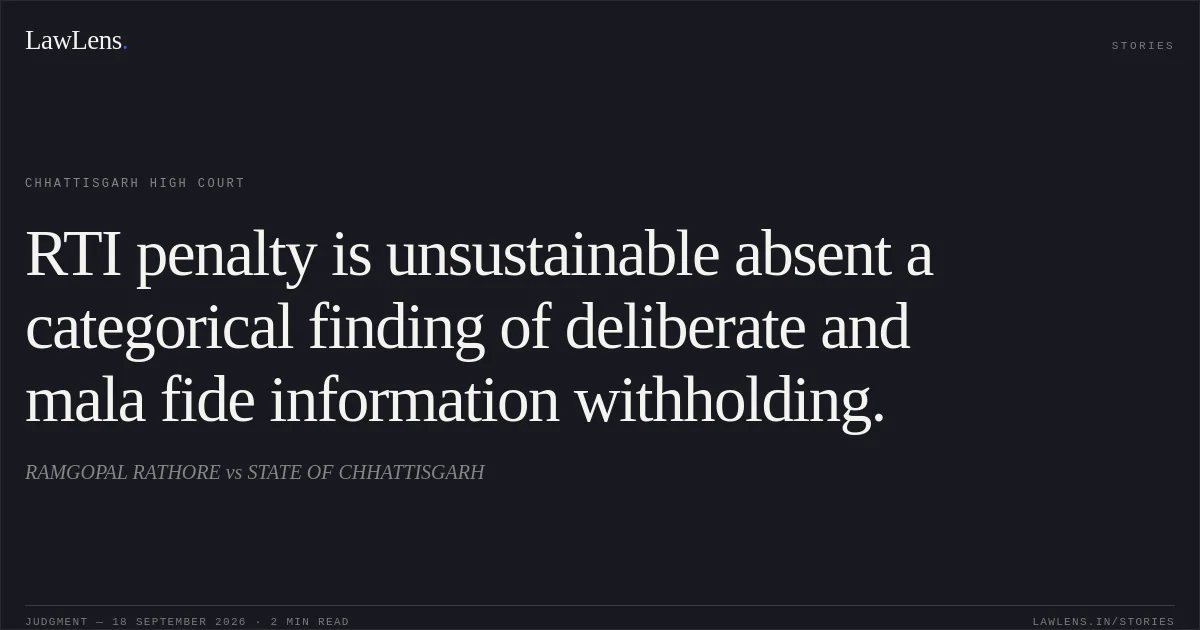
The Court held that the penalty imposed under Section 20(1) of the RTI Act was unsustainable because the State Information Commission had failed to record a categorical, reasoned finding of deliberate and mala fide withholding or delay of information.
Accordingly, the order dated 3 January 2024 was set aside to the extent that it imposed penalty upon the petitioner, and the writ petition was finally disposed of.
Source reference: paras. 8–9Acts & Sections Cited
1 provisions across 1 statute referred to in this judgment. Each provision opens on LawLens.
Right to Information Act, 20051
Original Court PDF
RAMGOPAL RATHOREvsSTATE OF CHHATTISGARH
Click to open original judgment
Original judgment, available to read, download and summarize on LawLens.in