Facts
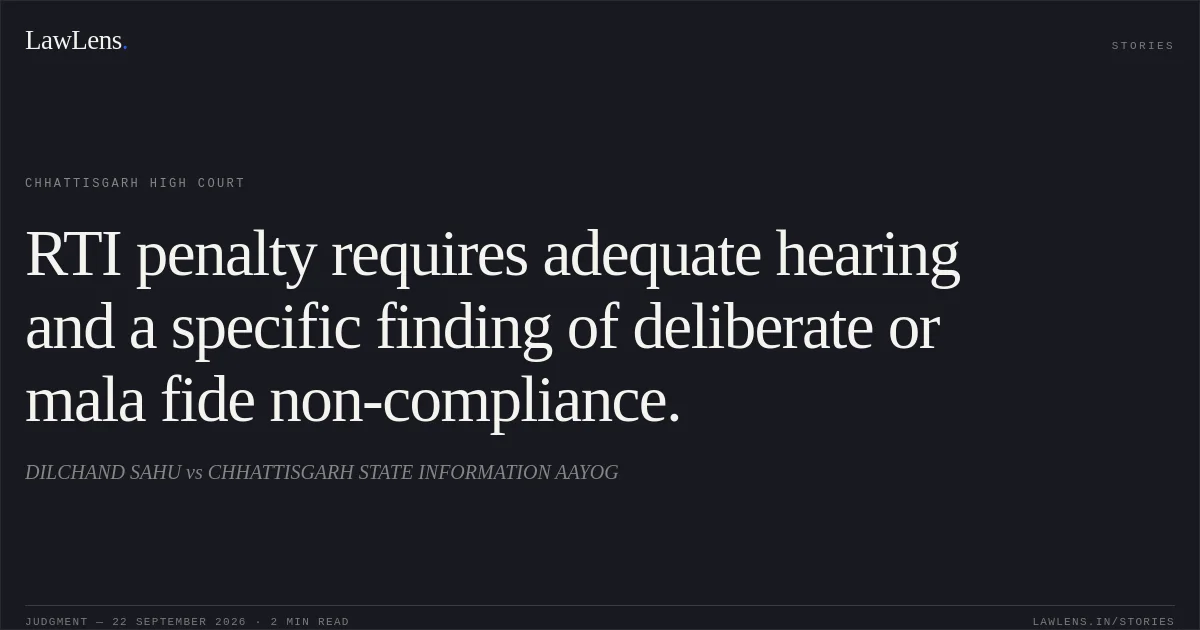
The petitioner, who had served as the Public Information Officer of Gram Panchayat Jervey, challenged the order dated 8 September 2023 passed by the Chhattisgarh State Information Commission imposing a penalty of ₹25,000 under Section 20(1) of the Right to Information Act, 2005.
Source reference: para. 1–2The petitioner contended that the information sought under the RTI application had subsequently been supplied and that the Commission had imposed the penalty without recording a specific finding that the delay or non-supply was deliberate or mala fide.
Source reference: para. 1–2The information seeker supported the petitioner’s submission that the requested information had been supplied.
Source reference: para. 2, 4The State Information Commission defended the penalty on the ground that the petitioner had failed to furnish the information within the period directed by the First Appellate Authority.
Source reference: para. 3Issues
Whether the State Information Commission could impose the maximum penalty under Section 20(1) of the RTI Act without recording a specific finding that the PIO’s failure was deliberate, mala fide, or without reasonable cause?
Source reference: para. 6–8Whether the penalty order was vitiated for failure to provide the PIO an adequate and legally compliant opportunity of hearing before imposing the penalty?
Source reference: para. 8Whether the subsequent furnishing of the information justified interference with the penalty order?
Source reference: para. 2, 4, 7–9Law Applied
The Court applied Section 20(1) of the Right to Information Act, 2005, which permits imposition of a penalty of ₹250 per day, subject to a maximum of ₹25,000, only where the Information Commission is satisfied that the PIO, without reasonable cause, failed to furnish information within the statutory period, knowingly furnished incorrect or incomplete information, or otherwise obstructed the supply of information; the burden of proving reasonable and diligent conduct lies on the PIO.
Source reference: para. 6The Court further held that the PIO must be afforded an adequate opportunity of hearing before penalty is imposed.
Source reference: para. 8It relied on Manohar S/o Manikrao Anchule v. State of Maharashtra & Another, (2012) 13 SCC 14, concerning the requirement of compliance with the statutory conditions governing imposition of penalty under Section 20(1).
Source reference: para. 8Reasoning
The Court found that the impugned order did not contain any specific finding that the petitioner had deliberately or mala fide failed to furnish the information within time.
Source reference: para. 7The mere fact that the First Appellate Authority had directed production of the information and that it was not supplied within the stipulated period was insufficient, by itself, to establish the statutory conditions for penalty under Section 20(1).
Source reference: para. 3, 6–8The Court also held that treating an earlier notice as the “final notice” under Section 20(1) did not satisfy the requirement of granting an adequate opportunity of hearing before imposing the penalty.
Source reference: para. 8Since the information had ultimately been supplied and the Commission had neither established deliberate or mala fide conduct nor followed the prescribed procedural safeguards, the penalty order could not be sustained.
Source reference: para. 7–8Holding
The Court answered the issues in favour of the petitioner and held that the penalty of ₹25,000 was imposed contrary to Section 20(1) of the RTI Act.
The Court accordingly allowed the writ petition and set aside the State Information Commission’s order dated 8 September 2023.
Source reference: para. 9Acts & Sections Cited
2 provisions across 1 statute referred to in this judgment. Each provision opens on LawLens.
Right to Information Act, 20052
Original Court PDF
DILCHAND SAHUvsCHHATTISGARH STATE INFORMATION AAYOG
Click to open original judgment
Original judgment, available to read, download and summarize on LawLens.in