01Facts
The petitioner was appointed as Second Division Assistant (SDA), a Clerk-cum-Typist post, in Methodist Co-Ed. High School, Raichur, on 07.12.1998 by the management (Respondents 5 and 6) following a vacancy caused by retirement in 1994.
¶ 5The petitioner topped the merit list.
¶ 5The management forwarded her appointment to the Department for grant-in-aid approval on 21.09.1998.
¶ 5Respondent No. 4 issued an endorsement dated 05.07.1998 stating that the management should review the proposal before forwarding it.
¶ 5Successive proposals were forwarded, including on 09.09.2005, and the authorities returned them on 14.10.2005, 25.10.2012, and 24.06.2017 on grounds including lack of prior government approval, absence of a departmental representative during selection, and a State ban on filling grant-in-aid posts.
¶ 6, 8, 9The petitioner challenged the endorsement dated 22.05.2017 (Annexure-Q), which forwarded the proposal from Respondent No. 4 to Respondent No. 3, and sought quashing of that endorsement and mandamus to include her under grant-in-aid from 07.12.1998.
¶ 1, 6, 7The State contended that the appointment was illegal, relying on the 1999 Recruitment Rules and on State of Odisha v. Sulekh Chandra Pradhan and Kolawana Gram Vikas Kendra.
¶ 3The petitioner relied on Smt. Bibi Fatima (WP No. 83170/2011, decided 11.12.2012), a similarly placed case.
¶ 2, 1102Issues
i.1. Whether the appointment of the petitioner, made without prior government approval and without a departmental representative on the selection panel, is illegal or void ab initio.
¶ 3, 8, 9, 10ii.2. Whether the 1999 Recruitment Rules apply to an appointment made before those Rules came into force.
¶ 9iii.3. Whether the impugned endorsement dated 22.05.2017 is liable to be quashed when it merely forwards a proposal favourable to the petitioner.
¶ 7iv.4. Whether the petitioner is entitled to mandamus for inclusion under grant-in-aid from the date of her initial appointment, 07.12.1998, and, if so, what directions should issue.
¶ 7, 11, 1203Law Applied
The Karnataka Educational Institutions (Recruitment and Terms and Conditions of Service of Employees in Private Aided Primary and Secondary Educational Institutions) Rules, 1999, invoked by the State to justify the returns, were held not to be in force when the petitioner was appointed and therefore had no bearing on her appointment.
¶ 8, 9The Grant-in-Aid Code of Karnataka, 1967, under which the appointment was held to be made in consonance with the rules.
¶ 10State of Odisha v. Sulekh Chandra Pradhan, (2022) 7 SCC 482, paras. 31–34, for the principle that appointments made contrary to rules are void ab initio, held inapplicable because the appointment conformed to the governing rules.
¶ 10Smt. Bibi Fathima (WP No. 83170/2011): where a vacancy in a salary-grant post arose through a vacancy and the post is admittedly grant-in-aid, the proposal must be reconsidered by the authorities.
¶ 2, 11Kolawana Gram Vikas Kendra v. State of Gujarat, (2010) 1 SCC 133, relied on by the State, was recorded but not discussed in the reasoning.
¶ 3Mandamus may issue to compel statutory authorities to consider a pending proposal in accordance with law.
¶ 1204Reasoning
The official respondents changed their stand at each stage, from the 1998 endorsement to the 2017 objections, and had dodged the process of approval.
¶ 9Since the 1999 Rules post-dated the 1998 appointment, the grounds for return based on them were irrelevant.
¶ 9The post was admittedly a grant-in-aid post that fell vacant on retirement, the petitioner was selected on merit after a notified process, and the management then forwarded her case for approval.
¶ 9Denying approval at this stage, after 18 years, would be a travesty of justice.
¶ 9Because the appointment was consistent with the 1967 Code, Sulekh Chandra Pradhan did not apply.
¶ 10The petitioner's case was materially identical to Bibi Fathima, which concerned a salary-grant vacancy, and the proposal therefore required reconsideration.
¶ 11The endorsement dated 22.05.2017 was a proposal favourable to the petitioner, and it was unclear why she sought its quashing.
¶ 705Holding
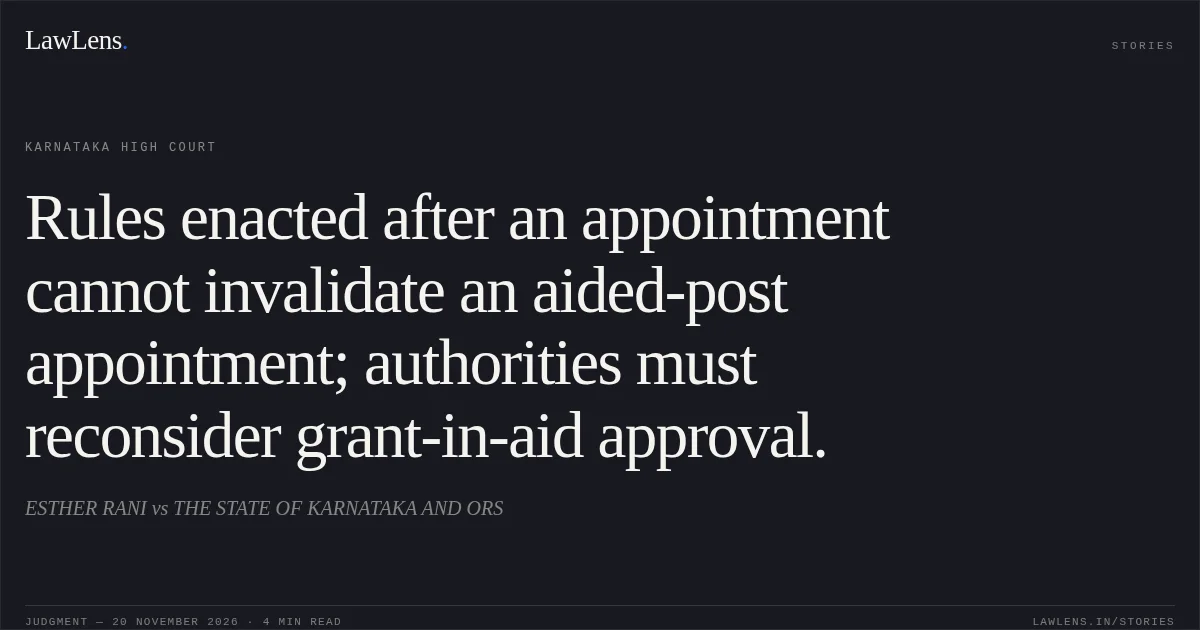
The appointment of the petitioner was not contrary to the applicable rules and was against an admitted grant-in-aid vacancy, so the 1999 Rules and the prior-approval objection could not defeat her claim.
¶ 9, 10, 11The prayer to quash the endorsement dated 22.05.2017 and the prayer for inclusion from 07.12.1998 were not expressly granted.
¶ 7, 12The petition is allowed in part. A writ of mandamus issues directing Respondent Nos. 2 to 4 to consider the petitioner's proposal for appointment under grant-in-aid in accordance with law within three months of receipt of the order.
¶ 11, 12If the proposal is returned, the management (Respondents 5 and 6) must resubmit it with the necessary documents, and Respondents 2 to 4 must reconsider it. No order as to costs.
¶ 11, 12Original Court PDF
ESTHER RANIvsTHE STATE OF KARNATAKA AND ORS
Click to open original judgment
Original judgment, available to read, download and summarize on LawLens.in