Facts
The respondents/plaintiffs, legal heirs of B. Suresh, claimed refund of an advance paid under a registered agreement of sale dated 29.09.2004.
Source reference: p.7, para.12Under the agreement, the sale consideration was ₹2,25,000, of which ₹2,00,000 was paid in advance, and the balance of ₹25,000 was to be paid within one year.
Source reference: p.7, para.12At the time of the agreement, the first defendant was only an allottee of the Tamil Nadu Housing Board property.
Source reference: p.7, para.12The Housing Board executed a sale deed in her favour on 30.06.2014, subject to a three-year restriction against alienation.
Source reference: pp.7–8, paras.12–13The plaintiffs alleged that B. Suresh remained ready and willing to complete the transaction, but the defendants postponed execution of the sale deed.
Source reference: pp.8–9, paras.13–14Suresh died on 12.08.2019.
Source reference: pp.8–9, paras.13–14After the first defendant sought removal of the registered sale agreement from the encumbrance records on 05.04.2023, the plaintiffs issued a reply on 29.04.2023, waiving specific performance and seeking refund of ₹2,00,000 with interest.
Source reference: pp.8–9, paras.13–14The suit, O.S. No.384 of 2023, was filed for recovery of ₹6,53,465.
Source reference: no citationThe defendants filed I.A. No.3 of 2024 under Order VII Rule 11(d) CPC for rejection of the plaint as barred by limitation.
Source reference: p.10, para.17The Trial Court dismissed the application, holding that limitation involved a mixed question of law and fact requiring trial.
Source reference: p.10, para.17The defendants therefore filed the present revision under Article 227 of the Constitution.
Source reference: no citationIssues
Whether a suit seeking refund of advance paid under an uncompleted agreement of sale is governed by Article 62 of the Limitation Act, 1963, on the basis of an alleged statutory charge under Section 55(6)(b) of the Transfer of Property Act, 1882, or by the residuary Article 113?
Source reference: pp.11–14, paras.18–22Whether the plaint, on its own averments and documents, disclosed that the suit was barred by limitation and was therefore liable to be rejected under Order VII Rule 11(d) CPC?
Source reference: pp.11–12, 14–16, paras.18, 22–24Whether the three-year restriction on alienation ending on 29.06.2017 postponed the accrual of the plaintiffs’ claim, and if so, whether the suit filed in 2023 was nevertheless time-barred?
Source reference: pp.12–15, paras.20, 23Law Applied
The Court applied Order VII Rule 11(d) CPC, under which a plaint must be rejected when the suit appears from the plaint and its documents to be barred by law.
Source reference: pp.10–14, paras.17, 21–22Section 55(6)(b) of the Transfer of Property Act, 1882 grants a buyer a charge over the property for purchase money paid in anticipation of delivery, provided the statutory conditions are satisfied; the Court held that this statutory charge arises in the context of a completed sale transaction and is not created merely by an unperformed agreement of sale.
Source reference: pp.10–14, paras.17, 21–22Article 62 of the Limitation Act, 1963, prescribing twelve years for enforcing money secured by a mortgage or otherwise charged upon immovable property, was therefore held inapplicable to a simple refund claim under an agreement of sale.
Source reference: pp.11–15, paras.17–23In the absence of a specific limitation provision, Article 113 applies, prescribing three years from when the right to sue accrues.
Source reference: pp.11–15, paras.17–23Reasoning
The Court found that the plaintiffs’ own pleadings established that the agreement of sale had never culminated in a sale deed and that the plaintiffs had expressly abandoned specific performance in favour of refund.
Source reference: pp.8–9, 12–13, paras.14, 19–20Consequently, the plaintiffs could not invoke Section 55(6)(b) or the twelve-year period under Article 62.
Source reference: pp.8–9, 12–13, paras.14, 19–20Although the first defendant could not alienate the property during the three-year restriction following the Housing Board sale deed, that restriction ended on 29.06.2017; from 30.06.2017, there was no pleaded legal impediment to performance or to seeking refund.
Source reference: pp.12–15, paras.20, 23Applying Article 113, the suit ought to have been filed by 29.06.2020.
Source reference: pp.14–16, paras.23–24The first defendant’s representation to the Sub-Registrar in April 2023 did not create a fresh cause of action or revive an already time-barred claim.
Source reference: pp.14–16, paras.23–24Since all material dates appeared from the plaint and plaint documents, limitation was not a mixed question requiring trial, and rejection under Order VII Rule 11(d) CPC was justified.
Source reference: pp.14–16, paras.23–24Holding
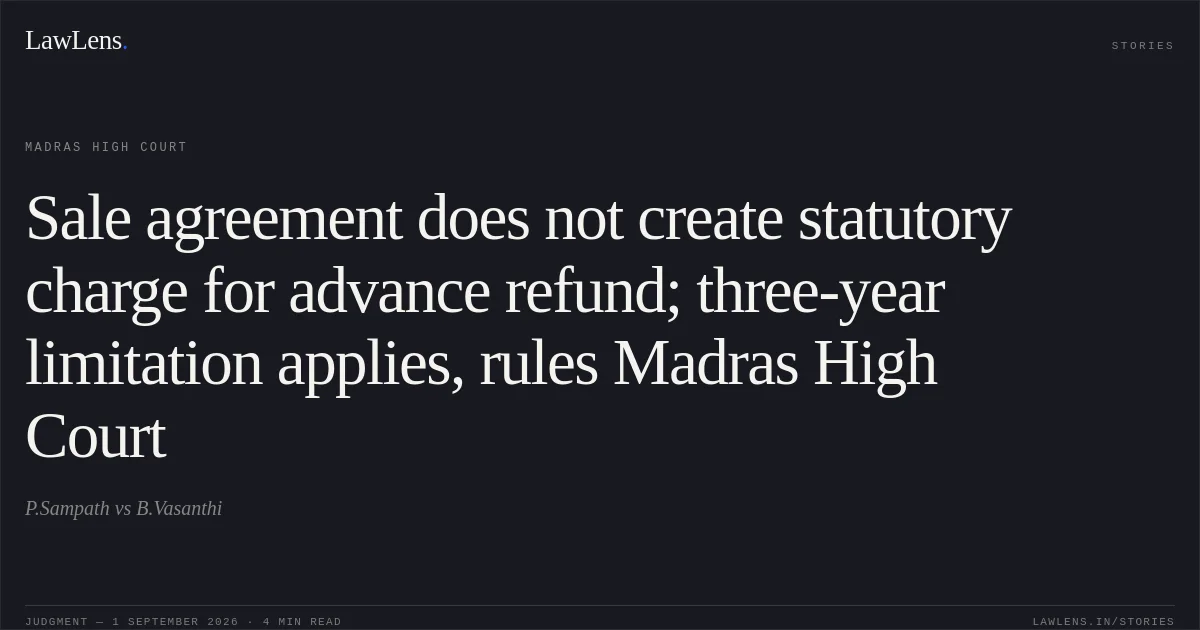
The High Court held that an uncompleted agreement of sale does not, by itself, create a statutory charge under Section 55(6)(b) of the Transfer of Property Act.
A suit for refund of advance in such circumstances is governed by Article 113 of the Limitation Act and must be filed within three years from accrual of the right to sue.
Source reference: p.16, para.25The suit filed in 2023, although the relevant period commenced no later than 30.06.2017, was barred by limitation.
Source reference: p.16, para.25The revision petition was allowed; the Trial Court’s order dismissing I.A. No.3 of 2024 was set aside, and O.S. No.384 of 2023 was rejected under Order VII Rule 11(d) CPC.
Source reference: p.16, para.25No costs were imposed, and the connected miscellaneous petitions were closed.
Source reference: p.16, para.25Acts & Sections Cited
54 provisions across 3 statutes referred to in this judgment. Each provision opens on LawLens.
Specific Relief Act, 19631
Transfer of Property Act, 18821
Limitation Act, 1963
Original Court PDF
P.SampathvsB.Vasanthi
Click to open original judgment
Original judgment, available to read, download and summarize on LawLens.in