Facts
Krishan Kumar, aged approximately 17 years, died in a motor-vehicle accident on 19 September 1997 due to the rash and negligent driving of van-bus No. DL-IV/9072.
Source reference: pp.1–3The vehicle had been insured by respondent No.3 in the name of respondent No.4, its registered owner, who had allegedly sold it to respondent No.1, Vishwas Sharda Shikshan Samiti, without notifying the insurer or obtaining transfer of the registration and insurance policy.
Source reference: pp.3–4The Motor Accident Claims Tribunal, Hisar, awarded Rs.1,50,000 to the deceased’s parents with interest at 12% per annum, but held the purchaser and driver liable and directed the insurer to pay the amount with a right of recovery, effectively exonerating the insurer from indemnifying the purchaser.
Source reference: pp.2–4The appeal challenged the finding on insurance liability. During the appeal, the parents also contended that the compensation was inadequate, although they had filed no separate appeal or cross-objections.
Source reference: pp.4–6Issues
1. Whether the insurer could be exonerated from liability towards third-party claims merely because the insured vehicle had been sold and the transfer was not intimated to, or endorsed by, the insurer.
Source reference: pp.6–7; para. 92. Whether the appellate court could enhance compensation in an appeal filed by the owner and driver, despite the claimants having filed no appeal or cross-objections.
Source reference: pp.7–8; para. 103. Whether the compensation awarded for the death of the 17-year-old deceased was required to be reassessed by applying minimum income, future prospects, deduction for personal expenses, the appropriate multiplier, and conventional heads of compensation.
Source reference: pp.8–12; paras. 11–18Law Applied
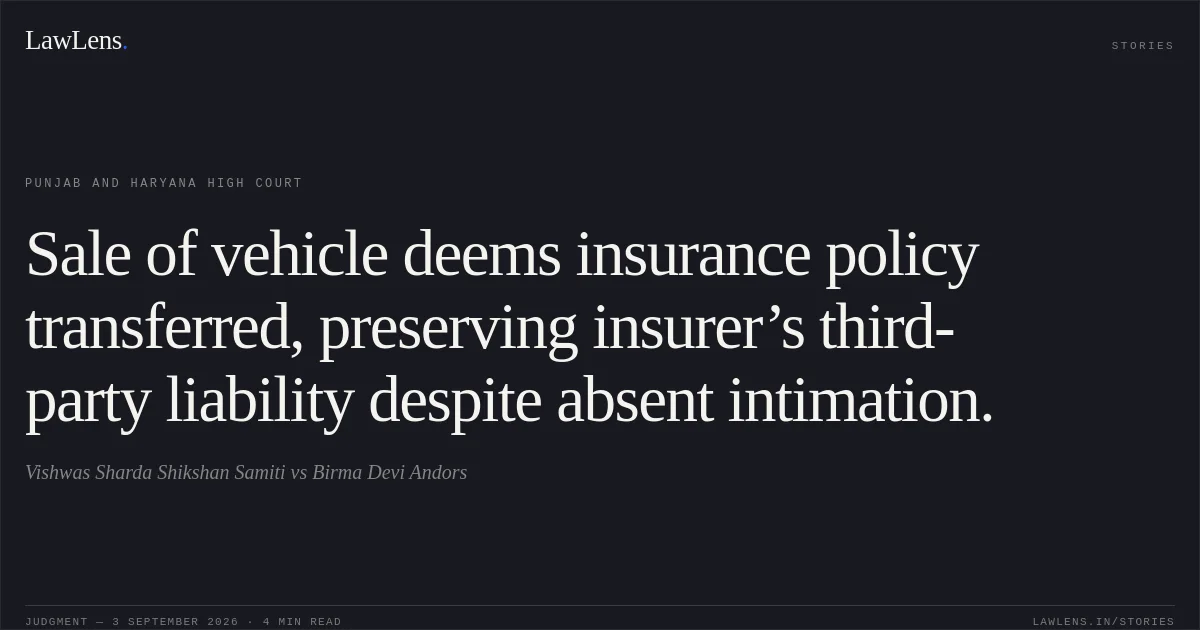
The court applied Sections 166 and 157 of the Motor Vehicles Act, 1988. Section 157 embodies the principle that, upon transfer of a motor vehicle, the insurance policy is deemed to have been transferred to the purchaser, particularly for protection against third-party risks; failure to intimate the insurer does not defeat such third-party coverage.
Source reference: pp.6–7; para. 9Relying on Mallamma (Dead) by LRs v. National Insurance Co. Ltd., C. Govindan v. New India Assurance Co. Ltd., Complete Insulations (P) Ltd. v. New India Assurance Co. Ltd., and Jaibir Singh v. The New India Assurance Co. Ltd., the court held that the insurer’s liability towards third parties continues notwithstanding non-intimation of the sale.
Source reference: pp.4, 6–7Under Order XLI Rule 33 CPC and the principle stated in Surekha v. Santosh, an appellate court may award just compensation even without a claimant’s cross-appeal or cross-objections.
Source reference: pp.7–8; para. 10For quantification, the court applied Sarla Verma v. Delhi Transport Corporation on deduction and multiplier, National Insurance Co. Ltd. v. Pranay Sethi on future prospects and conventional heads, and Karuna Parmar v. Prakash Sinha and Baby Sakshi Greola v. Manzoor Ahmad Simon on assessing income by reference to minimum wages.
Source reference: pp.8–11; paras. 11–17Reasoning
Since the vehicle was insured on the date of the accident and respondent No.4 remained its registered owner, the court held that the insurer could not avoid third-party liability merely because the vehicle had been sold to respondent No.1 and the transfer had not been reported. Section 157 operated to deem transfer of the policy along with the vehicle, preserving third-party protection.
Source reference: pp.6–7; para. 9The court further held that its statutory obligation was to award just compensation and that the absence of a claimant’s appeal did not prevent reassessment or enhancement under Order XLI Rule 33 CPC.
Source reference: pp.7–8; para. 10Although the Tribunal had awarded a lump sum of Rs.1,50,000, the court assessed the deceased’s monthly income at Rs.2,000, treated him as a 17-year-old, added 40% towards future prospects, deducted 50% for personal expenses as he was unmarried, and applied multiplier 18.
Source reference: pp.9–12; paras. 12–18This produced a loss of dependency of Rs.3,02,400. It additionally awarded Rs.40,000 towards filial consortium to both parents and Rs.15,000 towards loss of estate and funeral expenses, arriving at Rs.3,57,400, rounded to Rs.3,57,000.
Source reference: pp.9–12; paras. 12–18Holding
The court reversed the Tribunal’s finding exonerating the insurer and held that the driver, owner/purchaser, registered owner and insurer were jointly and severally liable for the third-party compensation.
The total compensation was enhanced to Rs.3,57,000, payable equally to the deceased’s parents, with interest at 9% per annum from 18 November 1997, the date of filing of the claim petition, until realization.
Source reference: pp.12–13; para. 19The judgment records the enhanced amount as Rs.2,07,400 over and above the Tribunal’s award, although the rounded total of Rs.3,57,000 mathematically represents an enhancement of Rs.2,07,000.
Source reference: pp.12–13; para. 19The appeal was allowed to that extent, and the insurer was directed to comply with the applicable Supreme Court directions concerning transmission and enforcement of the judgment.
Source reference: p.13; paras. 18–19Acts & Sections Cited
2 provisions across 1 statute referred to in this judgment. Each provision opens on LawLens.
Motor Vehicles Act, 19882
Original Court PDF
Vishwas Sharda Shikshan SamitivsBirma Devi Andors
Click to open original judgment
Original judgment, available to read, download and summarize on LawLens.in