01Facts
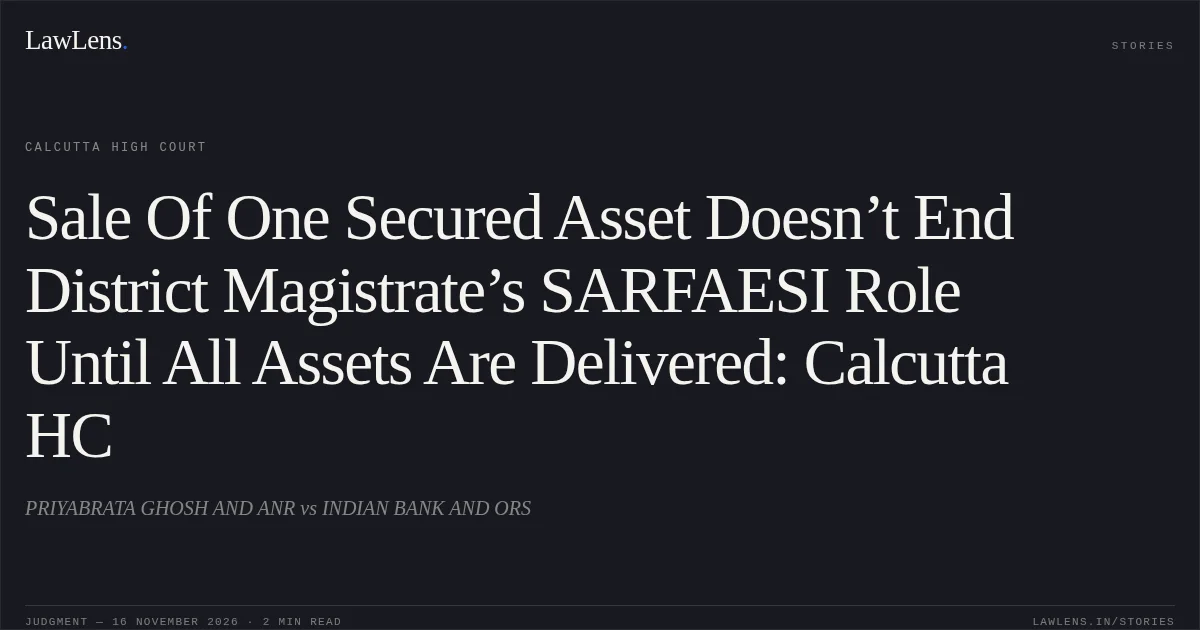
Indian Bank extended credit facilities to M/s Rina Textiles, a proprietorship of the appellant’s wife. The loan was secured by a mortgage over 0.005 acres of land and a showroom known as “Discovery”, part of property owned by the appellant’s late father. The appellant was a guarantor.
¶ 12–14After default, the Bank initiated measures under the SARFAESI Act, obtained an order under Section 14 for possession, and sold the secured asset by auction on the basis of symbolic possession.
¶ 16, 18The appellant’s brother had filed a partition suit in which the civil court directed the parties to maintain status quo regarding the property; the appellant contended that the order remained in force.
¶ 5, 13In an earlier appeal, a Division Bench recorded that the Bank’s claim and recovery steps were confined to the mortgaged 0.005 acres and showroom, and permitted it to proceed with sale formalities.
¶ 19–22The appellant then challenged an Advocate Commissioner’s notice requiring the occupants to vacate so that physical possession could be taken. The writ petition was dismissed, and the appellant appealed.
¶ 1–2, 1102Issues
i.1. Whether the subsisting civil-court status quo order and the pending partition suit barred the Bank from taking physical possession of the secured asset under Section 14 of the SARFAESI Act.
¶ 3–6, 13–15ii.2. Whether the Advocate Commissioner’s notice exceeded the property covered by the mortgage and the earlier Division Bench’s directions.
¶ 11, 19–22iii.3. Whether the appellant’s challenge was maintainable under Article 226 when the SARFAESI Act provided a remedy under Section 17.
¶ 15, 23–2503Law Applied
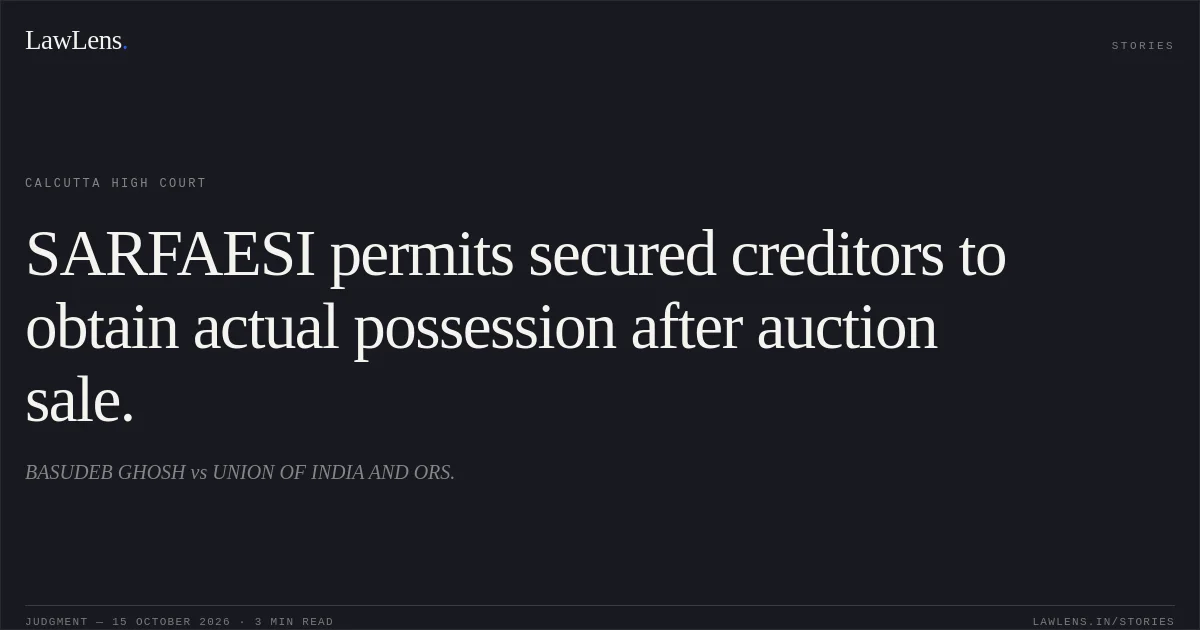
Sections 13(4) and 14 of the SARFAESI Act permit a secured creditor to pursue possession measures against secured assets; the creditor may seek actual possession even after a sale based on symbolic possession (ITC Ltd. v. Blue Coast Hotels Ltd., (2018) 15 SCC 99, paras. 8, 14; R.D. Jain & Co. v. Capital First Ltd., (2023) 1 SCC 675, para. 24).
¶ 14, 24–25Section 35 gives the Act overriding effect over inconsistent laws, while Section 17 provides an efficacious remedy to any person aggrieved by measures taken under the Act; the expression “any person” includes a guarantor and other affected persons (United Bank of India v. Satyawati Tondon, (2010) 8 SCC 110, para. 23).
¶ 23–25The High Court ordinarily should not entertain an Article 226 petition where an effective statutory remedy is available.
¶ 23–25The Court also relied on Section 2(1)(f), which includes persons who give a guarantee or create a mortgage within the definition of “borrower,” and on the principle that heirs inherit mortgaged property subject to the encumbrance.
¶ 15–17, 23–25Provisions in the judgment · 10 · Linked ones open on LawLens
Securitisation and Reconstruction of Financial Assets and Enforcement of Security Interest Act, 2002 Section 2Section 13Section 14Section 17Section 18Section 34Section 35
Banking Regulation Act, 1949 Section 5
Transfer of Property Act, 1882 Section 8Section 55
04Reasoning
The Court held that the appellant and the other heirs could not defeat enforcement of the mortgage by relying on the partition suit or the status quo order: the heirs took the property subject to the mortgage, and the appellant, as guarantor, was also within the statutory definition of “borrower”.
¶ 15–17The earlier Division Bench had already confined the Bank’s action to the mortgaged 0.005 acres and showroom, and the challenged notice concerned that secured asset; the Court found no basis to conclude that the Bank was proceeding against excess property.
¶ 19–22, 25Applying ITC Ltd. and R.D. Jain, the Court concluded that the Bank could pursue actual possession to complete the transfer despite the prior auction sale on symbolic possession.
¶ 14, 24–25Any challenge to the Bank’s measures was to be pursued before the Tribunal under Section 17, rather than through a further writ petition.
¶ 23–2505Holding
The Court found no illegality in the Single Judge’s order and upheld the Bank’s right to proceed with physical possession of the secured asset, subject to the property description and limits already recorded by the Division Bench.
¶ 22, 25–26The appeal was dismissed with costs of ₹20,000, payable to the West Bengal State Legal Services Authority for the Juvenile Justice Committee fund.
¶ 27Original Court PDF
BASUDEB GHOSHvsUNION OF INDIA AND ORS.
Click to open original judgment
Original judgment, available to read, download and summarize on LawLens.in