Facts
The petitioner’s deceased husband, an Assistant Professor, obtained an SBI personal loan of ₹15 lakh on 3 November 2020.
Source reference: para. 3The petitioner was not a co-borrower, guarantor, surety, indemnifier, nominee, or signatory to the loan documents, and there was no privity of contract between her and SBI.
Source reference: para. 3The loan was allegedly covered by insurance for which the deceased had paid a premium.
Source reference: para. 3The deceased had also issued standing instructions authorising SBI to receive amounts payable towards provident fund, gratuity, pension, or similar service dues until liquidation of the loan.
Source reference: para. 4After the borrower died of Covid-19 on 6 May 2021, SBI demanded repayment from the petitioner and issued a legal notice dated 23 September 2025 threatening recovery proceedings.
Source reference: para. 5The Bank also placed her salary account on hold, which was subsequently removed after intervention by the RBI Ombudsman.
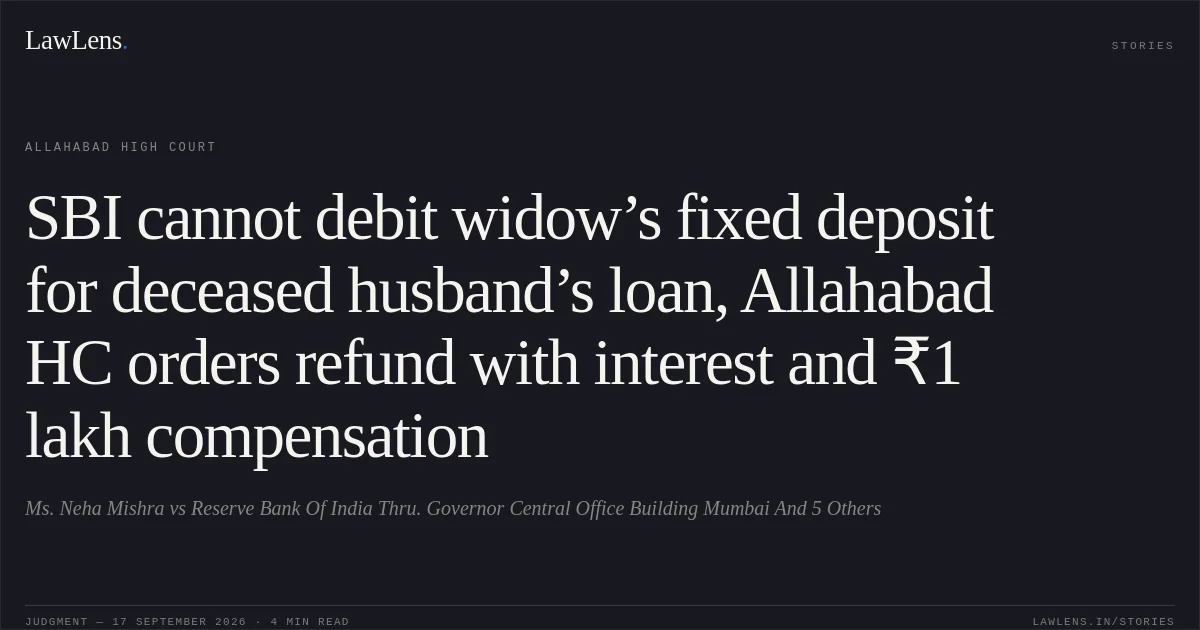
Source reference: para. 6Thereafter, SBI transferred the petitioner’s fixed-deposit account from Ashiyana Branch to Jankipuram Branch, appropriated ₹19,90,693 towards the deceased borrower’s loan liability, and transferred the account back to Ashiyana Branch.
Source reference: para. 7; p. 6The petitioner challenged the debit under Article 226 of the Constitution and sought refund of the amount, restoration of the fixed deposit with interest, settlement of the loan through the insurance cover, and compensation.
Source reference: paras. 8–11SBI relied on the deceased’s irrevocable standing instructions and contended that recovery from gratuity and other retiral benefits was legally permissible.
Source reference: paras. 8–11Issues
Whether SBI could unilaterally debit ₹19,90,693 from the petitioner’s fixed-deposit account towards the outstanding personal loan of her deceased husband, despite the petitioner having no contractual relationship with the Bank?
Source reference: paras. 12–15Whether the deceased borrower’s standing instruction authorising recovery from provident fund, gratuity, pension, or similar dues empowered SBI to appropriate funds standing in the petitioner’s independent account?
Source reference: paras. 4, 8–12Whether the petitioner was entitled to refund of the debited amount with applicable fixed-deposit interest and compensation for the Bank’s conduct?
Source reference: paras. 16–17Law Applied
The Court exercised jurisdiction under Article 226 of the Constitution to examine SBI’s allegedly arbitrary and unlawful action.
Source reference: para. 2It applied the principle that a bank cannot recover a borrower’s personal debt by unilaterally appropriating money from an independent account belonging to a third party with whom the bank has no privity of contract.
Source reference: paras. 12–15The Court relied on Section 60(1), proviso (g), of the Code of Civil Procedure, as discussed in Radhey Shyam Gupta v. Punjab National Bank, AIR 2009 SC 930, for the principle that pension, gratuity, provident fund, and similar retiral benefits retain their protected character even after payment to the beneficiary and cannot ordinarily be attached or appropriated.
Source reference: para. 9It also considered Arevarapu Indira v. Indian Overseas Bank, 2021 SCC OnLine AP 1004, and distinguished M/s Canara Bank v. Smt. Shantha Kumari, 2024 SCC OnLine Kar 21264, and State of Haryana v. K.N. Dutt, (1995) 3 SCC 144, because those cases concerned recovery or withholding of gratuity in materially different circumstances.
Source reference: paras. 9–12The Court further reiterated that recovery from a legal heir, if otherwise permissible, must be undertaken through due process of law and not by arbitrary or coercive self-help.
Source reference: para. 14Reasoning
The Court held that SBI’s reliance on the deceased borrower’s standing instruction was misplaced.
Source reference: paras. 4, 12–14The instruction related to amounts payable to the borrower towards provident fund, gratuity, pension, or similar service dues; it did not authorise SBI to debit an independent fixed deposit opened by the petitioner in her own name years after the borrower’s death.
Source reference: paras. 4, 12–14The petitioner was not a party to the loan transaction, and SBI could not establish any legal basis for treating her fixed deposit as security for her husband’s personal debt.
Source reference: para. 12The Bank’s conduct was particularly objectionable because it transferred the account to the branch from which the loan had been granted, appropriated the funds, and then transferred the account back, apparently to facilitate the debit surreptitiously.
Source reference: paras. 13, 15The Court distinguished the Bank’s precedents concerning recovery from an employee’s own gratuity because the present case involved appropriation from a third party’s account, not withholding or recovery from the borrower’s retiral benefits.
Source reference: para. 12The Court therefore found the debit arbitrary, contrary to banking practice, and an abuse of the Bank’s custodial relationship with the petitioner.
Source reference: para. 13Holding
The writ petition was allowed.
SBI was directed to immediately refund ₹19,90,693 debited from the petitioner’s account, together with interest at the fixed-deposit rate applicable to the petitioner’s deposit, within four weeks.
Source reference: para. 16The Court further directed SBI to pay the petitioner exemplary compensation of ₹1,00,000 within the same period for the Bank’s deplorable and surreptitious conduct.
Source reference: para. 17The Court thus held that SBI could not unilaterally appropriate the petitioner’s fixed-deposit funds towards her deceased husband’s loan liability in the absence of privity of contract or other lawful authority.
Source reference: paras. 12–18Acts & Sections Cited
1 provisions across 1 statute referred to in this judgment. Each provision opens on LawLens.
Code of Civil Procedure, 19081
Original Court PDF
Ms. Neha MishravsReserve Bank Of India Thru. Governor Central Office Building Mumbai And 5 Others
Click to open original judgment
Original judgment, available to read, download and summarize on LawLens.in