Facts
The Petitioner, a Constable (GD) in the Border Security Force (BSF), was charged with pointing his personal weapon at superior officers and using insubordinate/threatening language on 26.07.2021
Source reference: p. 2He was further charged with violating orders by using a mobile phone on duty and subsequently destroying it to eliminate evidence
Source reference: p. 2-3A Summary Security Force Court (SSFC) tried the Petitioner from 02.08.2021 to 04.08.2021, and he was dismissed from service after being found guilty
Source reference: p. 3The Petitioner’s Statutory Petition was dismissed on 26.10.2022
Source reference: p. 3The Petitioner challenged these orders under Article 226, alleging a violation of natural justice, claiming he was denied the opportunity to lead evidence or cross-examine witnesses
Source reference: p. 3Issues
1. Whether the SSFC trial proceedings were vitiated due to a violation of the principles of natural justice and denial of opportunity to defend
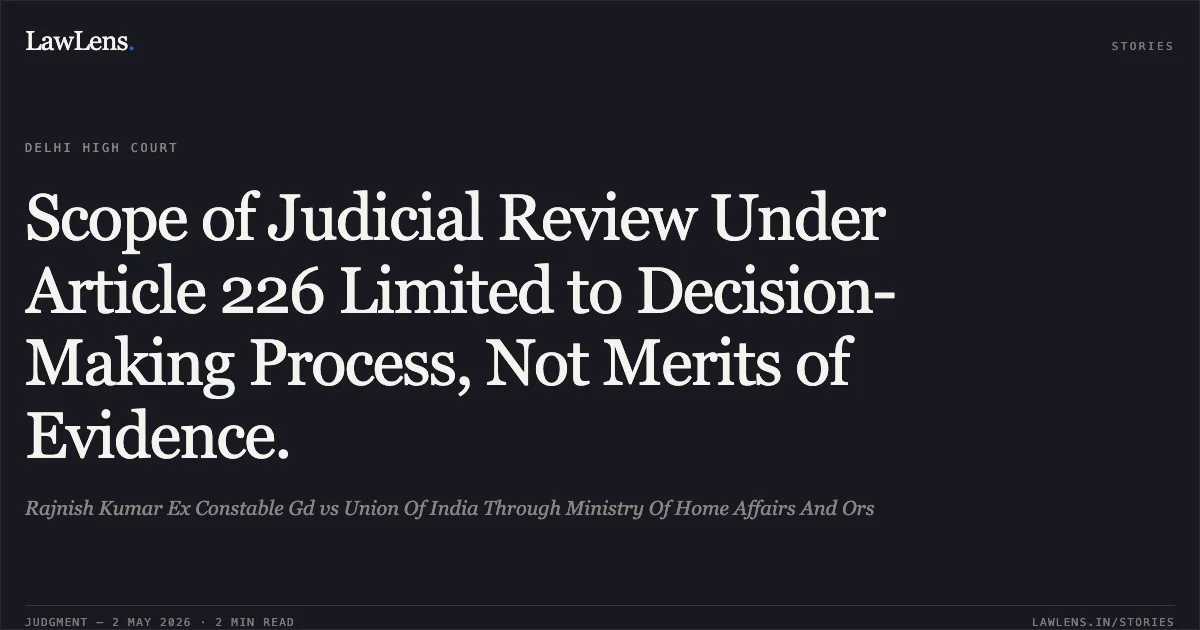
Source reference: p. 42. Whether the High Court, under Article 226, can reappreciate evidence or substitute factual findings made by the competent authorities
Source reference: p. 6Law Applied
The court applied Sections 20(b), 20(c), 22(a), and 40 of the BSF Act, 1968, regarding insubordination, neglect of orders, and conduct prejudicial to discipline
Source reference: p. 2-3Regarding the scope of judicial review, the court relied on the principle established in Syed Yakoob v. K.S. Radhakrishnan (1963), which mandates that writ jurisdiction is limited to the decision-making process and precludes the reappreciation of evidence or substitution of factual findings
Source reference: p. 6Reasoning
The Court scrutinized the original SSFC trial records, which contradicted the Petitioner’s claims. The records revealed that the Petitioner pleaded "not guilty," was present during the examination of six prosecution witnesses, and actively exercised his right to cross-examine them
Source reference: p. 5Furthermore, the record showed that the Petitioner was specifically asked if he wished to call defense witnesses but declined, choosing instead to submit a written statement
Source reference: p. 5The Court observed that the Petitioner had participated fully in the process, and the findings of the SSFC were backed by cogent factual evidence
Source reference: p. 6Consequently, since the decision-making process was procedurally sound and fair, the Court held there was no ground to interfere with the merits of the disciplinary action
Source reference: p. 6Holding
The Court held that the Petitioner was afforded a fair opportunity to defend himself and that the principles of natural justice were not violated
The Court dismissed the petition, affirming that it does not sit in appeal over the factual findings of the BSF authorities when the trial process is legally valid
Source reference: p. 6-7The dismissal from service stands.
Source reference: no citationActs & Sections Cited
3 provisions across 1 statute referred to in this judgment. Each provision opens on LawLens.
Border Security Force Act, 19683
Original Court PDF
Rajnish Kumar Ex Constable GdvsUnion Of India Through Ministry Of Home Affairs And Ors
Click to open original judgment
Original judgment, available to read, download and summarize on LawLens.in