01Facts
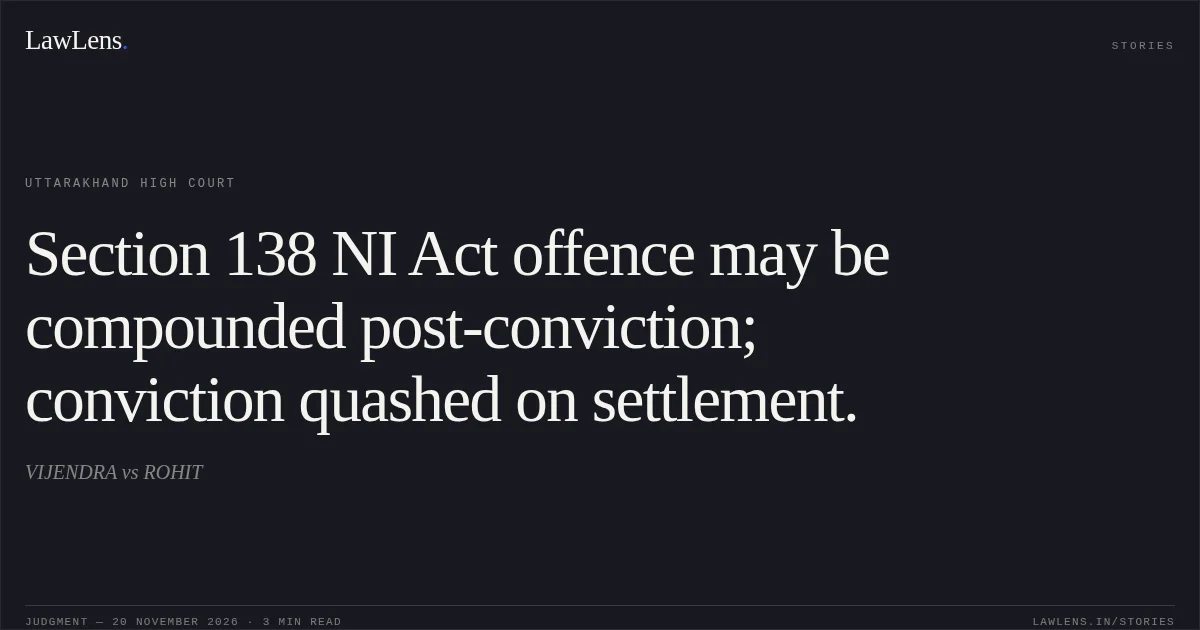
The respondent filed a complaint under Section 138 of the Negotiable Instruments Act, 1881 (NI Act), alleging that the applicant had borrowed money and issued a cheque for ₹9,00,000, which was dishonoured on presentation.
¶ 3The Judicial Magistrate, Kashipur, convicted the applicant on 29.03.2025 in Criminal Complaint Case No. 5040 of 2017, sentencing him to six months' simple imprisonment and a fine of ₹11,10,000, of which ₹11,00,000 was payable to the respondent, with additional imprisonment of one month in default.
¶ 3The applicant's appeal, Criminal Appeal No. 84 of 2025, was dismissed by the Additional Sessions Judge, Kashipur, on 08.10.2026.
¶ 3The parties then jointly filed a compounding application (I.A. No. 1 of 2026) seeking permission to compound the offence and quashing of both judgments.
¶ 2, 4Both parties appeared and were identified by counsel. The respondent filed an affidavit affirming that the dispute was amicably resolved.
¶ 5The respondent admitted receiving ₹8,50,000 from the applicant, stated that he did not wish to pursue the proceedings, and had no objection to the conviction and sentence being set aside.
¶ 7The learned State Counsel opposed the application.
¶ 802Issues
i.1. Whether the offence under Section 138 of the NI Act may be compounded at the High Court stage, on a joint application based on an out-of-court settlement, despite the State's opposition.
¶ 4, 8, 9ii.2. Whether the conviction, sentence, and consequential proceedings arising from the judgments dated 29.03.2025 and 08.10.2026 may be quashed on the basis of such compounding.
¶ 2, 7, 10iii.3. Whether the grant of relief should be made conditional on payment of costs, and on what terms.
¶ 1003Law Applied
Section 138 of the NI Act makes dishonour of a cheque for insufficiency of funds or exceeding arrangements a punishable offence.
¶ 3Section 147 of the NI Act provides that offences under Section 138 are compoundable notwithstanding anything contained in the Code of Criminal Procedure, 1973, and thereby permits compounding by agreement of the parties.
¶ 9A voluntary, uncoerced settlement between the complainant and accused, supported by the complainant's affidavit and consent, may justify compounding and quashing of the conviction.
¶ 5, 7, 9Provisions in the judgment · 2 · Linked ones open on LawLens
Negotiable Instruments Act, 1881 Section 138Section 147
04Reasoning
The Court first examined whether the compromise was genuine, recording the joint submission that all disputes had been settled.
¶ 6The Court relied on the respondent's acknowledgement of receiving ₹8,50,000 and on his affidavit supporting the compounding, and noted that both parties were personally present and identified by counsel.
¶ 5, 7On that basis, the Court found that the settlement was voluntary, amicable, and free from coercion or undue influence.
¶ 9Because Section 147 of the NI Act permits compounding of Section 138 offences, the Court held that the offences were compoundable and allowed the application over the State's objection.
¶ 8, 9Having compounded the offences, the Court quashed the consequential judgments of the trial court and the appellate court.
¶ 10The Court made the relief conditional on the applicant depositing ₹10,000 with the Advocates Welfare Fund of the High Court Bar Association within two weeks, failing which the order would be recalled and the benefit of compounding withheld.
¶ 1005Holding
The High Court held that the offences under Section 138 of the NI Act were compoundable under Section 147 and that the settlement between the parties was voluntary.
¶ 9The application was allowed, the offences were compounded, and the judgments dated 29.03.2025 (Magistrate) and 08.10.2026 (Sessions Court) were quashed.
¶ 9, 10Original Court PDF
VIJENDRAvsROHIT
Click to open original judgment
Original judgment, available to read, download and summarize on LawLens.in