Facts
The petitioner, Madhur Kaushal, was posted as a Junior Engineer/Inspector of Works with the Indian Railways at Jogighopa, Assam, and was responsible for supervising railway construction works and recording measurements relating to contracts executed by M/s ABCI Infrastructures Pvt. Ltd.
Source reference: p. 2–3The CBI alleged that he demanded and obtained an undue advantage of ₹10 lakhs from Pawan Baid, Director of the contractor-company, in connection with the recording of measurements and processing of bills. The amount was allegedly routed through the petitioner’s brother, Avdhesh Kumar Kaushal, after deduction of hawala commission.
Source reference: p. 2–3The CBI registered the case on 17 January 2021. The petitioner and his brother were arrested on 17 February 2021, and the prosecution relied upon the recovery of ₹4.40 lakhs, a deposit slip evidencing ₹4.90 lakhs, witness statements, and intercepted telephone conversations.
Source reference: p. 3The Trial Court rejected the petitioner’s discharge application by order dated 24 January 2026 and held that sufficient material existed to frame charges under Section 7 of the Prevention of Corruption Act, 1988 (“PC Act”) and Section 120B of the Indian Penal Code, 1860 (“IPC”) read with Sections 7, 8, 9 and 10 of the PC Act.
Source reference: p. 3–4Formal charges were framed on 13 February 2026.
Source reference: p. 4–6The petitioner challenged the order on charge and the framing of charges in the present revision petition under Sections 438 and 442 of the Bharatiya Nagarik Suraksha Sanhita, 2023, corresponding to Sections 397 and 401 of the Code of Criminal Procedure, 1973.
Source reference: p. 1Issues
Whether the investigation and consequent prosecution of the petitioner were barred or vitiated for want of prior approval under Section 17A of the PC Act?
Source reference: p. 6–10, 17–20Whether the CBI was required to register a fresh RC/FIR when the petitioner was implicated during investigation, rather than being named in the original RC?
Source reference: p. 7–8, 15–16, 20Whether the material on record disclosed a prima facie case or grave suspicion of demand, acceptance and receipt of illegal gratification sufficient to frame charges under Section 7 of the PC Act and Section 120B IPC read with Sections 7, 8, 9 and 10 of the PC Act?
Source reference: p. 9–14, 16–21Whether the alleged non-compliance with Rule 419A of the Indian Telegraph Rules, 1951 rendered the intercepted telephone conversations unusable at the stage of framing of charge?
Source reference: p. 11–12, 21Law Applied
At the stage of framing of charge, the court must determine whether the prosecution material raises a prima facie case or grave suspicion and must not conduct a mini-trial or assess the evidence finally, as held in Union of India v. Prafulla Kumar Samal and Amit Kapoor v. Ramesh Chander.
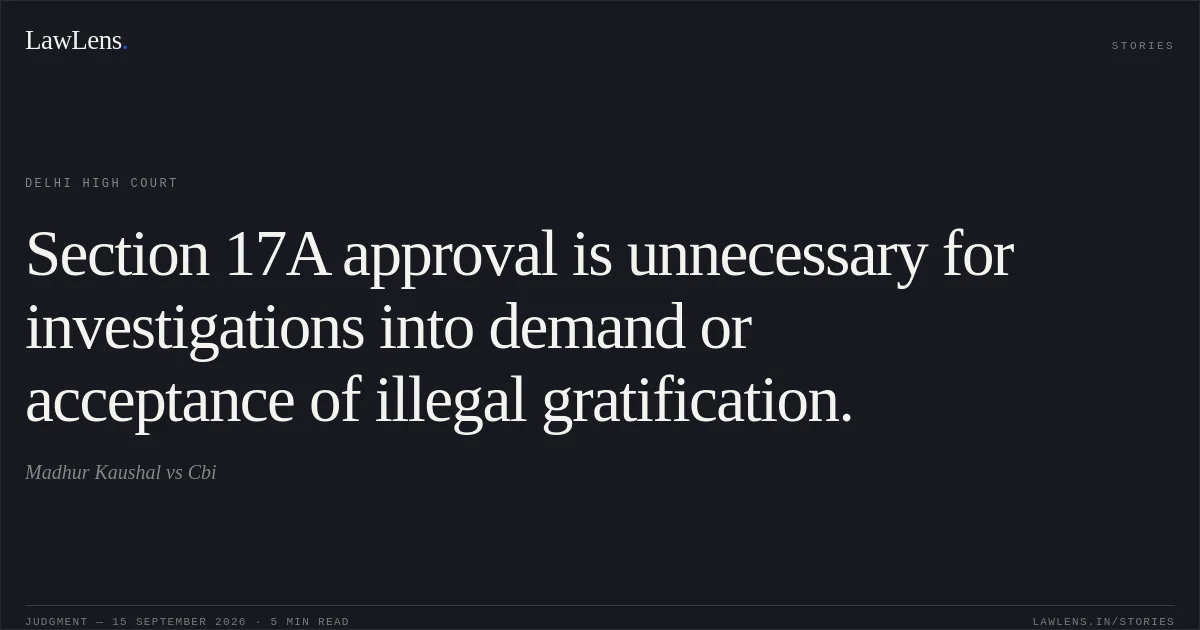
Source reference: p. 13–14, 16–17Section 17A of the PC Act requires prior approval only where the alleged offence is relatable to a recommendation made or decision taken by a public servant in discharge of official functions; it does not apply generally to every offence occurring in the context of official duty.
Source reference: p. 17–19Relying on Anil Daima v. State of Rajasthan, the Court held that Section 17A is not attracted to a prosecution founded on the demand and acceptance of illegal gratification, as distinct from the criminalisation of a particular official recommendation or decision.
Source reference: p. 19Any defect or irregularity in investigation does not automatically vitiate the trial or charges unless failure of justice is demonstrated, under H.N. Rishbud v. State of Delhi and State v. Prakash P. Hinduja.
Source reference: p. 20A second FIR or RC concerning the same occurrence is generally impermissible under T.T. Antony v. State of Kerala.
Source reference: p. 20Under Neeraj Dutta v. State (Government of NCT of Delhi), demand and acceptance of illegal gratification may be established through circumstantial evidence where the circumstances support the necessary inference.
Source reference: p. 21Reasoning
The Court held that the alleged criminality lay in the petitioner’s demand and receipt of illegal gratification, allegedly through his brother, and not in the petitioner’s measurements, recommendations or decisions being independently treated as criminal acts.
Source reference: p. 17–20Accordingly, Section 17A was inapplicable because the prosecution did not seek to criminalise the exercise of official discretion itself; the official functions merely provided the context for the alleged bribe demand.
Source reference: p. 17–20The Court also rejected the argument that a fresh RC was necessary, finding that the petitioner’s alleged role formed part of the wider conspiracy revealed during the investigation of the original RC; a second RC for the same occurrence would be impermissible.
Source reference: p. 20On the evidentiary question, the Court declined to assess the ultimate reliability or sufficiency of the evidence.
Source reference: p. 21It found that the statements concerning the petitioner’s monetary needs, the intercepted conversation relating to delivery of ₹10 lakhs at Kanpur, the alleged communication of the currency-note identifier, the release of ₹9.90 lakhs to A-2, and the subsequent recovery and deposit evidence formed a coherent circumstantial chain raising grave suspicion.
Source reference: p. 21The absence of a direct conversation between the petitioner and the bribe-giver, the omission of the petitioner’s name from one witness’s list, and the timing of the payment were matters for trial rather than grounds for discharge.
Source reference: p. 17The objection under Rule 419A concerned the admissibility of the intercepted material and could be determined when the evidence was formally tendered; it did not negate the existence of a prima facie case based also on other material.
Source reference: p. 21Holding
The Court answered the issues against the petitioner.
It held that prior approval under Section 17A of the PC Act was not required because the case concerned the alleged demand and acceptance of illegal gratification, not the criminalisation of a specific official recommendation or decision.
Source reference: p. 17–20No fresh RC was required, and the material on record disclosed a prima facie case and grave suspicion sufficient to proceed to trial.
Source reference: p. 20–21The admissibility of the intercepted conversations under Rule 419A was left open for determination by the Trial Court.
Source reference: p. 21The revision petition was dismissed, the order on charge dated 24 January 2026 and the charges framed on 13 February 2026 were upheld, and all pending applications were disposed of.
Source reference: p. 22The Court clarified that its observations were confined to the revision proceedings and would not influence the Trial Court’s determination on merits.
Source reference: p. 22Acts & Sections Cited
13 provisions across 3 statutes referred to in this judgment. Each provision opens on LawLens.
Bharatiya Nagarik Suraksha Sanhita, 20234
Code of Criminal Procedure, 19734
Prevention of Corruption Act, 19885
Original Court PDF
Madhur KaushalvsCbi
Click to open original judgment
Original judgment, available to read, download and summarize on LawLens.in