Facts
The parties married in 1983 and have two adult children.
Source reference: pp. 1–4, paras. 1–6After the husband instituted divorce proceedings on the ground of cruelty, the wife sought pendent lite maintenance under Section 24 of the Hindu Marriage Act, 1955 (HMA).
Source reference: pp. 1–4, paras. 1–6The Family Court dismissed her application, finding that the parties were retired government employees with pensions and savings, and that the wife’s financial position was at least equal to the husband’s.
Source reference: pp. 1–4, paras. 1–6On appeal, the wife challenged the assessment of their respective financial circumstances, including the treatment of her retirement benefits as income and the alleged failure to account for the husband’s assets and business income.
Source reference: p. 4, paras. 7–8The parties filed updated financial affidavits during the appeal.
Source reference: p. 5, para. 11Issues
1. Whether the Family Court’s dismissal of the wife’s Section 24 application warranted appellate interference under Section 19 of the Family Courts Act, 1984.
Source reference: p. 5, para. 102. Whether the wife had sufficient independent income and resources for her reasonable support and the necessary expenses of the proceedings, considering the parties’ incomes, assets, and reasonable needs.
Source reference: pp. 5–6, paras. 12–15; p. 12, para. 29Law Applied
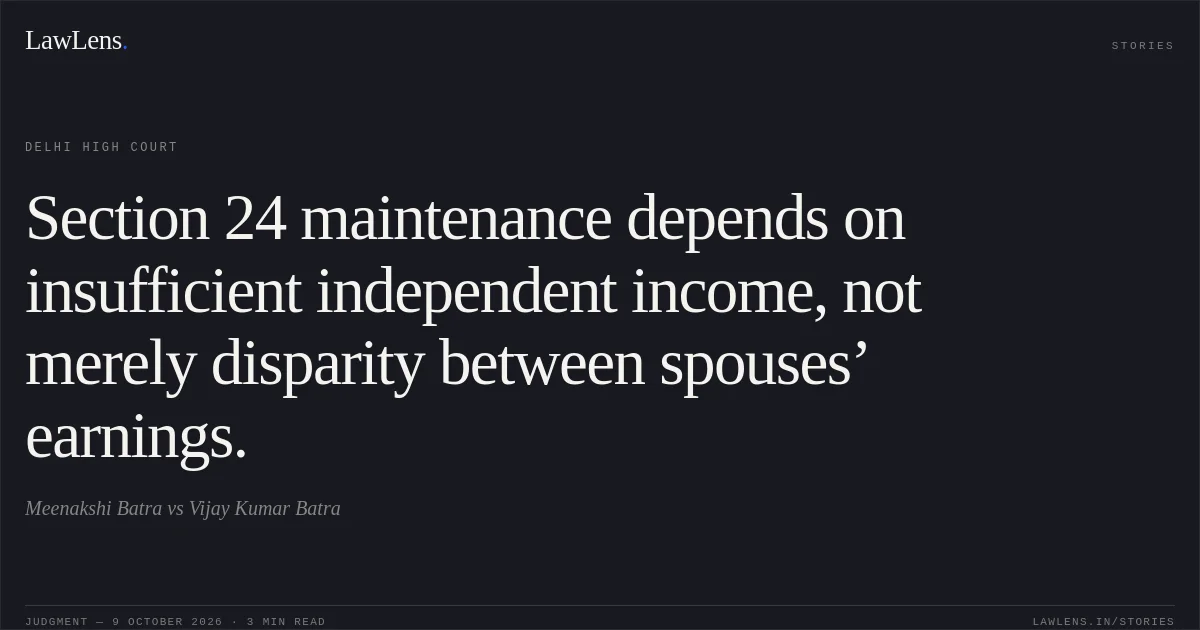
Section 24 HMA permits interim maintenance and litigation expenses where a spouse lacks independent income sufficient for their support and the necessary expenses of the proceedings; the Court must consider the incomes of both parties and determine a reasonable amount.
Source reference: pp. 5–6, para. 13Under Manish Jain v. Akanksha Jain, (2017) 15 SCC 801, the discretion is judicial and fact-specific, and education or the financial position of the applicant’s parents does not itself defeat a claim.
Source reference: pp. 5–6, para. 13Rajnesh v. Neha, (2021) 2 SCC 324, requires consideration of the parties’ status, reasonable needs, independent income, standard of living, the respondent’s capacity and obligations, and the circumstances as a whole; maintenance should be reasonable and neither oppressive nor inadequate.
Source reference: pp. 6–8, para. 14Section 24 does not equalise spouses’ incomes; a difference in income alone does not establish entitlement (K.N. v. R.G., 2019 SCC OnLine Del 7704).
Source reference: p. 8, para. 16A retirement corpus is not itself recurring income, although income generated from it and the corpus as part of a party’s overall financial resources may be considered.
Source reference: pp. 9–10, paras. 18–20Reasoning
The Court distinguished the wife’s accumulated retirement corpus from recurring income, while considering the interest it generated and her overall financial resources.
Source reference: pp. 9–10, paras. 17–20Her updated affidavit disclosed monthly pension of about ₹35,329 and investment interest of about ₹34,000, giving recurring income of approximately ₹69,000; she also had savings and investments, no dependent children, and access to ECHS medical facilities.
Source reference: p. 9, para. 17; p. 10, para. 23The Court found that her claimed expenditure was not conclusive and had to be assessed for reasonableness.
Source reference: p. 10, paras. 21–22Although the husband had a higher pension and investments, the Court considered his reasonable expenses and his dependent, aged mother.
Source reference: pp. 11–12, paras. 24–28It declined to attribute additional recurring income to his former business without supporting evidence, and held that donations alone did not prove undisclosed income.
Source reference: pp. 11–12, paras. 24–28On the evidence, the wife’s higher claimed expenditure and the husband’s higher pension did not establish that she lacked sufficient means for her reasonable support and litigation expenses.
Source reference: pp. 12–13, paras. 29–35Holding
The Court held that the wife did not meet Section 24’s threshold because she had sufficient independent income and resources for her reasonable support during the matrimonial proceedings.
It clarified that the dismissal was not based on treating her entire retirement corpus as income, nor on the proposition that any independent income or comparable incomes bar maintenance.
Source reference: pp. 13–14, paras. 34–37The Family Court’s reasoning could not be endorsed in its entirety, but its ultimate dismissal of the application did not warrant interference.
Source reference: pp. 13–14, paras. 34–37The appeal was dismissed, with no order as to costs.
Source reference: pp. 13–14, paras. 34–37Acts & Sections Cited
4 provisions across 3 statutes referred to in this judgment. Each provision opens on LawLens.
Family Courts Act, 19841
Hindu Marriage Act, 19552
Protection of Women from Domestic Violence Act, 20051
Original Court PDF
Meenakshi BatravsVijay Kumar Batra
Click to open original judgment
Original judgment, available to read, download and summarize on LawLens.in