Facts
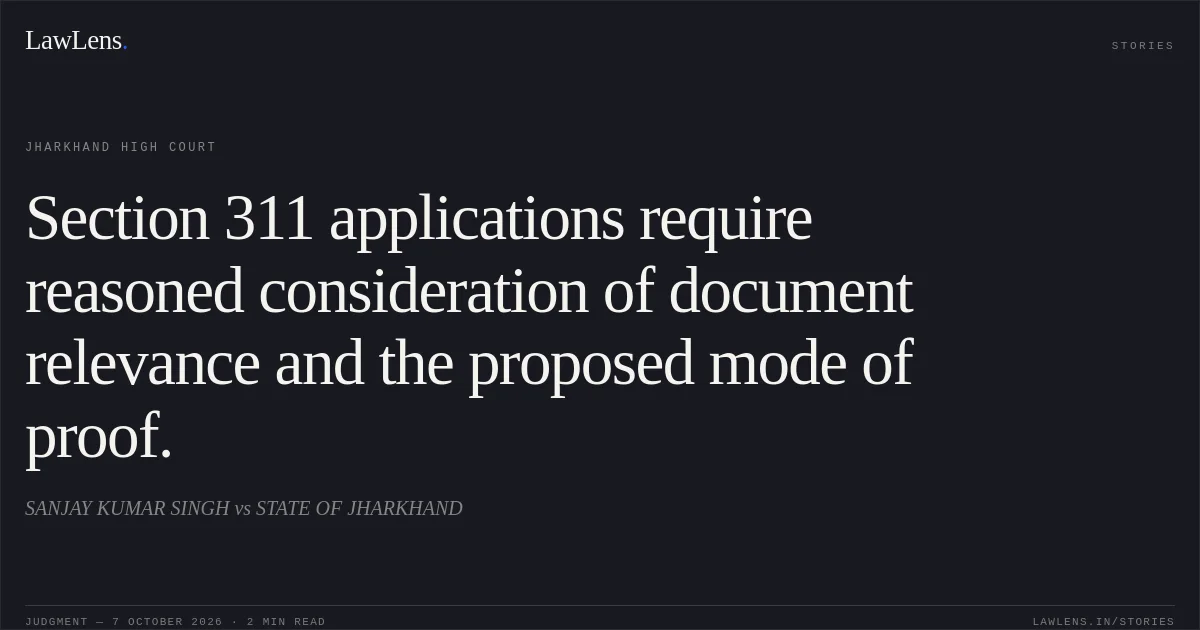
The prosecution applied under Sections 311 read with 91 of the Code of Criminal Procedure, 1973, seeking to produce nine documents after the case had been fixed for argument.
Source reference: para. 2On 24 July 2026, the Judicial Magistrate allowed the application and directed the prosecution to adduce evidence, without addressing the documents’ relevance or identifying the witness through whom they would be proved or the manner in which they would be exhibited.
Source reference: paras. 2–3, 12The accused challenged that order under Section 528 of the Bharatiya Nagarik Suraksha Sanhita, 2023, arguing, among other things, that the application was vague, belated, and part of repeated attempts to reopen evidence in a case registered in 2001.
Source reference: paras. 2, 10Issues
Whether the Magistrate’s order allowing the prosecution to adduce the nine documents, without considering their relevance or specifying the witness and method of proof, was sustainable in law
Source reference: para. 12Whether the order should be quashed and the matter remitted for fresh consideration
Source reference: paras. 12–14Law Applied
Section 311 CrPC empowers a court to summon, examine, recall, or re-examine a person where the evidence is essential to the just decision of the case; the power must be exercised judicially and for strong and valid reasons.
Source reference: paras. 4–10Section 91 CrPC concerns the production of documents or other things necessary or desirable for an investigation, inquiry, trial, or other proceeding.
Source reference: paras. 4–10The petitioner relied on State of Tripura v. Panna Ahmed, Swapan Kumar Chatterjee v. CBI, Ratanlal v. Prahlad Jat, Rajaram Prasad Yadav v. State of Bihar, Natasha Singh v. CBI, Vijay Kumar v. State of U.P., and Umar Mohammad v. State of Rajasthan for principles governing belated applications and the proper exercise of Section 311 powers.
Source reference: paras. 4–10The High Court’s operative reasoning was that the application and order must address the relevance of the proposed evidence and the means by which it is to be brought on record.
Source reference: para. 12Reasoning
The Magistrate allowed the prosecution’s application without determining whether the documents were relevant or identifying the witness to be examined and how the documents would be marked as exhibits.
Source reference: para. 12The High Court held that these were material considerations and that allowing the application without addressing them was mechanical and not in accordance with law.
Source reference: para. 12It therefore found the order unsustainable; it did not finally reject the prosecution’s request, but remitted the matter for fresh consideration.
Source reference: paras. 13–14Holding
The High Court quashed and set aside the Magistrate’s order dated 24 July 2026 and remanded the matter to the Judicial Magistrate, First Class, XXVIII, Ranchi, to pass a fresh order in accordance with law.
The criminal miscellaneous petition was allowed.
Source reference: para. 15Acts & Sections Cited
3 provisions across 2 statutes referred to in this judgment. Each provision opens on LawLens.
Bharatiya Nagarik Suraksha Sanhita, 20231
Code of Criminal Procedure, 19732
Original Court PDF
SANJAY KUMAR SINGHvsSTATE OF JHARKHAND
Click to open original judgment
Original judgment, available to read, download and summarize on LawLens.in