Facts
The petitioner-complainant sought transfer under Section 407 read with Section 482 Cr.P.C. of the trial arising from FIR No. 151 dated 12 October 2014, Police Station Sarhali, District Tarn Taran, registered under Sections 302, 148, 149 and 120-B IPC, alleging the murder of his son, Gurjant Singh, by an armed group.
Source reference: paras. 1–2After the initial investigation and earlier trial proceedings, the High Court, by order dated 6 December 2019, directed reinvestigation after noticing serious deficiencies in the investigation, prosecution and conduct of the earlier trial.
Source reference: para. 3Reinvestigation was conducted and a supplementary report under Section 173(8) Cr.P.C. was submitted. Three accused—Gurdev Singh, Stalanjit Singh and Gurcharan Singh—had already been acquitted in the earlier trial.
Source reference: para. 4The trial Court subsequently declined the complainant’s request to summon those acquitted persons afresh, holding that the acquittal remained in force and that no direction for their retrial had been issued.
Source reference: paras. 10–12The petitioner alleged that the prosecution and trial Court continued to act unfairly, particularly in relation to the proposed examination of witness Satnam Singh, and therefore sought transfer of the trial outside District Tarn Taran.
Source reference: paras. 5–6, 16The private respondents opposed the petition, also pointing out that the petitioner had himself appeared as PW-1 in the earlier trial and had substantially exonerated several accused, a fact not disclosed in the transfer petition.
Source reference: paras. 8, 17Issues
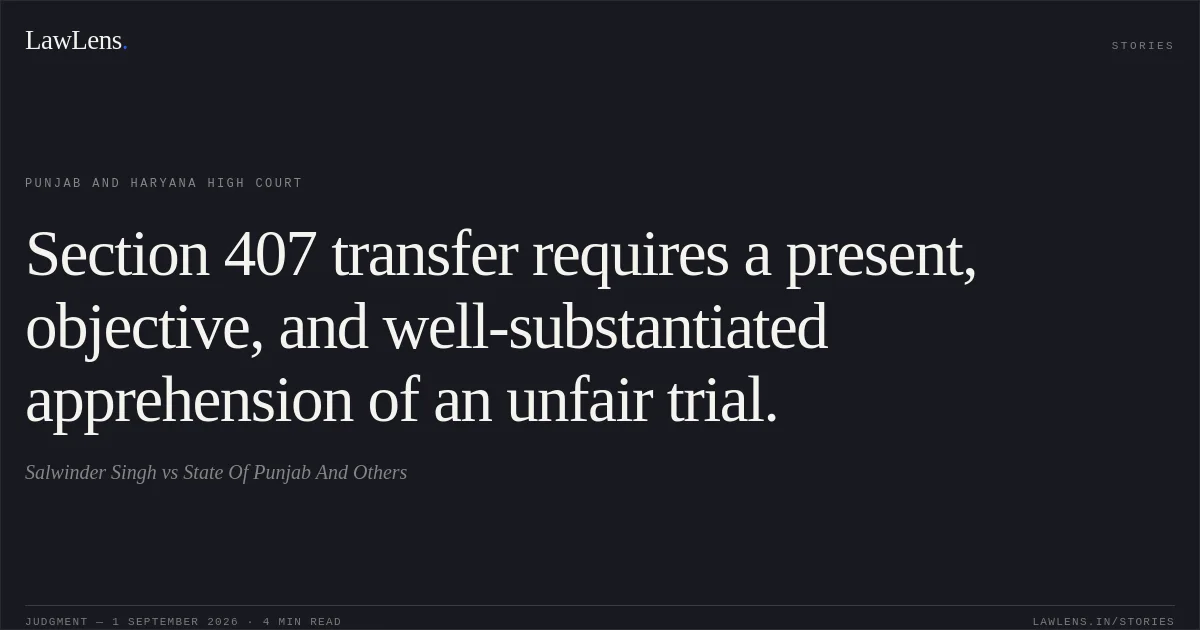
Whether the petitioner established a present, genuine and objectively reasonable apprehension that he would not receive a fair and impartial trial before the Court at Tarn Taran, warranting transfer under Section 407 Cr.P.C.
Source reference: paras. 10, 13–15, 19Whether the earlier deficiencies that led to the High Court’s direction for reinvestigation, together with the subsequent orders and conduct complained of by the petitioner, justified transfer of the entire trial outside District Tarn Taran.
Source reference: paras. 10–12, 15, 18–19Whether the trial Court’s decision concerning the previously acquitted accused and the examination of witness Satnam Singh demonstrated bias or incapacity to conduct a fair trial.
Source reference: paras. 12–13, 16, 18Law Applied
Section 407 Cr.P.C. confers an extraordinary power of transfer to secure the ends of justice, while Section 482 Cr.P.C. preserves the inherent jurisdiction of the High Court; the power must be exercised sparingly and only where a well-substantiated and objectively reasonable apprehension exists that justice will not be administered impartially, objectively and without bias.
Source reference: paras. 13–15In Himanshu Singh Sabharwal v. State of Madhya Pradesh, 2008 (3) SCC 602, the Supreme Court held that a fair trial protects not only the accused but also the victim and society, and requires an impartial Judge, a fair prosecutor and an atmosphere free from witness intimidation or coercion.
Source reference: para. 13In Nahar Singh Yadav v. Union of India, (2011) 1 SCC 307, the Supreme Court cautioned that a mere apprehension is insufficient and identified circumstances such as State or prosecutorial collusion, witness intimidation, an atmosphere hostile to a fair trial, or interference with the administration of justice as relevant grounds for transfer.
Source reference: para. 14An adverse or allegedly erroneous interlocutory order does not, by itself, establish judicial bias or justify transfer of the entire trial.
Source reference: paras. 13, 18Reasoning
The Court accepted that the earlier proceedings had involved serious deficiencies and had legitimately resulted in an order for reinvestigation; however, those past circumstances could not operate as a perpetual ground for transfer after reinvestigation had been completed and the supplementary report had been placed before the trial Court.
Source reference: paras. 10, 15, 18The trial Court’s refusal to summon persons already acquitted was treated as an adjudicatory decision based on the subsisting acquittal and the absence of a direction for retrial, not as evidence of present bias; its correctness on merits was not to be examined in a transfer petition.
Source reference: paras. 11–13, 18Likewise, the petitioner’s objection to the examination of Satnam Singh—on the ground that the witness had sided with the accused—did not establish unfairness, particularly because the petitioner himself had sought to prevent that witness from entering the witness-box.
Source reference: para. 16The Public Prosecutor’s intention to examine the witness was not, without more, evidence of collusion, and the witness’s testimony could be evaluated by the trial Court in accordance with law.
Source reference: para. 16The petitioner’s failure to disclose his own earlier deposition as PW-1, in which he substantially exonerated several accused, further weakened the bona fides and objective reasonableness of the apprehension projected by him.
Source reference: para. 17In the absence of specific subsequent conduct showing bias, denial of opportunity, witness intimidation or inability of the trial Court to act impartially, the statutory threshold for transfer was not met.
Source reference: paras. 15, 18–19The Court also considered that the FIR dated back to 2014 and that transfer would cause further delay.
Source reference: para. 19Holding
The High Court held that the petitioner had failed to establish a genuine, present and well-substantiated apprehension that a fair and impartial trial could not be conducted at Tarn Taran.
The earlier deficiencies that prompted reinvestigation, the trial Court’s order concerning acquitted accused, and the proposed examination of Satnam Singh did not justify exercise of the extraordinary transfer jurisdiction under Section 407 Cr.P.C.
Source reference: para. 19The petition was accordingly dismissed.
Source reference: para. 19The Court clarified that its observations were confined to the question of transfer and did not express any opinion on the merits of the criminal case or the evidentiary value of the witnesses’ statements.
Source reference: para. 20Acts & Sections Cited
6 provisions across 2 statutes referred to in this judgment. Each provision opens on LawLens.
Code of Criminal Procedure, 19733
Indian Penal Code, 18603
Original Court PDF
Salwinder SinghvsState Of Punjab And Others
Click to open original judgment
Original judgment, available to read, download and summarize on LawLens.in