Facts
The petitioners claimed to have purchased parcels of land under registered sale deeds executed between 2009 and 2011 and to have used a passage for ingress and egress.
Source reference: para. 3–5They alleged that opposite party no. 2 obstructed the passage by raising a boundary wall, claiming ownership under a sale deed dated 8 August 2012.
Source reference: para. 3–5On a police report, the S.D.O. initiated proceedings under Section 144 Cr.P.C. and, by order dated 27 May 2017, converted them into proceedings under Section 147 Cr.P.C.
Source reference: para. 6–7Opposite party no. 2’s revision was allowed by the Additional Sessions Judge on 17 November 2018, setting aside the S.D.O.’s order.
Source reference: para. 8The petitioners then sought to quash the revisional order under Section 482 Cr.P.C.
Source reference: para. 2, 9–10Issues
1. Whether the High Court should exercise its inherent jurisdiction under Section 482 Cr.P.C. to interfere with the revisional court’s order where the application substantially seeks a second revisional examination of the same dispute.
Source reference: para. 12–15, 27–312. Whether the circumstances relating to the Section 144 proceeding, the alleged right of passage and the parties’ competing claims demonstrated an exceptional illegality or miscarriage of justice warranting such interference.
Source reference: para. 16–26, 29–30Law Applied
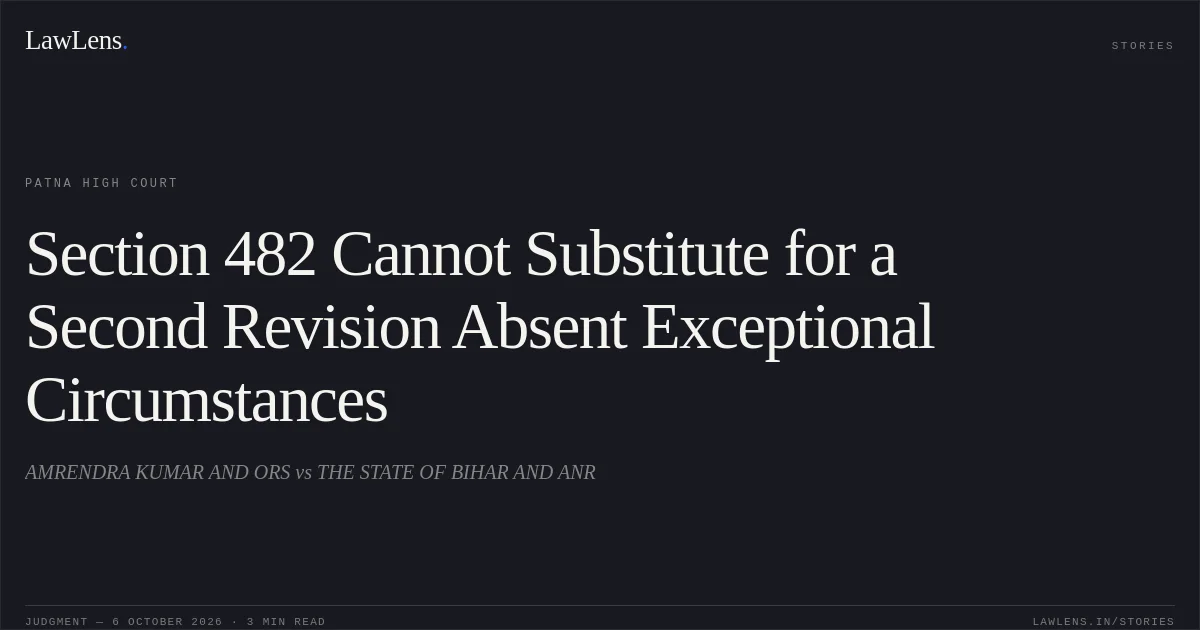
Section 482 Cr.P.C. confers inherent power to secure the ends of justice and prevent abuse of process, but that power is to be exercised sparingly and ordinarily cannot serve as a substitute for a second revision; Kailash Verma v. Punjab State Civil Supplies Corporation, (2005) 2 SCC 571, was relied on for this principle.
Source reference: para. 14Section 144 Cr.P.C. is temporary and preventive: under Section 144(6), an order ordinarily remains in force for no more than two months, subject to the specified statutory extension; State of Bihar v. Kamla Kant Misra, (1969) 3 SCC 337, and Madhu Limaye v. Sub-Divisional Magistrate, Monghyr, (1970) 3 SCC 746, were cited on its limited and emergent character.
Source reference: para. 16–18Section 147 Cr.P.C. addresses disputes over an alleged right of user of land or water likely to cause a breach of peace; it does not empower the Executive Magistrate to finally determine title.
Source reference: para. 25The Court also referred to Anuradha Bhasin v. Union of India, (2020) 3 SCC 637, and Acharya Jagdishwaranand Avadhuta v. Commissioner of Police, Calcutta, (1983) 4 SCC 522, regarding safeguards and the improper repetitive or continuing use of Section 144.
Source reference: para. 22Reasoning
The Court treated the application as an attempt to obtain fresh scrutiny of the same order and controversy already considered in revision.
Source reference: para. 13–15, 27–29, 31It found no exceptional circumstance, patent illegality, lack of jurisdiction or serious miscarriage of justice sufficient to justify Section 482 intervention; disagreement with the revisional court’s conclusion was not enough.
Source reference: para. 13–15, 27–29, 31Although the record did not clearly establish the duration of the original Section 144 order or any extension under Section 144(6), that uncertainty did not warrant reopening the matter as a further revision.
Source reference: para. 19–20The parties’ competing claims concerning the passage, registered deeds and right of user could not be finally resolved in the present proceeding, and the police report did not determine title or civil rights.
Source reference: para. 23–25, 30Holding
The Court dismissed the application as devoid of merit, holding that no exceptional basis for interference under Section 482 Cr.P.C. had been shown.
It clarified that its observations did not finally determine either party’s title or civil rights, which remained open to be pursued before the competent forum.
Source reference: para. 33Acts & Sections Cited
4 provisions across 1 statute referred to in this judgment. Each provision opens on LawLens.
Code of Criminal Procedure, 19734
Original Court PDF
AMRENDRA KUMAR AND ORSvsTHE STATE OF BIHAR AND ANR
Click to open original judgment
Original judgment, available to read, download and summarize on LawLens.in